Bay Bridge Opened November 12, 1936: Chains, Torches, 65 Cents
Key Points
- The Federal Highway Administration dates the Bay Bridge opening to a half hour after noon on November 12, 1936, so Thursday, November 12, 2026 is its 90th anniversary.
- The finished bridge cost $53.6 million, about $6 million under the estimate, according to the Federal Highway Administration.
- The state's 1936 dedication issue reports a flat toll of 65 cents per car for up to five people, against an average ferry rate of 80 cents.
- California Highways and Public Works reports more than 250,000 vehicles crossed in the first 108 hours with no serious accident.
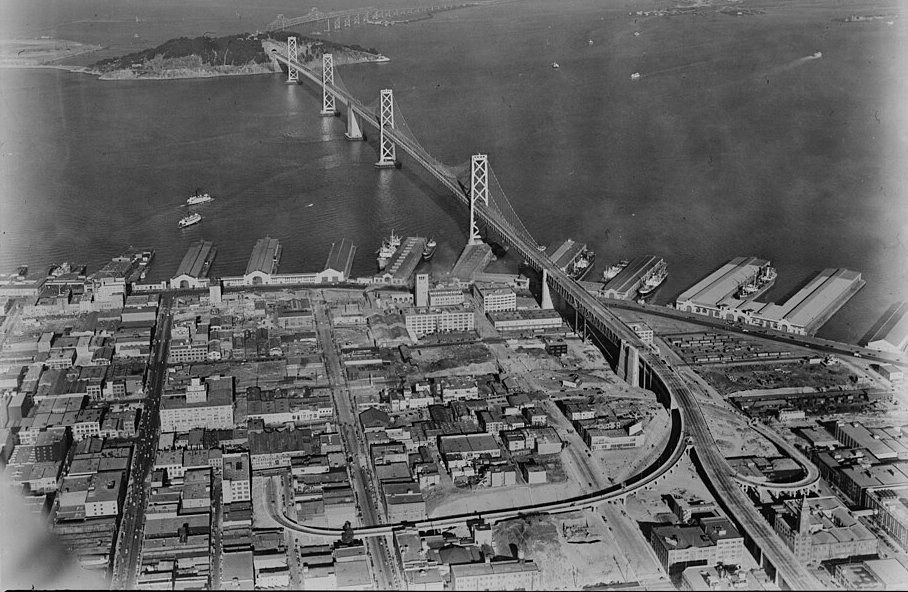

The Federal Highway Administration dates the opening of the San Francisco-Oakland Bay Bridge to a half hour after noon on November 12, 19361, which means Thursday, November 12, 2026 is its 90th anniversary. Governor Frank Merriam declared it open at a ceremony in which an acetylene torch cut a golden chain across the roadway1, and the bridge that carries Interstate 80 over San Francisco Bay has been working ever since.
A bridge that took decades to agree on
The Federal Highway Administration traces the idea of linking San Francisco with Oakland, Berkeley and Alameda to 1850, when newspaper editor William Walker proposed a causeway1. On August 18, 1869, the self-declared Emperor Norton issued a proclamation ordering a suspension bridge across the bay1, though little progress followed until the 1920s1. A bill introduced in Congress in 1928 stalled over Army and Navy objections, so California created its own Toll Bridge Authority in 19291.
Money was the next obstacle, because the Depression had made bond sales hard. With President Herbert Hoover helping, the federal Reconstruction Finance Corporation agreed on October 10, 1932 to buy $61.4 million in bonds, and the state added $6 million through a bond issue backed by the gas tax1. Ground was broken on July 9, 1933, and construction took 3 years and 5 months1.
What was built
The bridge is really two crossings joined at Yerba Buena Island. The design combined a 1,400-foot cantilever span in the East Bay crossing, two 2,310-foot center suspension spans and two 1,160-foot side spans in the West Bay crossing, and a tunnel through Yerba Buena Island1. Both decks ran through that tunnel: the upper deck carried six lanes of fast traffic, and the lower deck had three truck lanes and two interurban train tracks1. The total length is about 8 miles, and the finished cost was $53.6 million, about $6 million under the estimate1.
The state's own magazine said much the same in its November 1936 dedication issue. California Highways and Public Works reported that Chief Engineer Charles H. Purcell credited the finish ahead of schedule and below the estimated cost to the American working man2. That issue is a primary source, written within days of the ceremony.
Opening day, November 12, 1936
The Bay Area celebrated with a four-day festival that began in Oakland before the opening and ended in San Francisco after it1. The dedication began at 10 a.m. on November 12 at the toll plaza at the eastern end of the bridge, where thousands had waited, many of them overnight in their cars2. The crowd saw an ox-drawn cart from Sacramento, a stagecoach from Auburn and a prairie schooner from Woodland, set out as a reminder of earlier ways of travel1.
Governor Merriam cut the chain on the Oakland side while navy planes flew overhead, then rode across to San Francisco with former President Hoover and other officials, where a second chain waited1. His final speech was timed to the moment President Franklin Roosevelt pressed a switch in the White House, and a light on a signal tower turned from red to orange to green1. Hundreds of boats passed beneath the bridge in what the state magazine called the greatest marine parade San Francisco had ever seen1. When darkness fell, sodium vapor lamps along the upper deck lit up, and navy searchlights wove designs in the sky for an hour1.
During its first 108 hours as a state highway, California Highways and Public Works says more than 250,000 autos, buses and trucks and about one million people crossed without one serious accident, and it credited the six traffic lanes, the night lighting, separate decks for trucks and cars, and the California Highway Patrol2.
The 1936 toll, in 1936 dollars
The state set a flat toll of 65 cents per car, covering up to five people including the driver, for the first year, with a 45 cent rate on a $22.50 monthly commutation ticket2. The magazine compared that with an average ferry rate of 80 cents per passenger car that had stood for years until the ferries cut their fares to meet the bridge rate2. Bridge tickets also came with free parking under the bridge structure in San Francisco, up to the area's capacity of about 2,000 cars a day2.
The same issue records a hope that did not come true. Earl Lee Kelly, the state's Director of Public Works, predicted at the dedication that the bridge would be toll free in not more than twenty years2. The bridge is a toll bridge in 2026. For current tolls and conditions, check the Bay Area Toll Authority before a trip.
What came after
The Key System abandoned its rail service on April 20, 1958, and the lower deck was converted to all road traffic. On October 12, 1963, traffic was reconfigured to one way on each deck, westbound on the upper deck and eastbound on the lower3. The Loma Prieta earthquake of October 17, 1989 shook a section of the upper deck loose and killed a motorist1. The original eastern section was replaced, and the new eastern section opened September 2, 2013, at a reported cost of over $6.5 billion3.
The Golden Gate Bridge, which opened on May 27, 1937, took most of the fame1. The Federal Highway Administration notes that the Bay Bridge is older than its neighbor by a few months1, and the American Society of Civil Engineers called it the outstanding wonder among the bridges of the United States in 19551.
This page links no store and earns nothing from any link. Prices here are the 1936 figures the sources give, not current rates.
Trivia
- On what date did the Bay Bridge open to traffic? November 12, 19361, a half hour after noon, at the end of a ceremony that included the cutting of a golden chain.
- What tool did Governor Merriam use to cut the chain barriers? An acetylene torch1, applied to a golden chain across the traffic lanes at each end.
- What was the flat car toll in 1936? 65 cents2, covering the driver and up to four passengers, for the first year.
- Which island do the two crossings meet at? Yerba Buena Island1, where a tunnel carries both decks through the island.
- How much did the bridge cost to build, according to the Federal Highway Administration? $53.6 million1, about $6 million under the estimate.
Sources
- Two Bay Area Bridges: The Golden Gate and San Francisco-Oakland Bay Bridge, Richard Weingroff, General Highway History, Federal Highway Administration, updated June 27, 2017. Accessed November 7, 2026.
- California Highways and Public Works, San Francisco-Oakland Bay Bridge Dedication Number, California Department of Public Works, November 1936 (copy on the Metropolitan Transportation Commission library). Accessed November 7, 2026.
- San Francisco-Oakland Bay Bridge, Wikipedia. Accessed November 7, 2026.