Marines Landed on Betio at Tarawa on November 20, 1943
Key Points
- The 2d Marine Division began landing on Betio, Tarawa Atoll, on Saturday, November 20, 1943.
- The reef was partly exposed, so only amphibian tractors could cross it, and most troops after about 1000 waded ashore under fire.
- The battle lasted 76 hours, with 3,407 division casualties, 4,690 Japanese dead and 146 prisoners.
- Four men of the division received the Medal of Honor, and a Marine Corps historian called Tarawa the primer for later landings in the Central Pacific.

On Saturday, November 20, 1943, the 2d Marine Division began landing on Betio, the main island of Tarawa Atoll in the Gilbert Islands1, in what the Commandant of the Marine Corps, General A. A. Vandegrift, wrote in the foreword to the Corps’ 1947 history was the first example in history of a sea-borne assault against a heavily defended coral atoll2. Friday, November 20, 2026, is the 83rd anniversary. The fight on a low island lasted 76 hours.
Why Betio
In August 1943, Vice Admiral Raymond Spruance flew to New Zealand and told Major General Julian C. Smith and his staff to prepare for an amphibious assault in the Gilberts1. Intelligence reports said the Japanese had fortified Betio, where elite forces guarded a new bomber strip1. Tarawa Atoll lies 2,085 miles southwest of Pearl Harbor and 540 miles southeast of Kwajalein in the Marshall Islands1.
Admiral Chester Nimitz issued Operation Plan 13-43 for the Gilberts on October 5, 1943, which sent Vice Admiral Spruance’s Central Pacific Force against Makin, Tarawa and Apamama3. Betio was less than three miles long, no wider than 800 yards at its widest point and nowhere higher than 10 feet above sea level1. The Japanese had ringed it with a barrier wall of logs and coral around much of the island, minefields, barbed wire and nearly 500 pillboxes, most of them covered with logs, steel plates and sand1.
The reef and the tractors
Lieutenant Colonel David M. Shoup, the division’s operations officer, saw on the chart that a barrier reef surrounded the island1. The division decided to carry its first three waves over the reef in amphibian tractors and later waves in boats3. Tide tables from British residents of the islands gave 5 feet of water on the reef at high neap tide, enough to float the boats, but the planners also learned that the tides were not always dependable3.
When the first waves crossed on the morning of the landing, the reef was partly exposed, with 2 or 3 feet of water in places and only inches in others, so it barred every craft except the tractors4. The tractors ran late, and the landing hour was put back from 0830 to 0845 and then to 09004. The first tractors touched down at 0910 on Red Beach One, 0917 on Red Beach Three and 0922 on Red Beach Two1. After about 1000, most troops had to wade ashore from the reef, covering 500 to 1,000 yards under fire1.
Admiral Nimitz had limited the preliminary bombardment of Betio to about three hours in the interest of strategic surprise1. Colonel William Marshall, who commanded the assault regiment, became too ill to continue while the division was at Efate, and General Smith put Shoup in his place1.
Three days on the sand
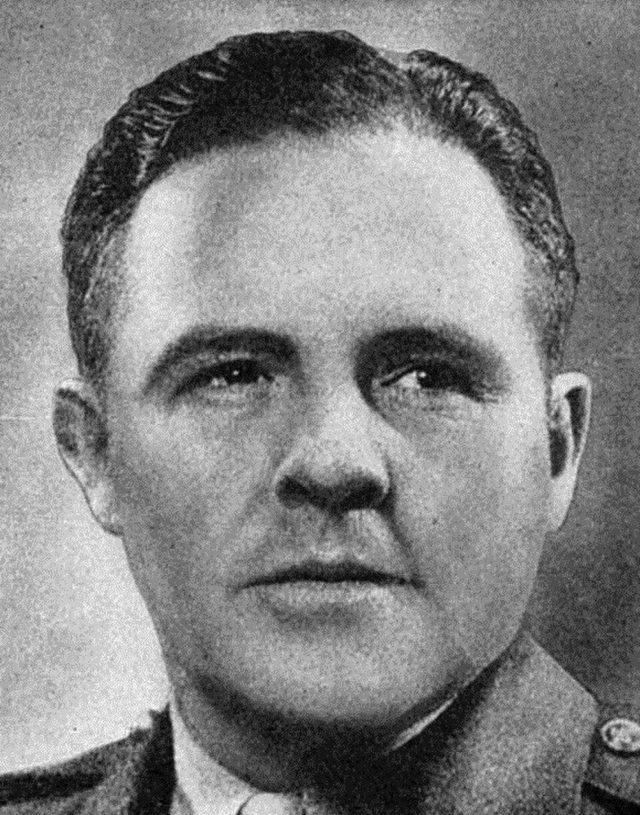
Shoup was 38 and the junior colonel in the division1. When he sent Lieutenant Colonel Evans Carlson back to the flagship to report, his message for the general and the admiral was that the Marines were “going to stick and fight it out”1.
Staff Sergeant William Bordelon, killed on the first day, was the first of four men of the division to receive the Medal of Honor1. First Lieutenant William Hawkins, who led the scout-sniper platoon that seized the long pier, and First Lieutenant Alexander Bonnyman, killed assaulting a bombproof shelter on the third day, received it too, as did Shoup1.
The costly Japanese counterattacks of the night of November 22 to 23 effectively broke the back of the defense, and nearly 600 defenders chose to attack that night1. On the fourth day the Marines reached the far end of Betio shortly after 1300 and declared it secure5. After 76 hours, 4,690 Japanese lay dead and 146 had been taken prisoner, most of them conscripted Korean laborers, and only 17 wounded Japanese soldiers surrendered1.
The cost and the verdict
The division’s final casualty figures were 997 Marines and 30 sailors dead, 88 Marines missing and presumed dead, and 2,233 Marines and 59 sailors wounded, a total of 3,4071. Altogether 18,088 Marines and sailors of the division took part in the assault on the atoll, and about 19 percent of the Marines engaged in the assault became casualties1. The 1947 Marine Corps monograph put the cost at roughly 3,000 killed, wounded or missing, which raised a storm of criticism in the United States6. A national magazine wrote that some 2,000 or 3,000 Marines, most of them dead or wounded, had given the nation a name to stand beside Concord Bridge, the Bon Homme Richard, the Alamo, Little Big Horn and Belleau Wood, and that the name was Tarawa6.
Henry Shaw, a longtime Chief Historian of the Marine Corps, called Tarawa the primer, the textbook on amphibious assault that guided and influenced all subsequent landings in the Central Pacific1. The Marine Corps’ own 1947 monograph held that Tarawa demonstrated the soundness of its doctrines of amphibious assault and pointed out weaknesses in technique7. Staff Sergeant Norman Hatch filmed the fighting, and his documentary won an Academy Award in 19441.
Trivia
- What natural obstacle did the Marines have to cross before they could reach Betio’s beaches? A fringing coral reef, which barred every craft except the amphibian tractors4.
- Which colonel took over the assault regiment when its commander fell ill during rehearsals? David M. Shoup, later the 22d Commandant of the Marine Corps, in 19591.
- How many hours did the battle for Betio last? 76 hours1.
- Where did Betio’s four eight-inch guns come from, according to the Marine Corps history? They were made by Vickers in Britain and sold to Japan in 1905, not captured at Singapore1.
- Which Hawaiian island got a copy of Betio’s bunkers and pillboxes within a month, after Nimitz asked his staff to work out how they were built? Kahoolawe1.
Sources
- Colonel Joseph H. Alexander, USMC (Ret), Across the Reef: The Marine Assault of Tarawa, Marines in World War II Commemorative Series, U.S. Marine Corps, 1993, HyperWar transcription. Accessed November 18, 2026.
- Capt. James R. Stockman, USMC, The Battle for Tarawa, Foreword by Gen. A. A. Vandegrift, Historical Section, Division of Public Information, Headquarters, U.S. Marine Corps, 1947, HyperWar transcription. Accessed November 18, 2026.
- Capt. James R. Stockman, USMC, The Battle for Tarawa, Chapter 1, Introduction, Historical Section, Division of Public Information, Headquarters, U.S. Marine Corps, 1947, HyperWar transcription. Accessed November 18, 2026.
- Capt. James R. Stockman, USMC, The Battle for Tarawa, Chapter 2, The First Day, 20 November 1943, Historical Section, Division of Public Information, Headquarters, U.S. Marine Corps, 1947, HyperWar transcription. Accessed November 18, 2026.
- Capt. James R. Stockman, USMC, The Battle for Tarawa, Chapter 5, The Island is Secured, Historical Section, Division of Public Information, Headquarters, U.S. Marine Corps, 1947, HyperWar transcription. Accessed November 18, 2026.
- Capt. James R. Stockman, USMC, The Battle for Tarawa, Chapter 6, Mission Completed, Historical Section, Division of Public Information, Headquarters, U.S. Marine Corps, 1947, HyperWar transcription. Accessed November 18, 2026.
- Capt. James R. Stockman, USMC, The Battle for Tarawa, Chapter 7, Conclusion, Historical Section, Division of Public Information, Headquarters, U.S. Marine Corps, 1947, HyperWar transcription. Accessed November 18, 2026.