Touch-Tone at 63: Push-Button Dialing Debuted November 18, 1963
Key Points
- Bell Telephone began the first commercial touch-tone service on November 18, 1963, for customers in Carnegie and Greensburg, Pennsylvania, sold as a premium at an extra $1.50 a month.
- Each button sends one tone from a low group (697, 770, 852, 941) and one from a high group (1209, 1336, 1477, 1633), with one frequency for each row and another for each column.
- Tests run by Richard L. Deininger found that the layout with 1 2 3 in the top row gave the fastest dialing with the fewest errors.
- The original sets had ten keys, and AT&T added the * and # keys in 1968.
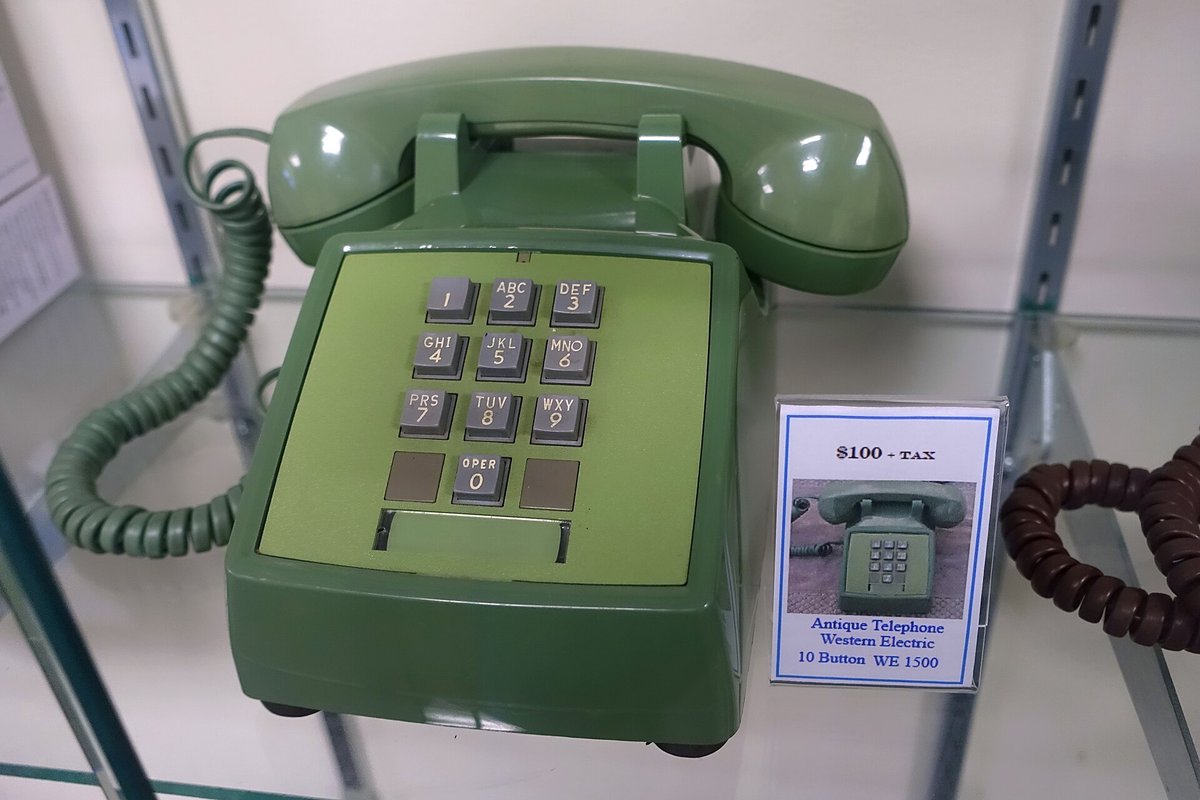

On November 18, 1963, Bell Telephone began offering the world’s first commercial service for an electronic push-button, touch-tone telephone, open at first only to customers in Carnegie and Greensburg, Pennsylvania1. Both towns sit on the outskirts of Pittsburgh3. It was a Monday. This November 18 marks 63 years.
What the first customers got
Customers who paid an extra fee received a touch-tone telephone with 10 push buttons, made by Western Electric1. The service was sold as a premium option at an extra $1.50 a month, which the IEEE History Center puts at $11.50 in 2014 dollars2.
A Bell System Practice issued in September 1963 describes two changes. A pushbutton device replaced the rotary dial, and audible tones replaced dial pulses to carry the called number to the local central office6. Touch-Tone calling was faster than rotary dialing, because a digit goes to the central office while the button is held down, so the speed depends mainly on the customer6. Offices built for dial pulses needed added equipment, a receiver to detect the tones and a converter to turn them into a form the switches could use, and rotary and Touch-Tone sets were allowed on the same central office line6.
Two tones for every button
The signaling scheme uses two groups of four frequencies: a low group of 697, 770, 852 and 941 cycles per second, and a high group of 1209, 1336, 1477 and 16336. Each button sends one tone from the low group and one from the high group at the same moment, which allows 16 combinations; ten of them stood for the digits one through zero6. Since those ten used only three of the high frequencies, the 1963 practice calls the code four-by-three6. On the keypad, each row of keys has its own frequency and each column has another2.
L. Schenker laid out the full four-by-four code in the Bell System Technical Journal in January 19604, and the IEEE History Center names Leo Schenker as the leader of the Bell Labs team behind the tone scheme2. His paper argues that a two-tone code with well-chosen frequencies is hard for speech or music to imitate, which guards against talk-off, the paper's term for false signaling caused by speech or noise4. All the frequencies sit roughly within the range of 700 to 1,700 cycles per second, inside the voice band, so the tones can travel over any ordinary voice connection4. The paper also reports that customers in a trial of some 400 users reacted favorably to pushbutton operation4.
Why 1 2 3 sits on top
Bell Labs began looking for alternatives to the rotary dial in the 1940s3. In the late 1950s, volunteer groups tried out keypad designs in studies by Richard L. Deininger, and the layout with the fastest dialing and the fewest errors put 1 2 3 in the top row2. Deininger’s July 1960 paper in the same journal describes test groups of typically 10 to 15 employees at Bell Telephone Laboratories in Murray Hill, New Jersey, drawn at random for each study5. The first round compared 16 different arrangements5.
One of them was the layout common on ten-key adding machines, which averaged 5.08 seconds per number, while the same grid with a different numbering averaged 4.92 seconds5. Deininger called that difference small5. Accountants objected that a standard number pad already existed on the calculator, with 7 8 9 across the top, and AT&T answered that calculator keypads carried numbers only, while telephone dials carried letters as well2. In the first round, the letter groups that went with each number on a rotary dial were printed on the button tops too5.
The 1500 and the two extra keys
The Westport Tech Museum describes the Western Electric 1500D as the standard single-line desk model of the 10-button Touch-Tone telephone, built on the base, handset and ringer of the older Model 500 rotary set7. Ten keys matched the ten positions of the rotary dial2. With no star or pound key, it could only dial numbers, and the museum says it was phased out after a few years in favor of the 12-button 2500D7.
In 1968, AT&T added the * and # keys, for advanced services2. Western Electric said in a 1973 press release that the name of the # key was emphatically the number sign, though most people today call it the pound key3.
From two towns to most of the network
By January 1968, more than four million Touch-Tone phones were in service across the United States2. By the end of 1976, 70 percent of Bell System lines were equipped to provide Touch-Tone service, and 30 percent of those lines had it installed, even though it still cost extra2.
Trivia
- Where did subscribers test a push-button telephone in 1948, and how were its keys arranged? Media, Pennsylvania, on a set with two rows of five keys3.
- Which frequency sat in the high group of Schenker’s 1960 paper but is missing from the 1963 Bell System list? 1,094 cycles per second, the lowest of the four high tones in the paper4.
- What two frequencies make up the new dial tone the 1963 practice called for in Touch-Tone offices? 350 and 440 cycles per second6.
- How long must a tone pair last before the receiver accepts it as a digit? 22.5 milliseconds, with no power in the rest of the speech band6.
- Which key arrangement did Deininger’s subjects dislike, even though it performed acceptably? Two vertical columns of keys5.
- What name did many at Bell Labs give the # key? The octothorp3.
- Which major city got Touch-Tone in its first two exchanges in 1966? Atlanta3.
- Who did Schenker credit with guiding the whole pushbutton signaling project? L. A. Meacham4.
Sources
- Date: November 18, 1963, Bell Telephone began offering world’s first commercial service for an electronic push-button, touch-tone telephone, Hagley Museum and Library, Nov. 18, 2024. Accessed November 18, 2026.
- Sheldon Hochheiser, Your Engineering Heritage: Dials, Keypads and Smartphones, IEEE-USA InSight, Sept. 1, 2014. Accessed November 18, 2026.
- Telephone Dials, Engineering and Technology History Wiki. Accessed November 18, 2026.
- L. Schenker, Pushbutton Calling with a Two-Group Voice-Frequency Code, The Bell System Technical Journal 39, no. 1 (January 1960): 235 to 255. Accessed November 18, 2026.
- R. L. Deininger, Human Factors Engineering Studies of the Design and Use of Pushbutton Telephone Sets, The Bell System Technical Journal 39, no. 4 (July 1960): 995 to 1012. Accessed November 18, 2026.
- American Telephone and Telegraph Company, Bell System Practices, Section 951-920-100, Issue 1: TOUCH-TONE Calling, General Descriptive Information, September 1963 (TCI Library scan). Accessed November 18, 2026.
- Western Electric 1500D (1963 to 1967), Westport Tech Museum. Accessed November 18, 2026.