The Last Concorde Flight: BA002 From New York, 24 October 2003
Key Points
- On 24 October 2003, G-BOAG flew British Airways flight BA002 from New York JFK to London Heathrow, the last commercial Concorde flight, with Captain Mike Bannister in command.
- Air France ended its Concorde service on 31 May 2003, and the last Concorde to fly at all was Alpha Foxtrot (G-BOAF), which flew from Heathrow to Filton on 26 November 2003.
- Concorde cruised at 1,350 mph at 60,000 feet, and sources put a New York to London crossing at anywhere from under three hours to around three and a half.
- As of 23 October 2026, Boom Supersonic lists 130 orders and pre-orders for its Mach 1.7 Overture.
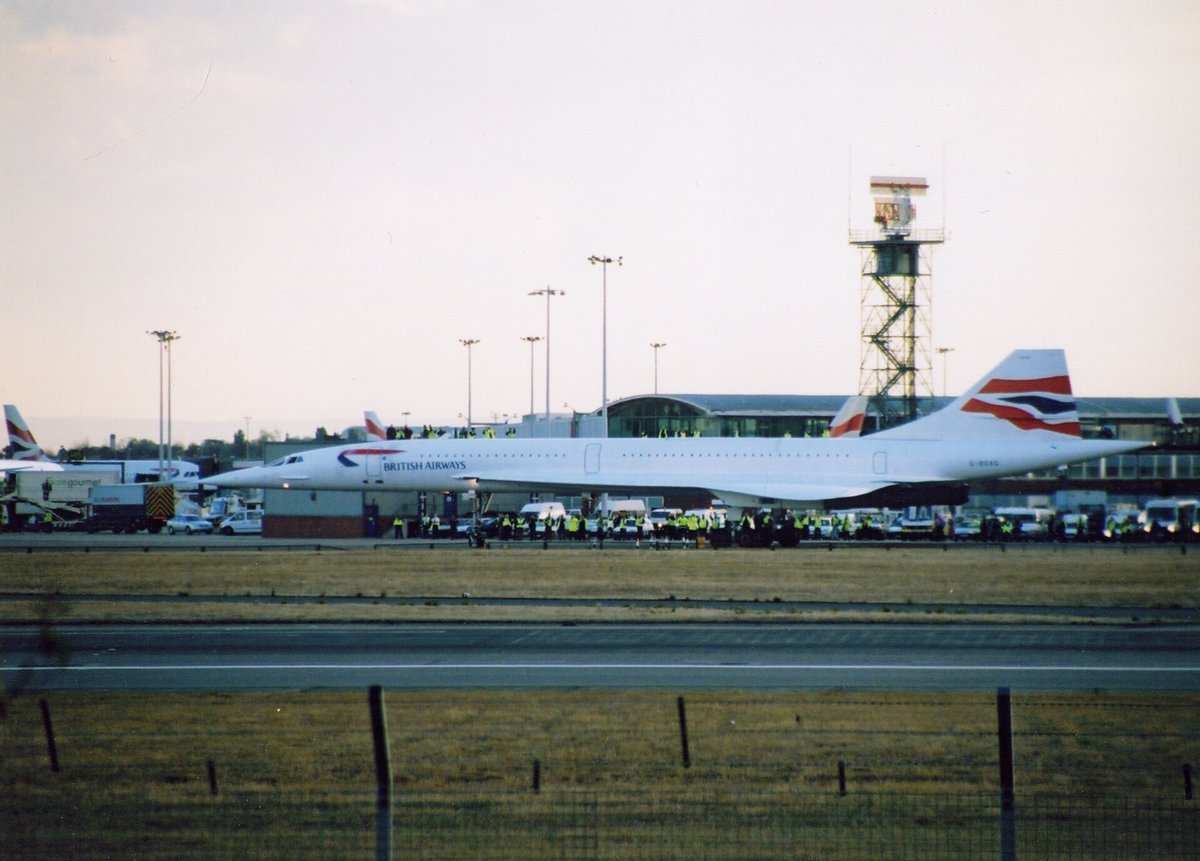

On 24 October 2003, British Airways flight BA002 left New York’s JFK for London Heathrow with Captain Mike Bannister in command, and when it touched down, supersonic passenger travel came down with it. The aircraft was G-BOAG, which operated the final scheduled commercial flight from JFK2. Saturday, 24 October 2026, is the 23rd anniversary.
Three arrivals, one ending
British Airways did not bring the last one home alone. Aerospace Bristol, a museum at Filton, records that a triple arrival of Concorde was scheduled, from Edinburgh, London via the Bay of Biscay and New York3. History.com describes the same day, with the New York flight landing alongside two other final Concorde flights from Edinburgh and the Bay of Biscay4.
The passenger list was part of the show. The jet carried 100 passengers, including actress Joan Collins, model Christie Brinkley and an Ohio couple4 who reportedly paid $60,000 on eBay for two tickets4. For scale, History.com puts a typical round trip across the Atlantic at about $9,0004. When the outbound leg left London the day before, UPI counted about 1,000 people1 at Heathrow and expected thousands for the arrivals.
Twice the speed of sound
What those fares bought was time. Concorde flew at twice the speed of sound4 and could get from New York to London in around three and a half hours4. The Intrepid Museum in New York gives its cruise as 1,350 mph (2,150 kph) at an altitude of 60,000 ft6, high enough for passengers to see the earth’s curvature6. The Intrepid says Concordes crossed the Atlantic Ocean in under three hours6, at least half an hour quicker than History.com’s figure.
Why it stopped
The long goodbye began on 25 July 2000, when an Air France Concorde crashed after takeoff from Paris, killing all 109 people on board and four others on the ground4. The French encyclopedia Universalis traces it to a tyre on the left landing gear that burst after running over a strip of metal7, and to debris that led to the rupture of one of the fuel tanks (tank no. 5)7. All Concorde flights were grounded for over a year4.
The return came at a bad moment. Universalis ties the end of the service to a severe crisis in air travel after the attack on the World Trade Center in New York on 11 September 20017 and the start of the Iraq war in March 20037, along with repeated technical problems7. On 10 April 2003 the two airlines announced the retirement of their Concorde fleets with effect from the end of October 20038. British Airways said the decision had been made for commercial reasons with passenger revenue falling steadily8. Air France’s chairman, Jean-Cyril Spinetta, was blunter: “Operating Concorde has become a severely and structurally loss-making operation.8” Air France added that maintenance costs have substantially increased since its return to service8, and Noël Forgeard of Airbus, which supported the fleet, said “its maintenance regime is increasing fast with age8.”
Which flight was the last?
That depends on the airline and on what counts. Air France went first, saying it will cease all its Concorde flights from May 31, 20038, and Universalis gives 31 May 20037 as the end of Air France service. One of its aircraft made a final landing at Washington Dulles International Airport on 12 June 200310, bound for the Smithsonian’s Steven F. Udvar-Hazy Center10.
BA002 was the last commercial flight, not the last flight. G-BOAG flew on to Seattle on its retirement flight to The Museum of Flight on November 5, 20035, and it sits there as of 23 October 2026. The finale came on 26 November 2003, when Alpha Foxtrot, G-BOAF, flew from Heathrow to Filton near Bristol with 100 British Airways employees on board11 in a flight of just over 1 hour, 30 minutes11. Aerospace Bristol calls it Concorde’s final flight altogether3, and says of the aircraft, “She was the last Concorde ever to fly.12” It was also the last of twenty Concordes to be built11.
Where they are now
On 30 October 2003, British Airways said final negotiations are under way to house the seven Concordes9 at Airbus UK in Filton, Manchester Airport, the Museum of Flight near Edinburgh, Heathrow, the Museum of Flight in Seattle, the Intrepid Sea, Air and Space Museum in New York, and Grantley Adams Airport in Barbados. Airways Magazine matches each jet to its home: Barbados (AE), Edinburgh (AA), Filton (AF), Manchester (AC), New York (AD), and Seattle (AG), with one plane (AB) remaining at LHR2.
G-BOAD is at the Intrepid in New York, on loan from British Airways6, and as of 23 October 2026 the museum calls it the only British Airways Concorde on display in the Northeast6. Alpha Foxtrot made her final journey across Filton Airfield12 to a new hangar on 7 February 2017, and Aerospace Bristol opened on 17 October 2017 with the aircraft as the showcasing centrepiece12.
Why nothing replaced it
Concorde never had the run of the map. The Intrepid notes that environmentalists’ protests prevented its supersonic use over the United States and limited airport operation6. A Greenberg Traurig alert of 3 August 2026 says US rules still generally prohibit civil aircraft from operating above Mach 1 within the United States13, a limit the FAA adopted in 1973. On 2 July 2026 the FAA issued a Notice of Proposed Rulemaking13 that would repeal the ban and set a noise-based standard instead, with comments due by Aug. 17, 202613. As of that alert, the House had passed the Supersonic Aviation Modernization Act by voice vote on 24 March 2026, and a Senate committee had backed it on 22 July 2026.
The best-known airliner project, Boom Supersonic’s Overture, aims lower than Concorde did. As of 23 October 2026, Boom’s page lists a cruise of Mach 1.714 with 60 to 80 passengers14, says its XB-1 demonstrator proved the aerodynamics and materials in supersonic flight in 202514, and counts 130 orders and pre-orders14 from airlines including United, American and Japan Airlines.
Trivia
- What is the fastest New York to London crossing by Concorde? 2 hours, 52 minutes and 59 seconds15, set in 1996 under Captain Les Scott.
- How fast was G-BOAG’s retirement flight from New York to Seattle? 3 hours, 55 minutes and 2 seconds5, a speed record for the route.
- What was British Airways’ first commercial Concorde flight? BA300 from Heathrow to Bahrain, on 21 January 19762, with Captain Norman Todd.
- How were Concorde’s 100 seats split? 40 in the front cabin and 60 in the rear cabin2.
- How many hours had Alpha Foxtrot flown by the end? 18,257 hours11, with 6,045 takeoffs and landings, and it had gone supersonic 5,639 times.
- How long was the strip of metal behind the 2000 crash? About 40 centimetres7, by Universalis’s account.
- How many flights did British Airways’ Concordes make? Just under 50,0002, carrying more than 2.5 million passengers supersonically.
- What range does Boom list for Overture, as of 23 October 2026? 4,250 nautical miles14.
Sources
- UPI, “Aviation fans bid the Concorde farewell”, 23 October 2003. Accessed October 23, 2026.
- Helwing Villamizar, “11/10/2003: British Airways Concorde Final Flight”, Airways Magazine, 10 November 2024. Accessed October 23, 2026.
- “21 years on from Concorde’s final commercial flight”, Aerospace Bristol, October 2024. Accessed October 23, 2026.
- HISTORY.com Editors, “The Concorde makes its final flight”, This Day in History, History.com. Accessed October 23, 2026.
- “Concorde”, aircraft collection, The Museum of Flight, Seattle. Accessed October 23, 2026.
- “British Airways Concorde”, permanent exhibitions, Intrepid Museum. Accessed October 23, 2026.
- Marc Thomas, “Concorde, avion: accident et fin de l’exploitation commerciale”, Encyclopædia Universalis. Accessed October 23, 2026.
- “Concorde: the end of an era”, Asia Travel Tips, 10 April 2003. Accessed October 23, 2026.
- “British Airways announces retirement homes for Concorde”, Asia Travel Tips, 30 October 2003. Accessed October 23, 2026.
- “Concorde Makes Historic Landing at Dulles International Airport”, Metropolitan Washington Airports Authority. Accessed October 23, 2026.
- Bryan Swopes, “26 November 2003”, This Day in Aviation. Accessed October 23, 2026.
- “The Last Concorde”, Aerospace Bristol. Accessed October 23, 2026.
- Greenberg Traurig, “FAA Proposes New Framework for Supersonic Overland Flight as Congress Considers Supersonic Aviation Modernization Act”, GT Alert, 3 August 2026. Accessed October 23, 2026.
- “Overture”, Boom Supersonic. Accessed October 23, 2026.
- “G-BOAD crossed the Atlantic at a record-breaking pace 29 years ago!”, Aerospace Bristol, 6 February 2025. Accessed October 23, 2026.