Día de Muertos on Lake Pátzcuaro: A Night on Janitzio Island
Key Points
- Every November 1 and 2, Purépecha families gather on Janitzio, an island in Lake Pátzcuaro, to keep vigil, sing and make offerings to their dead.
- UNESCO proclaimed the tradition in 2003 and inscribed it in 2008 on the Representative List of the Intangible Cultural Heritage of Humanity.
- As of October 14, 2026, the British government advises against all but essential travel to Michoacán, with exceptions including Pátzcuaro by federal toll roads 14D and 15 and boat trips to the lake's islands.
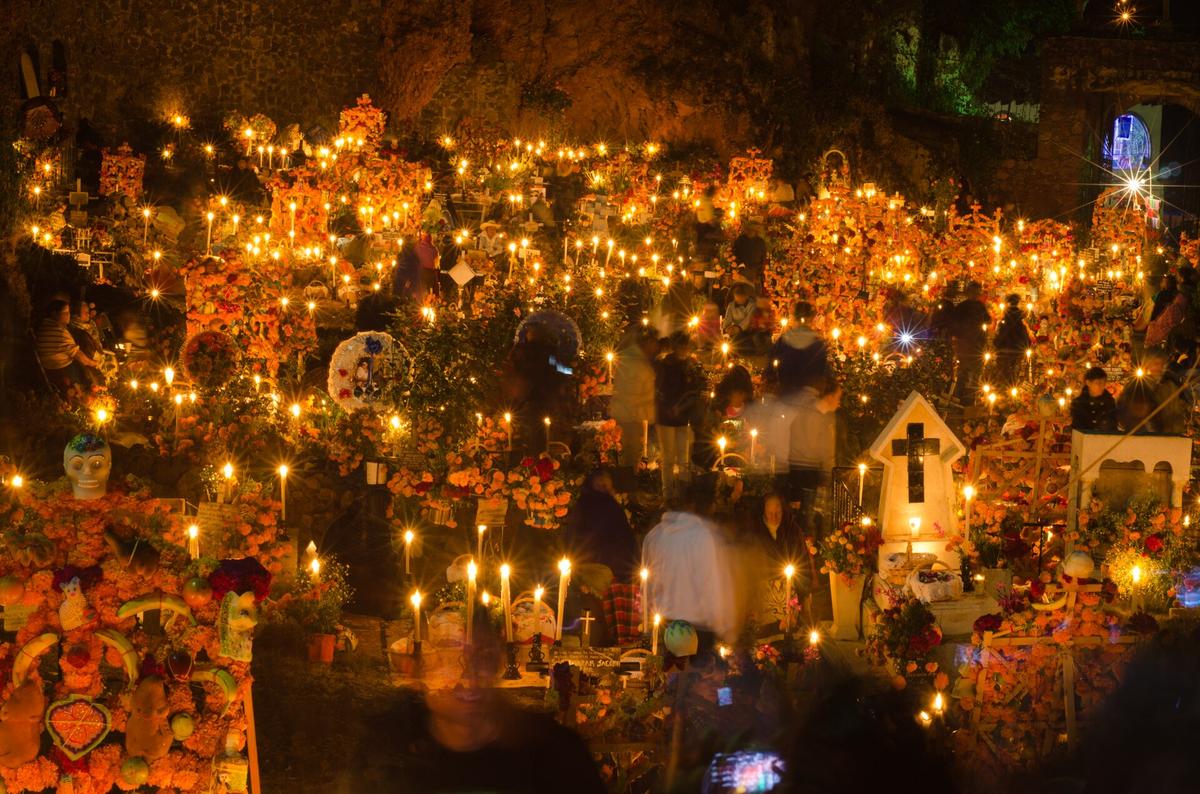

Janitzio is an island in Lake Pátzcuaro4 that Mexico's Secretaría de Educación Pública calls a central place for Día de Muertos. Every November 1 and 2, Purépecha families gather there to keep vigil, sing and make offerings to their dead, and hundreds of candles are lit to guide the souls. In 2026 those dates fall on a Sunday and a Monday.
What the holiday is
Day of the Dead lines up with All Saints' Day and All Souls' Day on the Catholic calendar. National Geographic says it originated several thousand years ago with the Aztec, Toltec and other Nahua people2, for whom the dead remained members of the community. UNESCO describes the festivity as a commemoration of the transitory return to Earth of deceased relatives and loved ones1. Families lay flower petals, candles and offerings along the path from the cemetery to their homes1, and set out the favorite dishes of the dead at the home altar and the tomb. The dead are believed capable of bringing prosperity, such as an abundant maize harvest, or misfortune, depending on how well the rituals are carried out.
The tradition was proclaimed by UNESCO in 2003 and inscribed in 20081 on the Representative List of the Intangible Cultural Heritage of Humanity, under the name "Indigenous festivity dedicated to the dead."
Noche de Ánimas around the lake
In Michoacán the celebration is known as Noche de Muertos, and its traditional name is Noche de Ánimas. Speaking to Uno TV in 2025, Michoacán's tourism secretary, Roberto Monroy García, said it rests on the Purépecha view of the world, in which death is a transition to another dimension rather than an end5. Uno TV's report placed the center of the celebration in the municipalities of Pátzcuaro, Tzintzuntzan, Quiroga and Erongarícuaro, and called the island cemeteries of Janitzio, Pacanda and Yunuen unique settings for anyone after the most authentic experience.
National Geographic describes Indigenous people from the countryside converging on the shore, piling into canoes with a single candle burning in each bow2 and paddling to Janitzio for an all-night vigil in the cemetery.
On Janitzio, where the community calls its celebration Noche de las Ánimas, large quantities of cempasúchil flowers, candles, papel picado and fruit for the altars begin arriving on October 30 and 316, N+ reported in 2025. México Desconocido lists pan de muerto, cempasúchil, fruit and aguardiente7 among the items in the traditional offering, and notes that islanders keep their own clothing and their mother tongue.
The marigolds and the bread
The orange flower on every grave is cempasúchil, a Mexican marigold. Mexico's environment ministry, Semarnat, says the name comes from the Nahuatl Cempohualxochitl, meaning "twenty flowers" or "several flowers"9, and that its scent is believed to guide the souls of the dead along the road to the offering waiting for them. Scattered from altar to grave, the petals are meant to guide wandering souls back2.
The flower is also a Michoacán crop. The state government reported in 2023 that it is grown on 430 hectares in the state10, in municipalities that include Pátzcuaro and Tzintzuntzan.
Pan de muerto is the sweet bread of the season, a pan dulce often made with anise seed2 and decorated with dough bones and skulls. Michoacán has its own versions. Mexico's National Institute of Indigenous Peoples describes the state's pan de ofrenda, made with wheat flour and decorated with figures such as virgins, rabbits, donkeys and farmers12, and a round, glossy, dark bread called pan de hule that carries written dedications.
The butterfly nets
Lake Pátzcuaro is also known for its fishermen's wide, wing-shaped nets, and visitors heading to Janitzio can see them in a short performance. N+ described the scene a few meters before the boats reach the island, where four fishermen perform a short butterfly-net routine and then come alongside each boat with a plastic bowl for tips6. Residents told the outlet that about 80 percent of the community works in tourism.
Going this year
Check the travel advice first. As of October 14, 2026, the British government's Foreign, Commonwealth and Development Office advises against all but essential travel to the state of Michoacán. Its listed exceptions include the town of Pátzcuaro reached by federal toll roads 14D and 15 from Morelia, and boat trips out to islands on Lake Pátzcuaro13, as well as the city of Morelia reached by named federal toll roads. The US State Department's Mexico advisory, last updated May 28, 2026, says conditions can vary widely from state to state14, that US government employees may not travel to certain high-risk areas, and that US citizens should follow the same restrictions, including not traveling between cities after dark. Check the advisory's maps of restricted areas, and your own government's advice, before booking.
Getting to Janitzio. Boats leave from the Pátzcuaro docks known as El General and San Pedrito, and the crossing takes about 20 minutes6, according to N+. Many of the boatmen are Purépecha community members who were able to buy and improve their boats thanks to a family legacy.
Expect a big season. As of September 30, 2026, Mexico's federal tourism secretary and Michoacán's tourism secretary had presented more than 700 activities across the state, running from October 23 to November 215, and officials projected more than a million visitors to destinations across Michoacán, Crónica reported.
Excélsior's report on the same program lists a canoe show called "El camino de las ánimas" at the Urandén springs on Lake Pátzcuaro16, family altars in Santa Fe de la Laguna from October 30, and craft workshops in Pátzcuaro, Tzintzuntzan and Ihuatzio. Uno TV's 2025 report pointed readers to the state's tourism site, visitmichoacan.com.mx, for schedules, workshops and certified guides5.
Remember it is a vigil. Because this is a spiritual ceremony, Michoacán's tourism secretary asks visitors to come with respect, not to smoke, eat or walk on the graves, and to ask permission before taking photographs5. A Janitzio boatman told N+ that some visitors arrive drunk or think the night is a party6, and a teacher at an intercultural secondary school on Janitzio said some tourists come for the culture while others come to have fun.
Trivia
- What does México Desconocido say the name Janitzio means in Purépecha? Flor de maíz7, or corn flower.
- Whose statue stands at the top of Janitzio? A sculpture of José María Morelos y Pavón7 stands on an ornamented lookout at the top of the island.
- Which of the two days is set aside for children who have died? November 1, All Saints' Day, is for the "muertos chiquitos," and November 2 is for adults, according to INAFED8.
- When did a pan de muerto recipe first appear in a Mexican cookbook? In 1938, in Repostería Selecta by Josefina Velázquez de León, according to Ciencia UNAM11.
- What did the Purépecha believe the arriving monarch butterflies were? The souls of their ancestors returning to Earth3, National Geographic reports, because the butterflies arrive around the time of the holiday.
- Who drew the skeleton that became La Catrina, and who gave her that name? José Guadalupe Posada drew the skeleton, which he called the Calavera Garbancera, and Diego Rivera made the figure female and named her Catrina in a 1947 mural2.
- How many species of cempasúchil grow in Mexico? An estimated 35, out of 58 recorded in the Americas, according to Mexico's agrifood information service as cited by the Michoacán government10.
- What is a corunda? A Michoacán Indigenous bread made of corn dough, with a touch of tomato and chile de árbol salsa12.
Sources
- Indigenous festivity dedicated to the dead, Representative List of the Intangible Cultural Heritage of Humanity, UNESCO. Accessed October 14, 2026.
- Logan Ward, Top 10 things to know about the Day of the Dead, National Geographic, October 26, 2017, updated October 27, 2025. Accessed October 14, 2026.
- Jessica Vincent, On the path of Latin America’s greatest wildlife migration, National Geographic, April 22, 2024. Accessed October 14, 2026.
- Janitzio. El corazón del Día de Muertos en Michoacán, Nueva Escuela Mexicana Digital, Secretaría de Educación Pública, May 22, 2026. Accessed October 14, 2026.
- Alejandro Villa, Día de Muertos en Michoacán 2025: tradiciones, talleres y velaciones en la Noche de Ánimas, Uno TV, October 24, 2025. Accessed October 14, 2026.
- Janitzio lucha para que su tradición no se convierta en folklore, N+, November 2, 2025. Accessed October 14, 2026.
- Rodrigo Osegueda, Janitzio, un pueblo flotante en el lago de Pátzcuaro, México Desconocido. Accessed October 14, 2026.
- Día de Muertos, tradición mexicana que trasciende en el tiempo, Instituto Nacional para el Federalismo y el Desarrollo Municipal, gob.mx, November 1, 2019. Accessed October 14, 2026.
- Cempasúchil o veinte flores, Secretaría de Medio Ambiente y Recursos Naturales (Semarnat), gob.mx, November 1, 2023. Accessed October 14, 2026.
- Flor de cempasúchil, símbolo vital de Noche de Muertos, Gobierno del Estado de Michoacán, October 29, 2023. Accessed October 14, 2026.
- Karla Angélica Castro Yáñez, Pan de Muerto. Sabor y tradición en un alimento, Ciencia UNAM, November 1, 2021. Accessed October 14, 2026.
- El origen del pan de muerto y las variedades regionales actuales, Instituto Nacional de los Pueblos Indígenas, gob.mx, October 25, 2019. Accessed October 14, 2026.
- Mexico travel advice: Warnings and insurance, Foreign, Commonwealth and Development Office, GOV.UK, updated October 13, 2026. Accessed October 14, 2026.
- U.S. Department of State, Mexico Travel Advisory, Level 2: Exercise Increased Caution, May 28, 2026 (summary in the department's travel advisory data feed; the full advisory is at travel.state.gov). Accessed October 14, 2026.
- Diana Chávez Zea, Michoacán prepara más de 700 actividades para la celebración de Noche de Muertos, anuncia Sectur, Crónica, September 30, 2026. Accessed October 14, 2026.
- Porfirio Escandón, Michoacán prepara una histórica celebración de Noche de Muertos 2026, Excélsior, October 2, 2026. Accessed October 14, 2026.