Galloping Gertie: The Tacoma Narrows Bridge Fell on 7 November 1940
Key Points
- The first Tacoma Narrows Bridge opened on 1 July 1940 and collapsed on 7 November 1940, with the 86th anniversary falling on Saturday, 7 November 2026.
- Workers noticed the bridge's bounce in May 1940, and WSDOT's timeline says the roadway moved in winds as light as 4 miles per hour.
- On the morning of the collapse the wind measured 38 to 42 miles per hour, and WSDOT says the roadway tilted up to 45 degrees before sections fell between 11:02 and 11:08 a.m.
- WSDOT says the failure led to wind tunnel testing for bridges, a replacement span that opened on 14 October 1950, and remains that now rest on Puget Sound's floor.
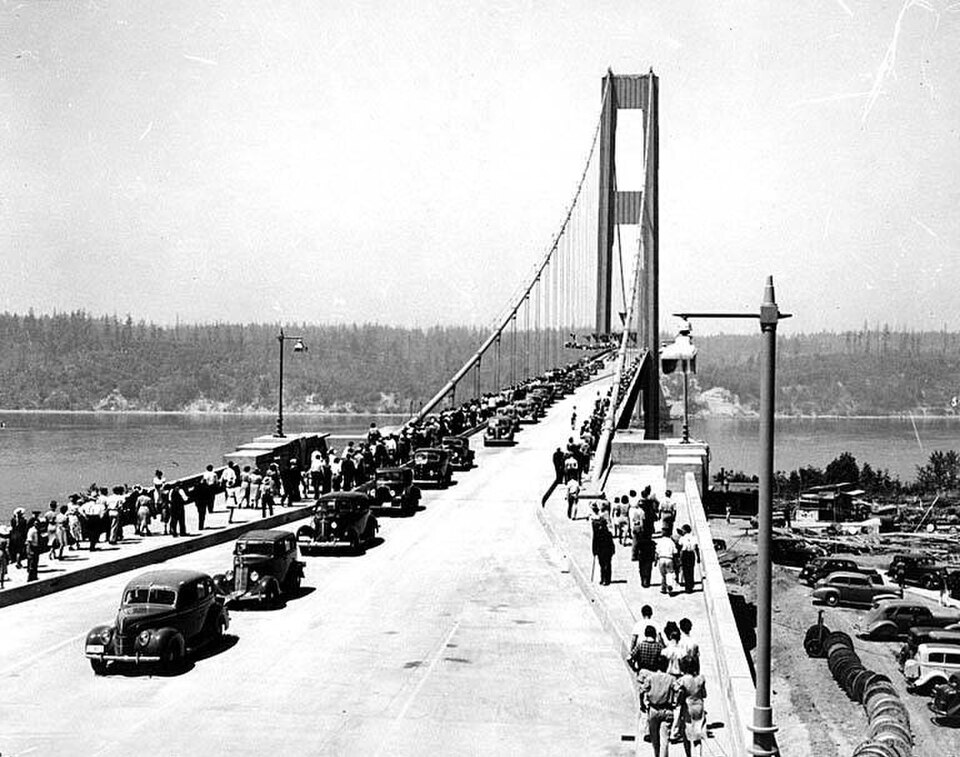

The 86th anniversary of the day the first Tacoma Narrows Bridge fell into Puget Sound falls on Saturday, 7 November 2026. The span had been open to traffic for just over four months, and the Washington State Department of Transportation (WSDOT) history site says it was the third longest suspension span in the world1 when it opened on 1 July 1940. Its nickname, Galloping Gertie, came from a motion drivers and workers noticed almost from the start.
Where it is
The Narrows is in western Washington. WSDOT says it is about 8 miles west of downtown Tacoma and 40 miles south of Seattle on State Route 16, where Puget Sound narrows to a channel almost a mile wide1.
A bridge that moved from the first spring
WSDOT's timeline puts the construction time at 19 months2, with the official opening ceremonies in July 1940. The ripple showed up before that. In about May 1940, while the roadway was still being built, riveters and other workmen noticed the "bounce," or "galloping" of the bridge2, and some chewed lemons to fight the nausea. Engineers installed four hydraulic jacks as shock absorbers, and the timeline says they had no effect2.
The motion did not stop once cars arrived. Between July and September 1940, WSDOT says the roadway sometimes bounced in a wind as light as 4 miles per hour2, with waves of 1 to 5 feet common and a few extreme cases of 10 feet that made some motorists seasick. The history site also records a bit of naming trivia. The name "Galloping Gertie" was first used for the Wheeling Bridge6, a suspension span over the Ohio River that collapsed in a windstorm in May 1854. The same page says one of the bridge workers probably gave the Tacoma span its nickname.
In September 1940 the State Toll Bridge Authority hired Professor F. B. Farquharson of the University of Washington to study the problem with a wind tunnel model. WSDOT says the state added temporary tie-down cables in October, and that a tie-down cable on the east side span broke in a high wind2 in November, when the bridge began to gallop again. Farquharson's tests with a 54-foot model found a twisting motion that could destroy the span, and the state began drafting a contract for wind deflectors. The collapse came first.
7 November 1940, hour by hour
The WSDOT timeline gives the morning in clock times. At 7:30 a.m. the wind measured 38 miles per hour2, and by 9:30 it measured 42. The bridge was undulating with waves of 2 to 5 feet. At 10:03 a.m. the roadway began a lateral twisting motion, and by 10:07 WSDOT says it was tilting the roadway up to 28 feet on one side then the other2, at an angle of up to 45 degrees.
The failure came in stages. At 10:30 a.m. a large chunk of concrete fell from the west side of the center span. At 11:02 a.m. a 600-foot long section of roadway in the eastern half of the center span broke free and fell into the Narrows2, and the final section followed at 11:08 a.m.
Tubby, a black cocker spaniel belonging to the daughter of Leonard Coatsworth, a Tacoma newspaper employee, was left in a car that stopped on the bridge. WSDOT's Tubby page says Coatsworth abandoned the car and could not get back to it, and that Professor Farquharson tried to coax the dog out5 but was nipped on the knuckle and retreated to safety moments before the collapse. The same page calls Tubby "the only victim of that great disaster"5.
Why it fell, and what changed
Three boards of experts investigated. The federal panel, known as the Carmody Board, included Othmar Ammann, Theodore von Karman and Glen Woodruff, and it announced its findings in March 1941. WSDOT's summary says its key points were that the principal cause was the bridge's "excessive flexibility"3, that the solid plate girder and deck acted like an aerofoil, and that engineers needed to test suspension bridge designs in wind tunnels. The same page lists the deck as only 8 feet deep and extremely narrow compared with its center span, a ratio of 1 to 723.
WSDOT adds that the explanation is still discussed. It says the experts disagree, at least on some aspects of the explanation3, and quotes bridge historian David P. Billington on a "blind spot" among 1930s designers, who thought wind had almost no effect on vertical movement. The legacy is easier to state. WSDOT says Galloping Gertie became the first suspension bridge ever studied using both visual observation and wind tunnel testing4, and that now the United States government requires that bridges built with federal funds have their preliminary design tested in a wind tunnel3 using a three-dimensional model.
Salvage, a replacement and a reef
The ruin did not stay in the news for long, but it stayed in the water. WSDOT's aftermath page says the state paid $646,6614 to dismantle the wreckage and received $295,726 for 7,000 tons of scrap steel, a net cost of $350,933, over about 29 months. The piers and anchorages had survived. A replacement bridge opened on 14 October 19501 after 29 months of construction, at 5,979 feet in length, which WSDOT says is 40 feet longer than Galloping Gertie.
The old roadway never left Puget Sound. The WSDOT home page says the sunken remains were placed on the National Register of Historic Places in 19921 to protect them from salvagers, and calls them "one of the world's largest man-made reefs." A second, parallel bridge for eastbound traffic opened to traffic in the early morning hours of 16 July 20071. The 1950 bridge carries westbound State Route 16 traffic between Tacoma and Gig Harbor, and the 2007 bridge carries eastbound traffic. WSDOT notes that its history site was developed during the 2007 construction and that some information was outdated by that bridge's completion, so its traffic counts are not repeated here.
Small stories from the same week
The WSDOT "Weird facts" page collects some of the human details. Lacey V. Murrow, the former state highway director, told a reporter after the collapse, "Every major bridge project is an adventure."6 And Clark Eldridge, the bridge engineer who accepted some of the blame, later spent three years and nine months in a Japanese prisoner of war camp, where an officer who had once been a student in America recognized him and said "Tacoma Bridge!"6
Coatsworth's own claim moved slowly. WSDOT says the state eventually reimbursed him $450.00 for his car5 after paying $364.40 for its contents. Leon Moisseiff, the designer, died of heart failure three years later, at age 706, according to WSDOT.
Trivia
- How long was the first Tacoma Narrows Bridge open before it fell? It opened on 1 July 1940 and collapsed on 7 November 19401, a little over four months.
- What did the wind measure at 7:30 a.m. on the morning of the collapse? 38 miles per hour2, rising to 42 by 9:30.
- How steeply did the roadway tilt by 10:07 a.m.? Up to 45 degrees2, with the roadway rising as much as 28 feet on one side and then the other.
- According to WSDOT's history site, which earlier bridge first carried the name Galloping Gertie? The Wheeling Bridge over the Ohio River6, which fell in a windstorm in May 1854.
- How long did the replacement bridge take to build? About 29 months4, opening on 14 October 1950.
Sources
- Washington State Department of Transportation, “Tacoma Narrows Bridge history” (home page), accessed 4 November 2026. Accessed November 4, 2026.
- Washington State Department of Transportation, “Tacoma Narrows Bridge history: Bridge timeline”. Accessed November 4, 2026.
- Washington State Department of Transportation, “Tacoma Narrows Bridge history: Lessons from the failure of a great machine”. Accessed November 4, 2026.
- Washington State Department of Transportation, “Tacoma Narrows Bridge history: Aftermath, engineering challenge and the rise of a new bridge”. Accessed November 4, 2026.
- Washington State Department of Transportation, “Tacoma Narrows Bridge history: Tubby trivia”. Accessed November 4, 2026.
- Washington State Department of Transportation, “Tacoma Narrows Bridge history: Weird facts”. Accessed November 4, 2026.