Gateway Arch Topped Out: The Final Piece Goes In, October 28, 1965
Key Points
- The final stainless steel section of the Gateway Arch was put into place on October 28, 1965, completing the 630 foot monument.
- Eero Saarinen’s arch won the design competition in February 1948 as the consensus choice of all seven judges, who reviewed 172 drawings.
- As of October 27, 2026, tram tickets start at $15 for adults, and the ride to the top is a 4-minute journey.
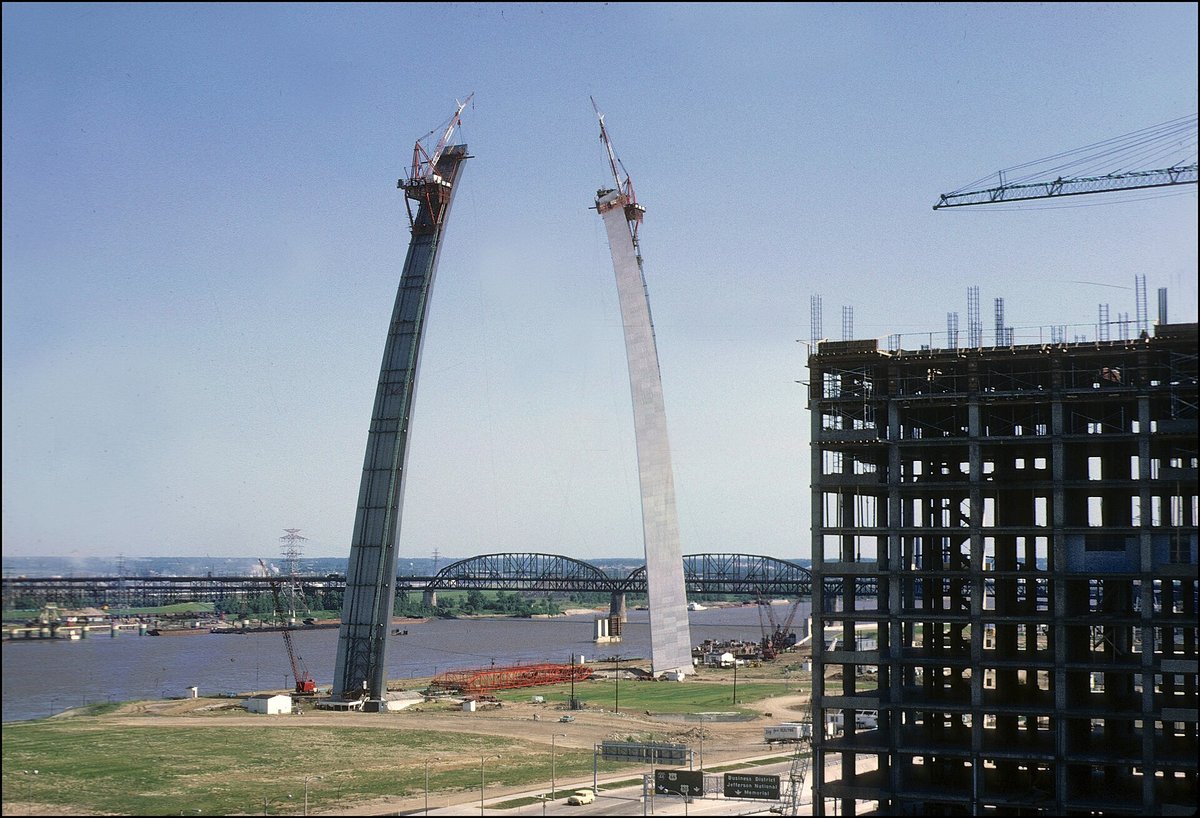

On October 28, 1965, crews in St. Louis lifted the last section of steel into the gap at the top of the Gateway Arch. The National Park Service says that day the final stainless steel section was put into place1, completing a 630 foot stainless steel monument1 to the city’s role in the westward expansion of the United States. TIME puts the moment at 11:00 a.m.11 Wednesday, October 28, 2026, is the 61st anniversary.
A contest with 172 drawings
In 1947 the Jefferson National Expansion Memorial Association launched a national design competition8 for the riverfront site, and History.com’s Christopher Klein reports that the judges reviewed 172 conceptual drawings marked only with entry numbers8, so nobody knew whose drawing was whose. The jury named five semifinalists in September 19478. The field included Charles and Ray Eames, Walter Gropius and Minoru Yamasaki8.
The final choice came in February 19488, and it was Eero Saarinen’s arch, the consensus winner on the ballots of all seven judges8.
Saarinen was born in Finland in 19105 to the architect Eliel Saarinen, and his family moved to the United States in 19235. He wanted a shape that suited the site, reasoning that “neither an obelisk nor a rectangular box nor a dome seemed right on this site or for this purpose.”5 Klein writes that he tested forms with pipe cleaners planted in his living room rug8. His first design was a 590-foot concrete arch with a stainless steel skin8; the final plan rose to 630 feet, with sections changed from four-sided trapezoids to equilateral triangles8.
He never saw it built. Saarinen died in 1961 at age 515 of a brain tumor, and financing and site issues delayed construction by more than a decade8.
Building it in the open air
Work on the Arch began on February 12, 19639, and the Park Service says it was built in 33 months for a total cost of less than $15 million1. MacDonald Construction Co.10 was the general contractor, and the steel work was done by the Pittsburgh-Des Moines steel company10, St. Louis Public Radio reported in 2015.
TIME reports that the curve was calculated by hand11 and that builders could only take measurements at night11, because warm sunlight made the structure flex slightly. Welds were checked after dark as well: inspector Clarence Cherry told St. Louis Public Radio, “We worked at night because we worked with radiation to X-ray the welds.”10 The project’s insurer had expected up to 13 men11 might die during construction, and not a single worker did11.
Topping out
Heat was the last problem. Vito Comporato, the radio operator on topping out day, directed the keystone section into place10. He told St. Louis Public Radio that during construction the readings had been off by about a foot until the crew worked out that sun on the south leg was moving the steel, and that on the last day the St. Louis Fire Department was called to run cold water on the back side of the south leg10. Once the piece was in, the Arch was “topped out”14, as the Park Service’s administrative history puts it. The cranes came down afterward: a photograph in that history shows the creeper derricks slowly backing down the Arch legs14 on January 6, 1966.
The numbers
The Park Service fact sheet gives the Arch a maximum height of 630 feet2 and the same 630 feet2 between the outer edges of its legs. Each leg is an equilateral triangle2 in section, 54 feet2 on a side at the base and 17 feet2 at the top. It was built from 1422 sections, with an outer skin of 1/4 inch stainless steel2.
Most of the weight is out of sight. The fact sheet lists 5,199 tons2 of steel and 38,107 tons2 of concrete, of which 25,980 tons2 sits in the foundation below ground. Those foundations are sunk 60 feet into the ground1. The Arch is built to move a little: it will sway up to 1 inch in a 20 mph wind1 and can sway 18 inches in a 150 mph wind.
Getting people to the top was its own problem. The Park Service credits Dick Bowser, an elevator manufacturer who was given just two weeks13 to design a way up the curve. His answer was a pair of trams: there are 22 trams, each with 82 cars holding 52 people. The Park Service dates the first ride to the top to July 24, 196712.
Visiting today
The memorial changed its name in 2018. On February 22 of that year the President signed the Gateway Arch National Park Designation Act, which redesignates the Jefferson National Expansion Memorial6 in Missouri as Gateway Arch National Park. A $380-million renovation9 project was completed the same year.
As of October 27, 2026, the Park Service lists the grounds as open from 5:00 a.m. to 11:00 p.m. year round3, with the visitor center and museum open 9:00 a.m. to 6:00 p.m. every day3 in spring, fall and winter. The last tram leaves one hour prior to closing3, and the park is closed on Thanksgiving, Christmas and New Year’s Day3.
Tram tickets, as of October 27, 2026, start at $15 for adults (16 and up)4, $11 for children 3 to 154 and $12 for park pass holders4, and infants 2 and under ride free. Of each ticket for a visitor 16 and up, $3.00 goes to the National Park Service4 as the entrance fee. The ride up is a 4-minute journey12, and riders stay in the observation area for one tram cycle (around 8 to 10 minutes)12 before heading down. The Arch’s own fact sheet counts more than 145 million9 visitors to the park since construction began in 1963.
Trivia
- Who placed second in the competition? Three University of Illinois graduate students, Gordon Phillips, William Eng and George Foster8, who won a $20,000 runner-up award.
- Which Saarinen first received the semifinalist telegram? His father, Eliel. History.com says the telegram had been sent by mistake8 and was meant for Eero.
- How much prize money did the competition offer? $40,0008, in what History.com calls the first major design competition following World War II.
- Which two entries drew six votes each in the first round of judging? Eero Saarinen and the Smith, Hinchman, Grylls and Yamasaki team15; the jury report says no other entry got six.
- In which Pennsylvania town did TIME say individual Arch sections were made? Warren11, from where they were brought to St. Louis by railroad.
- How many stairs run inside the Arch? 1,0762, for emergency and maintenance use only.
- How many windows does the observation area have? 16 looking east over the Mississippi River12 and 16 looking west over St. Louis.
- How far can visitors see from the top on a clear day? Up to 30 miles7, according to History.com.
Sources
- “The Gateway Arch Celebrates 50th Year of Completion”, Gateway Arch National Park, National Park Service. Accessed October 27, 2026.
- “Gateway Arch Fact Sheet”, Gateway Arch National Park, National Park Service. Accessed October 27, 2026.
- “Operating Hours & Seasons”, Gateway Arch National Park, National Park Service. Accessed October 27, 2026.
- “Fees & Passes”, Gateway Arch National Park, National Park Service. Accessed October 27, 2026.
- “Architect Eero Saarinen”, Gateway Arch National Park, National Park Service. Accessed October 27, 2026.
- “President Donald J. Trump Signs S. 1438 into Law”, statement, February 22, 2018, The American Presidency Project, UC Santa Barbara. Accessed October 27, 2026.
- HISTORY.com Editors, “St. Louis’ Gateway Arch is completed”, This Day in History, History.com. Accessed October 27, 2026.
- Christopher Klein, “St. Louis’ Gateway Arch Beat Out 172 Other Monument Designs”, History.com, October 27, 2025. Accessed October 27, 2026.
- “Gateway Arch Fact Sheet”, Gateway Arch (gatewayarch.com). Accessed October 27, 2026.
- Mary Delach Leonard, “Builders of the Gateway Arch say it was a monumental task and an honor”, St. Louis Public Radio, October 27, 2015. Accessed October 27, 2026.
- Lily Rothman, “See Photos of the Iconic Gateway Arch Being Built”, TIME, October 28, 2015. Accessed October 27, 2026.
- “Tram System”, Gateway Arch National Park, National Park Service. Accessed October 27, 2026.
- “National Park Service Celebrates the 101st Birthday of Dick Bowser”, National Park Service, August 30, 2022. Accessed October 27, 2026.
- Sharon A. Brown, Jefferson National Expansion Memorial: Administrative History, Appendix C, National Park Service, reproduced by npshistory.com. Accessed October 27, 2026.
- Jennifer Clark, “Report of the Jury of Award from the Jefferson National Expansion Memorial Architectural Competition, First Round”, Gateway Arch National Park, National Park Service, October 9, 2018. Accessed October 27, 2026.