Halloween (1978): How John Carpenter Made a Classic on a Shoestring
Key Points
- Box Office Mojo dates the release to October 25, 1978, and sources put the budget at about $300,000 to $325,000.
- South Pasadena stood in for Haddonfield, Illinois, in a spring 1978 shoot, with homemade brown leaves scattered for autumn.
- Jamie Lee Curtis was 19 and paid $8,000 for her film debut, and Donald Pleasence played Dr. Loomis.
- The Library of Congress added Halloween to the National Film Registry in 2006.

Box Office Mojo gives October 25, 19783 as the earliest release date for Halloween, a small independent horror film distributed by Compass International Pictures. It was shot in the wrong season in the wrong state for a few hundred thousand dollars, and it became, in the words of the Library of Congress essay on the film, "an unexpected hit."1
A small idea with a holiday attached
The idea started with the producer Irwin Yablans, who, according to film scholar Murray Leeder's essay for the Library of Congress, wanted an inexpensive horror film with teen appeal, with events unfolding over a single night1. Partnering with Moustapha Akkad, Yablans approached John Carpenter, a young graduate of USC's film program whose low budget work on Assault on Precinct 13 (1976)1 had caught his eye. Then Yablans had what Leeder calls perhaps the key insight, which was to set the whole thing on Halloween.
Carpenter took the job on his own terms. Leeder lists them as near complete creative control, his own cast and crew, a share of the profits, and the right to compose the score1. He wrote the screenplay with the producer Debra Hill, and his core crew included Tommy Lee Wallace as production designer and editor and Dean Cundey behind the camera.
How small was the budget?
Small enough that the sources do not agree to the dollar. Leeder's Library of Congress essay puts it at around $320,000, shot in 21 days1. Box Office Mojo and The Numbers both list a $325,000 budget3, while Los Angeles magazine and History.com use $300,0007.
South Pasadena plays Illinois
The story is set in Haddonfield, Illinois, on October 31. The film was shot in Southern California in the spring of 1978, and, as Leeder dryly notes, California "subbed for Illinois, March subbed for October, in neither case seamlessly."1 Los Angeles magazine reports that the crew built Haddonfield entirely from Los Angeles locations7, with South Pasadena, a city of about 3.4 square miles between Pasadena and Alhambra, as the main setting. Its Craftsman houses and tree lined streets passed for a Midwestern small town, and since Los Angeles has no real autumn foliage, the crew made its own brown leaves and scattered them through the frame7.
Not everything was shot there. Entertainment Weekly's location guide notes that most of the nighttime scenes, including the Doyle and Wallace houses, were filmed on Orange Grove Avenue in West Hollywood, just north of Sunset Boulevard8, while the daytime walks through Haddonfield belong to South Pasadena.
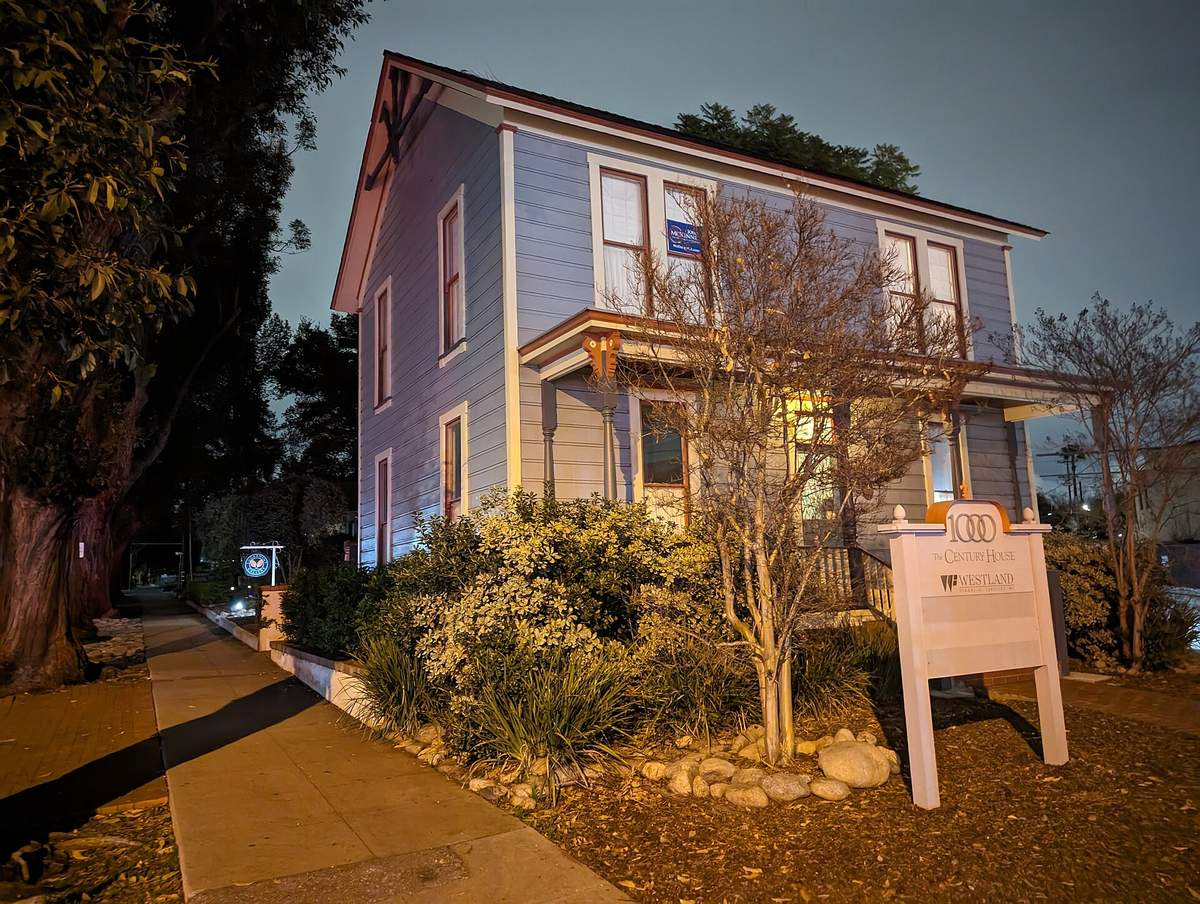
The most famous location is the Myers house, built in a 19th century New England saltbox style8. It originally stood on Meridian Avenue (at No. 709, by Los Angeles magazine's account), and about a decade after filming it faced demolition until councilmember David Margrave bought it and moved it to 1000 Mission Street7, where it still stands.
A two dollar mask
Leeder calls the mask worn by Michael Myers the key design element and writes that it was modified from a William Shatner mask purchased for two dollars1. In his words, "His blank white mask yields no answers, and when it is stripped off, his face reveals no more."1
The score Carpenter played himself
Carpenter showed an unscored cut to an executive who, as /Film tells it, was not impressed10, and he later told Dazed, "Being told that [it wasn't scary] wasn't the greatest moment of my career."10 So he wrote the fear in. Speaking with Classical California, he recalled, "I only had three days to do the music to Halloween."9 He recorded five or six themes, scoring blind and cutting them into the picture afterward, because, as he put it, "We couldn't afford a real orchestra."9
Leeder argues the film is "unthinkable without Carpenter's primitivist, minimalist score"1, noting that Carpenter's father was a music professor and that the score, like the gliding camera, makes Michael feel present even when he is nowhere on screen.
The cast
Laurie Strode, the bookish babysitter, went to Jamie Lee Curtis. History.com notes that Curtis was 19 at the time and was paid only $8,000 for her film debut5. Fox News, citing her interview with People, quotes her looking back on the shoot: "I made $2,000 a week, which at the time was a fortune."6 Leeder points out that her mother was Janet Leigh, star of Psycho (1960), which made for free publicity1.
The only familiar name in the cast, by Leeder's account, was Donald Pleasence as the gun toting psychiatrist Dr. Loomis1. The British actor had a long career playing unsettling men, and when he died in 1995 the Associated Press described him as "Uncannily able to be both menacing and menaced"11, naming the Halloween series and The Great Escape among his work. Nancy Loomis and P.J. Soles played Laurie's friends Annie and Lynda, and Leeder credits their unforced, believable banter1 with making them more than forgettable victims.
Release and box office
Expectations were low. Leeder writes that word of mouth, a striking publicity campaign and strong reviews (notably from Tom Allen, Dave Kehr and Roger Ebert) turned it into an unexpected hit, earning more than $70 million on its initial worldwide release1.
Box Office Mojo lists $47,000,000 domestic for the original release3 and $47,160,000 domestic across all releases, later revivals included. The Numbers lists $47,274,000 domestic and $70,274,000 worldwide4, which it calculates as 216.2 times the production budget. History.com's round version is more than $47 million in North America5.
A place in the National Film Registry
The Library of Congress added Halloween to the National Film Registry in 20062. Leeder's registry essay credits the film with triggering the cycle of low budget slasher movies aimed at replicating its success1, while arguing that the original has "a sense of restraint and subtlety"1 and an elegance few of its successors could equal. The American Film Institute calls it Carpenter's pioneering prototype of the enduring slasher genre12 and includes it on its list of cinema's greatest thrills.
Like Michael himself, Leeder writes, the franchise "collapses occasionally but never stays down."1 He lists sequels, remakes, sequels to remakes, novels, comic books and a legendarily terrible 1983 video game1. Forty years after the original, the Library of Congress noted a new sequel arriving in theaters in October 20182.
Trivia
- What did producer Irwin Yablans first call the idea? The Babysitter Murders1, the producer's first concept.
- Which camera rig did Halloween become the first film to use extensively? Panaglide, a chest strapped Steadicam1, used for the long, gliding takes that follow Michael's point of view.
- In what time signature is the main theme written? 5/4 time1, which gives its repeated phrases their uneven feel.
- What does the script call Michael Myers? "The Shape"1. Children call him the boogeyman, and Loomis calls him "it".
- Where did Carpenter record the score? At Sound Arts, a studio in mid Los Angeles9.
- How much did Jamie Lee Curtis get to buy Laurie's wardrobe, and where did she shop? $200, by her own account to People, spent at JCPenney6.
- Which older film does Halloween briefly show as a tribute to Howard Hawks? The Thing from Another World12, which Carpenter later remade as The Thing.
- Where was the graveyard scene filmed? Sierra Madre Pioneer Cemetery in Sierra Madre, California7.
Sources
- Murray Leeder, Halloween, National Film Registry essay, Library of Congress National Film Preservation Board (2018). Accessed October 17, 2026.
- Cary O'Dell, Reading the Film Registry: Halloween (1978), Now See Hear!, Library of Congress (October 16, 2018). Accessed October 17, 2026.
- Halloween (1978), Box Office Mojo by IMDbPro. Accessed October 17, 2026.
- Halloween (1978), The Numbers, Nash Information Services. Accessed October 17, 2026.
- Halloween premieres, This Day in History, October 25, History.com. Accessed October 17, 2026.
- Stephanie Nolasco, Jamie Lee Curtis recalls humble beginnings filming original Halloween, buying wardrobe at JCPenney, Fox News (October 26, 2018). Accessed October 17, 2026.
- Jared Cowan, Halloween filming locations, Los Angeles magazine (October 12, 2018). Accessed October 17, 2026.
- Where Halloween was filmed, Entertainment Weekly, via Yahoo News Canada (October 25, 2023). Accessed October 17, 2026.
- Tim Greiving, John Carpenter on the music of Halloween, Classical California (October 30, 2021). Accessed October 17, 2026.
- Miyako Pleines, John Carpenter Was On A Tight Deadline To Create Halloween's Signature Score, /Film (October 15, 2022). Accessed October 17, 2026.
- Associated Press, Donald Pleasence Dies, Longtime British Actor, Deseret News (February 2, 1995). Accessed October 17, 2026.
- Halloween (1978), AFI Movie Club, American Film Institute. Accessed October 17, 2026.