How the Jeep Was Born: Bantam, Willys and Ford Answer the Army in 1940
Key Points
- The Army sent its specifications for a light four-wheel-drive scout car to 135 U.S. automotive firms on July 11, 1940, with bids due by July 22.
- Bantam's pilot car, designed by Karl Probst, reached Camp Holabird, Maryland, at 4:30 p.m. on September 23, 1940, half an hour inside the deadline.
- Willys-Overland won the standard design mainly on its stronger 60 hp Go Devil engine, and Ford built the same design as the GPW.
- Where the name jeep came from is still uncertain; the two popular theories are the initials G.P. and Eugene the Jeep from Popeye.
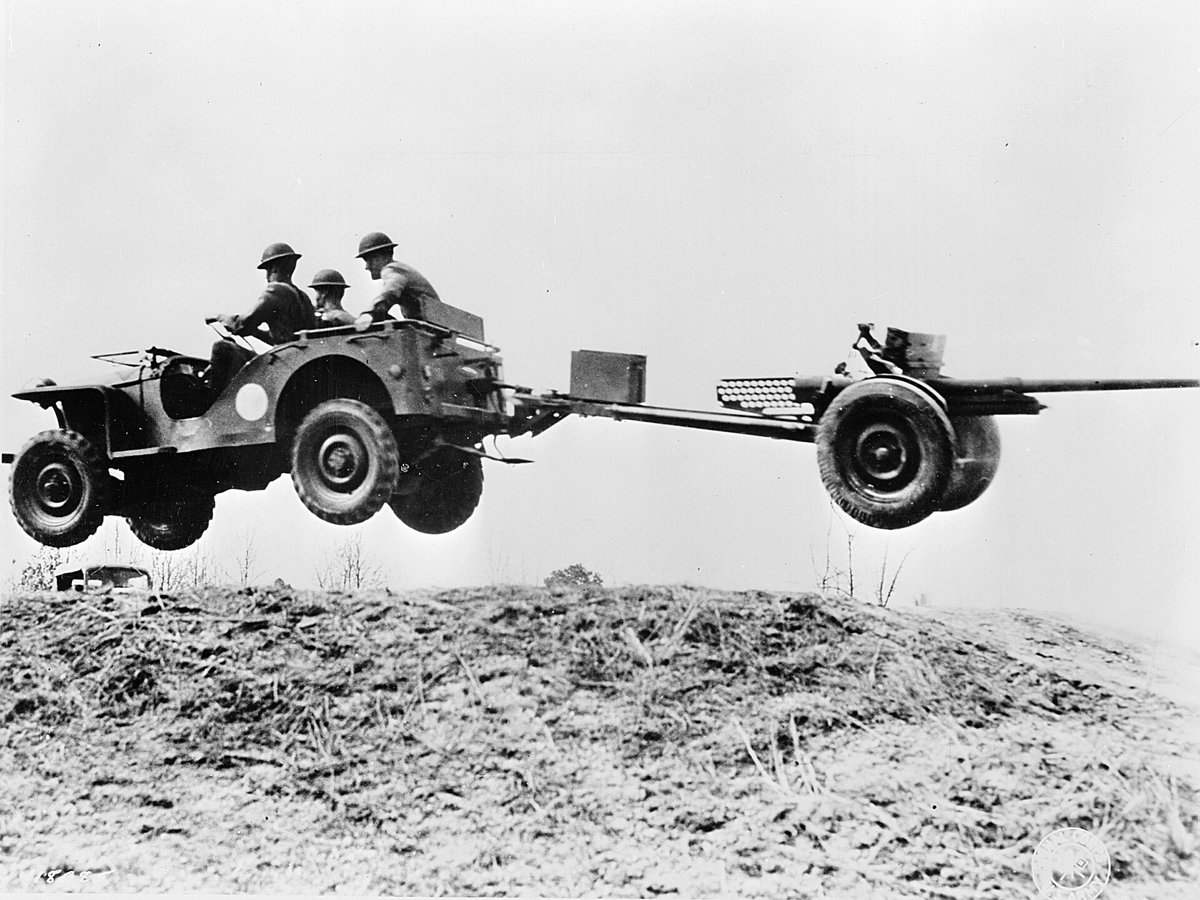

In the summer of 1940, with war already underway in Europe, the U.S. Army put out a call for a small truck that did not exist yet. On July 11, 1940, its specifications went out to 135 U.S. automotive firms, with bids due by July 221, eleven days later. Within a year the answer had a nickname, and by the end of the war Willys-Overland and Ford had built it by the hundreds of thousands.
What the Army asked for
The Army wanted a light, four-wheel-drive general-purpose vehicle and scout car, because the motorcycle and sidecar had been deemed unsatisfactory1 for years. It asked for four-wheel drive with a two-speed transfer unit, an engine good for 85 foot-pounds of torque, a rectangular body, a fold-down windshield, three seats and blackout lighting. It had to run from 3 to 50 miles per hour on a 75-inch wheelbase, carry a 660-pound payload including a .30-caliber machine gun, and weigh a low 1,300 pounds1.
The winner would get just seven weeks (49 days)2 to deliver a pilot model and 75 days to complete 70 test vehicles. Only two companies answered at first, Willys-Overland of Toledo and the American Bantam Company of Butler, Pennsylvania1. Ford's bid was accepted later.
Bantam gets there first
Bantam brought in the engineer Karl Probst2, with only five days before bids were due6. He began work on July 17, 1940, and laid out full design drawings for the prototype in two days. ASME credits the result, nicknamed the "Blitz Buggy"1, to Probst. The Heinz History Center in Pittsburgh says the big companies dismissed the 49-day deadline and that Bantam was the only company to meet it5, winning the Army's contract for 70 vehicles. ASME places the order for the 70 after the pilot car was accepted.
The pilot car went to the Army's test center at Camp Holabird, Maryland, arriving at 4:30 p.m. on September 23, 19402, half an hour inside the deadline. Testing at Holabird, the History Center says, showed it "could perform like a horse and even tow field artillery over the roughest terrain."5
Willys answers with the Quad
At Willys-Overland, chief engineer Delmar Roos kept working on a prototype of his own. ASME says the "Quad," so named for its four-wheel drive system1, was ready by November, was symbolically pictured first on Armistice Day, November 11, 1940, and arrived for testing ten days ahead of the Ford model.
The Quad had a weight problem. It came in 250 pounds too heavy1. Roos weighed whether to buy a Continental engine, as Bantam was doing, and decided to keep his own. Instead the vehicle was taken apart piece by piece, overlong bolts were trimmed, and a single coat of paint went on. The refined car got under the Army's revised weight limit by seven ounces1, ASME says.
The engine Roos kept was the 60 hp "Go Devil" 4-cylinder L-head1. When he joined Willys in 1938, the same engine produced only 45 horsepower at 3,400 rpm. Redesigned cooling, tin-plated aluminum pistons and a string of other fixes got it running at 4,000 rpm for 100 hours without failing. By ASME's figures, its 105 foot-pounds of torque1 beat Bantam's 83 and Ford's 85.
Three makers, one standard
The Army then gave each of the three companies a contract for 1,500 units1, with delivery to begin in June 1941. That order came with a new weight limit of 2,160 pounds after accepting that the first figure was neither sound nor realistic. Writing in American Heritage in 1960, Dickson Hartwell describes the Infantry Board's report on the first vehicles from all three makers, which concluded that "the standard vehicle should be based upon the Willys chassis, with the Ford shift lever and hand brake arrangement, and the power and performance characteristics of the Willys."4 By July 1941 the War Department wanted a single manufacturer for the next order of 16,000 vehicles2, and Willys won it, mainly on its stronger engine and lower cost.
The production car, the Willys MB, was a blend of all three entries. In ASME's summary, "The general design and bodywork were largely from Bantam; the front end, Ford; the power unit, Willys."1 The Army also asked for changes before the MB went into production, among them a hand brake moved to the center, where the driver or the passenger could reach it.
One factory was not enough. In early October 1941, with Willys unable to keep up, Ford was brought in to build the Willys design as the GPW2, the "W" standing for the licensed Willys design. ASME counts 368,714 MBs from Willys (1941 to 1945) and 277,896 jeeps from Ford1, while The Henry Ford museum gives 362,872 and 282,3543. Bantam built 2,675 before it was cut from further orders, The Henry Ford says, and the background to the Butler historical marker says the company switched to trailers and accessories in late 19416.
Who gets the credit, and the name
Credit has been argued over ever since. In the fall of 1941, Lt. E.P. Hogan of the Quartermaster Corps wrote that credit for the original design "may not be claimed by any single individual or manufacturer."2 The Butler marker comes down on Bantam's side, saying that Bantam, working with the Army, originally created the jeep6.
The name is murkier still. ASME calls its origin "clouded in mystery"1 and gives two popular theories, the initials G.P., for "General Purpose," and Eugene the Jeep, a go-anywhere character from the Popeye comic strip. Hartwell's 1960 article calls the G.P. pronunciation the most widely accepted theory4, while allowing that no one is certain. After the war, The Henry Ford says, Willys-Overland turned the generic "jeep" into "Jeep" and trademarked it in 19503, after a legal battle with Bantam.
Trivia
- What vehicle had the Army's search turned up by March 1940, and how did its driver sit? A two-person car called the "Bellyflopper"1, which the driver drove lying on his stomach.
- Who answered "It's a Jeep" when asked what the vehicle was at a demonstration on the Capitol steps? Willys test driver Irving "Red" Hausmann. Katherine Hillyer's article using the name appeared in the newspaper on February 20, 19412.
- What was the amphibious jeep called, and how long was it made? The "Seep," for seagoing Jeep1. Ford started building it in September 1942 and halted production in 1943.
- What was the first production civilian Jeep, and what did it cost? The CJ-2A1, introduced in the summer of 1945 at a price of $1,090.
- What is the nickname of the oldest surviving jeep, and where is it shown? "Gramps,"5 on long-term loan from the Smithsonian and, as of 2020, shown in the first floor Great Hall of the Heinz History Center in Pittsburgh.
- What was the company that became American Bantam called when it was founded in 1929? The American Austin Car Company6.
- What did General George C. Marshall call the jeep? "America's greatest contribution to modern warfare."1
- When did ASME name the Willys MB a landmark? On July 23, 19911, at the Jeep House in Toledo, as the 33rd International Historic Mechanical Engineering Landmark.
Sources
- The Jeep MB: An International Historic Mechanical Engineering Landmark, American Society of Mechanical Engineers, July 23, 1991. Accessed November 13, 2026.
- Willys MB, Wikipedia. Accessed November 13, 2026.
- Jeep, The Henry Ford, digital collections set. Accessed November 13, 2026.
- Dickson Hartwell, The Mighty Jeep, American Heritage, December 1960. Accessed November 13, 2026.
- 80th Anniversary of the Jeep, Senator John Heinz History Center, September 24, 2020. Accessed November 13, 2026.
- Invention of the Jeep historical marker, Butler, Pennsylvania, ExplorePAhistory.com. Accessed November 13, 2026.
- File:Bantam jeep flying 37mm sm.jpg, Wikimedia Commons file page. Accessed November 13, 2026.