Lincoln Highway Dedication Day: October 31, 1913
Key Points
- The Lincoln Highway Association dedicated the route on October 31, 1913, and the Lincoln Highway Illinois history site says bonfires, fireworks, concerts and parades marked hundreds of cities along the way.
- Sources differ: NPR headlined a 2013 report America’s first transcontinental highway, while a Federal Highway Administration column concludes, by its own definition, that it was not first, and the sources give 1915 and other dates for its completion.
- The association ended operations on December 31, 1927, and on September 1, 1928, Boy Scouts placed approximately 3,000 concrete markers along the route.
- The Illinois site says the national Lincoln Highway Association was reactivated on October 31, 1992.

On October 31, 1913, the Lincoln Highway Association dedicated the route of the Lincoln Highway. NPR describes the road as one that stretched from Times Square in New York City to Lincoln Park in San Francisco3. Saturday, October 31, 2026, marks the 113th anniversary of that dedication.
A dinner in Indianapolis
A Federal Highway Administration (FHWA) history says that in September 1912 the automotive entrepreneur Carl G. Fisher held a dinner in the Old Deutsches Haus in Indianapolis1 to ask industry leaders to help pay for a “coast-to-coast rock highway” from New York City to San Francisco. He estimated the cost at about $10 million and hoped it could be finished in time for the 1915 Panama-Pacific Exposition. The Lincoln Highway Illinois history site, which credits an Illinois Department of Transportation planning grant, dates that dinner to September 104. Roads of the time were a patchwork: the FHWA’s “Back in Time” page says America had 2.5 million miles of roads, but most roads were dirt and didn’t connect2.
Sources differ on who chose the Lincoln name. Kay Shelton, president of the Lincoln Highway Association, told NPR in 2013 that Fisher wanted to call it the Coast-to-Coast Rock Highway3 and that his friend Henry Joy came up with the idea of honoring Abraham Lincoln’s memory3. The FHWA, by contrast, says Fisher soon christened his road the Lincoln Highway1.
Incorporated, announced, dedicated
The association was formally incorporated in Detroit on July 1, 19134, according to the Illinois site; the FHWA says only that it was incorporated in July 19131. The route has more than one date. The FHWA says the association announced the route on September 14, 19131, the Illinois site says it adopted the official route on September 4, 19134, and a caption on the same site dates a route proclamation to September 10, 1913. The sources do not agree, so this page does not pick one.
The October 31 date is not in dispute between the sources that give it. The Illinois history site says the association officially dedicated the route4, that the milestone was celebrated across the 13 states the highway crossed, and that bonfires, fireworks, concerts and parades marked hundreds of cities. In at least two places, it adds, the streets were swept and washed so dances could be held on the highway4. The same site gives the length, in its account of the 1926 completion, as a 3,389-mile4 road.
A route, not a paved road
Shelton described the project to NPR as a route-making process3: the highway was made of existing roads, and a lot of it followed where Alice Ramsey had driven a Maxwell coast to coast in 1909. A trip along it took generally about a month3, she said. The association’s own 1916 motorist guide, the FHWA reports, called a transcontinental trip “something of a sporting proposition”1 that would take 20 to 30 days, and advised, “Don’t wear new shoes.”
Paying for the road did not go as first planned. The FHWA says the association soon abandoned the idea that the automobile industry would pay for the Lincoln Highway1, because the $10 million estimate was too low and the highway could not have been finished for the 1915 exposition.
Was it first, and was it ever finished?
NPR’s 2013 report was headlined “America’s First Transcontinental Highway Turns 100”3. The FHWA’s “Ask the Rambler” column takes the other side. It sets a definition of a first transcontinental highway that includes a trail association mapping the road, signing it and promoting it, and then notes that the National Old Trails Road Convention met in Kansas City on April 17 and 18, 19121, aiming at a road from Baltimore to Los Angeles. The column says it is not claiming the National Old Trails Road met its definition, but concludes that the Lincoln Highway wasn’t first1.
The sources also differ on when the road was done. The FHWA’s “Back in Time” page says the road was completed by 19152, and the Illinois site refers to the completion of the Lincoln Highway in 19154 (the same site also describes the substantial completion of the 3,389-mile road in 19264). The FHWA’s “Ask the Rambler” column says the claim that it was completed in 1916, 1923, 1925, 1935 or any other year is not correct, and that the Lincoln Highway was not paved from New York City to San Francisco1 when the association closed on December 31, 1927.
From names to numbers
In 1919, the Army agreed to send its first transcontinental motor convoy on the route. The FHWA says the convoy encountered miserable conditions1 despite using the best known road in the country, and that for one participant, Dwight D. Eisenhower, his two months on the road played a part in his support for the Interstate System when he became President.
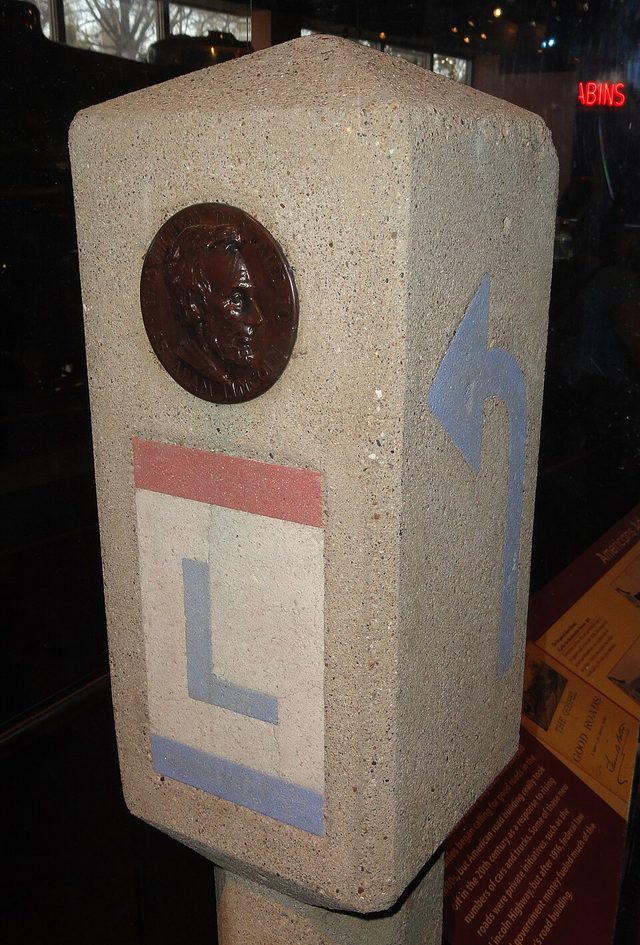
By the mid-1920s, federal and state officials judged that private groups naming interstate roads was impractical. The American Association of State Highway Officials approved the U.S. numbered highway system on November 11, 19261, and the FHWA says a large part of the Lincoln Highway became U.S. 30. The association ended operations on December 31, 1927. For a last publicity stunt, at 1:00 p.m. on September 1, 1928, Boy Scouts placed approximately 3,000 concrete markers1 along the route, each carrying the highway’s insignia, a bronze medallion of Lincoln and a directional arrow. The marker in the photo above is one of that 1928 type, on display at the National Museum of American History, so it is a later object than the 1913 dedication.
The association comes back
The Illinois site records that on October 31, 1992, the national Lincoln Highway Association was reactivated4, established by Gregory M. Franzwa, 79 years to the day after the dedication. It adds that in 2000 the state’s chapter submitted the road for National Scenic Byway designation, and that the Illinois segment of 178.8 miles4 is, in its words, the first and only section to receive the designation in its entirety.
Trivia
- Which two places did NPR name as the ends of the Lincoln Highway? Times Square in New York City and Lincoln Park in San Francisco3.
- Who, according to Kay Shelton, drove a Maxwell coast to coast in 1909 on roads the highway later followed? Alice Ramsey3.
- What did Carl Fisher want to call the road before it became the Lincoln Highway? The Coast-to-Coast Rock Highway3.
- What footwear advice did the 1916 Lincoln Highway motorist guide give? “Don’t wear new shoes.”1
- According to the FHWA, about how many concrete markers did Boy Scouts place along the route on September 1, 1928? Approximately 3,0001.
Sources
- “Ask the Rambler: Was the Lincoln Highway the First Transcontinental Highway?”, Federal Highway Administration. Accessed October 29, 2026.
- Rickie Longfellow, “The Lincoln Highway”, Back in Time, Federal Highway Administration, updated June 27, 2017. Accessed October 29, 2026.
- “America’s First Transcontinental Highway Turns 100”, All Things Considered, NPR, October 31, 2013. Accessed October 29, 2026.
- “History of the Lincoln Highway”, Lincoln Highway Illinois, Heritage Corridor Destinations and Illinois Department of Transportation grant. Accessed October 29, 2026.