Moby-Dick: The US Edition Published on November 14, 1851
Key Points
- The American edition of Moby-Dick was published on November 14, 1851, and its 175th anniversary falls on Saturday, November 14, 2026.
- The London edition, titled The Whale, came out first, on October 18, 1851, in a printing of 500 copies, and differs from the American edition in over 700 wordings.
- Wikipedia reports that the book sold 3,215 copies in the decades after its publication and that Melville’s earnings from it add up to $1,260.
- Wikipedia lists the Essex sinking in 1820 and the albino whale Mocha Dick as the two real events behind the story.

Moby-Dick, in its single-volume American edition, was published on November 14, 18511 by the standard account, so its 175th anniversary falls on Saturday, November 14, 2026. The book had a quiet first act. Most of the facts below come from one Wikipedia article, with the title page and dedication from Wikisource. Here is how the two editions differed, how the title changed late, what real events fed the story, and how few copies it sold for decades.
Two editions, a month apart
The British edition, titled The Whale, came out in London on October 18, 1851, in a printing of only 500 copies1. The London Morning Herald printed the earliest known review on October 201. The American edition followed on November 14, and was reviewed the same day in both the Albany Argus and the Morning Courier and New-York Enquirer1. Its title page reads Moby-Dick; or, The Whale, by Herman Melville, with Harper & Brothers of New York as publisher and Richard Bentley of London named as well2. The book is inscribed to Nathaniel Hawthorne2.
Harper’s first printing was 2,915 copies, including 125 review copies, and the book sold for $1.50, about a fifth of the price of the British three-volume edition1. The American edition ran to 635 pages in one volume, while the British edition spread 927 pages across three volumes, in both cases not counting the front matter1.
A title changed late
After the sheets had been sent to London, Melville changed the title. A letter to Bentley, of which only a draft survives, said he had settled on a new title and dedication, and that it was thought the new title would sell better1. Biographer Hershel Parker suggests the reason was that Harper’s had published a book with a similar title, The Whale and His Captors1. Bentley had already announced The Whale in the Athenaeum and the Spectator on October 4 and 11, so he added a half-title page reading The Whale; or, Moby Dick to the first volume only1.
What the London edition lost
The British edition differs from the American one in over 700 wordings and thousands of punctuation and spelling changes1. Scholar Steven Olsen-Smith attributes unauthorized changes, up to outright censorship, to the revisers Bentley hired, and biographer Robertson-Lorant calls the result “badly mutilated”1. More than 1,200 words of passages judged sacrilegious were cut or revised, and the epilogue, which tells of Ishmael’s survival, is missing from the British edition1.
Where the whale came from
Two real events are credited as the genesis of the tale. One was the sinking of the Nantucket ship Essex in 1820 after a sperm whale rammed her, recorded by first mate Owen Chase in his 1821 Narrative1. The other was the alleged killing in the late 1830s of the albino sperm whale Mocha Dick, whose battle with a whaler was the subject of an article by J. N. Reynolds in the May 1839 issue of The Knickerbocker1. Melville also drew on his own 18 months as an ordinary seaman aboard the whaler Acushnet in 1841 and 18421.
Melville wrote most of the book at Arrowhead, his house in Pittsfield, Massachusetts, over the winter of 1850 to 18511. The earliest surviving mention is a letter to Richard Henry Dana Jr. dated May 1, 1850, in which he said he was halfway through the whaling book and feared it would be a strange sort of book1. In August 1851 the whaler Ann Alexander was sunk by a whale in the Pacific, and Melville remarked on the event1.
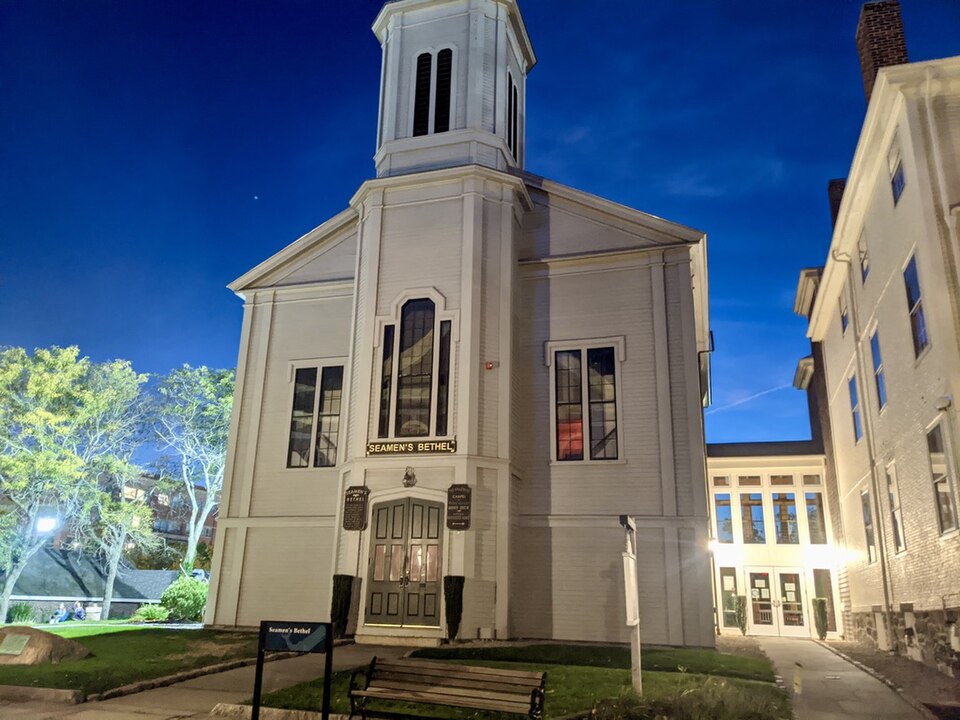
The model for the Whaleman’s Chapel of chapter 7 is the Seamen’s Bethel in New Bedford, Massachusetts, and Melville attended a service there shortly before he shipped out on the Acushnet1. Reverend Enoch Mudge, who preached there, is at least in part the inspiration for Father Mapple1.
First reactions
The New Haven Daily Palladium of November 17 mixed praise with reservations about the “irreverence and profane jesting”1. George Ripley reviewed it favorably in the New York Tribune on November 22, and Nathaniel Parker Willis called it “a very racy, spirited, curious and entertaining book” in the Home Journal on November 291. Biographer Robertson-Lorant writes that reviewers who actually read the book found much to praise, while conservative reviewers did not like it1.
Slow sales, late fame
About 1,500 copies of the American edition were sold within 11 days, and then sales slowed to fewer than 300 the next year1. The book sold 2,300 copies in its first year and a half and an average of 27 a year for the next 34 years, 3,215 in total, and Melville’s earnings from it add up to $1,2601. It was out of print during the last four years of Melville’s life1.
Within a year after Melville’s death in 1891, Harper & Brothers reprinted Moby-Dick along with three of his earlier novels, giving it a chance to be rediscovered1. Carl Van Doren called it a pinnacle of American Romanticism in 1921, and D. H. Lawrence celebrated Melville in his 1923 Studies in Classic American Literature1. The Modern Library issued it in 1926, and Rockwell Kent illustrated a three-volume edition that appeared in 19301.
On screen and aloud
The first adaptation was the 1926 silent movie The Sea Beast, starring John Barrymore, and the most famous is the 1956 John Huston film from a screenplay by Ray Bradbury1. Both the New Bedford Whaling Museum and Mystic Seaport hold annual marathon readings in which volunteers read the chapters aloud1. Project Gutenberg offers the novel as a free ebook3.
Trivia
- Which New York publisher issued the American edition? Harper & Brothers2.
- What was the title of the London edition published on October 18, 1851? The Whale1.
- How many copies were in the first American printing, including review copies? 2,9151.
- Which Nantucket ship, sunk by a sperm whale in 1820, is credited as one of the two real events behind the story? The Essex1.
- To which author is the book inscribed? Nathaniel Hawthorne2.
Sources
- Moby-Dick, Wikipedia. Accessed November 8, 2026.
- Moby-Dick (1851) US edition, Wikisource. Accessed November 8, 2026.
- Moby Dick; Or, The Whale by Herman Melville, Project Gutenberg. Accessed November 8, 2026.