Rutgers 6, Princeton 4: The First College Football Game, 1869
Key Points
- Rutgers beat Princeton 6-4 on November 6, 1869, on a field behind the College Avenue Gymnasium in New Brunswick, New Jersey, in front of about 100 spectators.
- The game used Rutgers rules based on the English Football Association rules of 1863, with 25 players a side and no throwing or running with the ball.
- Princeton won the rematch 8-0 under its own rules on November 13, 1869, and the planned third game never took place.
- The game is still usually regarded as the first intercollegiate American football game, though it has also been called the first intercollegiate soccer game in the United States.
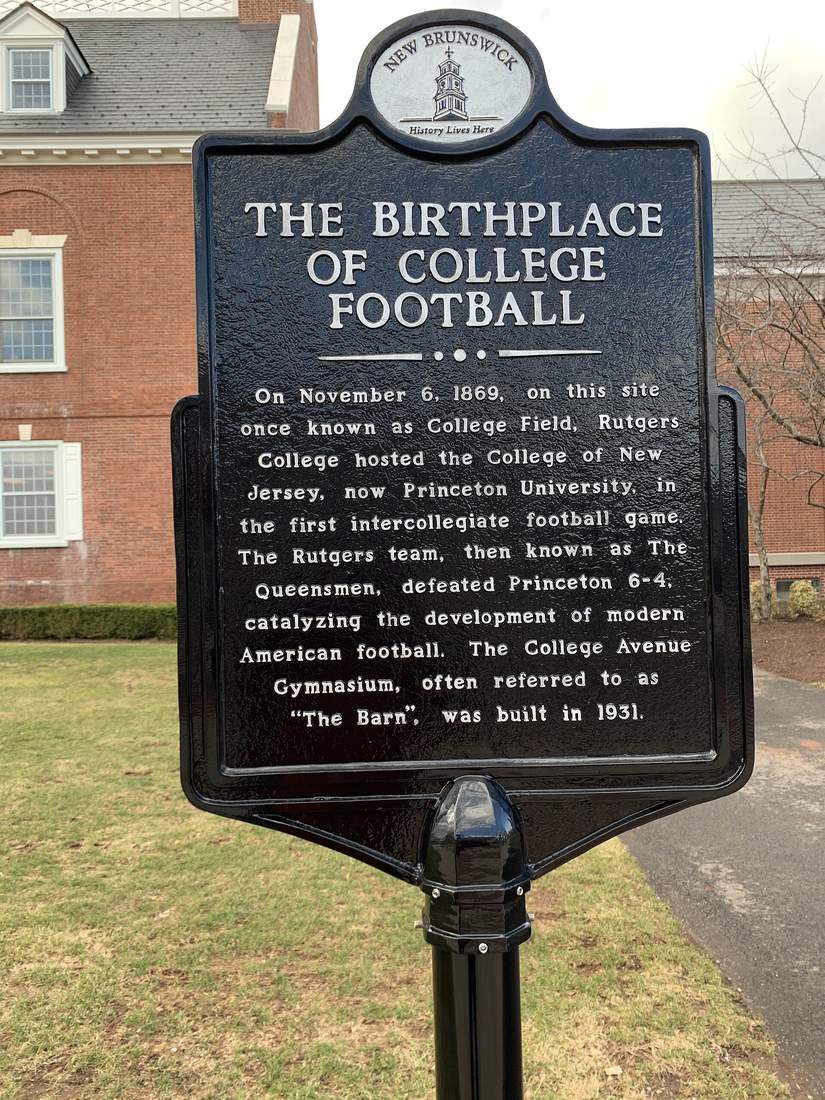

Friday, November 6, 2026, is 157 years to the day since Rutgers and Princeton played the first collegiate football game, on November 6, 1869, on a field behind the College Avenue Gymnasium in New Brunswick, New Jersey1. Rutgers won 6-4 in front of about 100 spectators1. The game looked very little like the sport now played on autumn Saturdays, and whether it counts as the first American football game depends on how strictly the word football is read.
A grudge and a challenge
The rivalry was older than the football. Princeton had beaten Rutgers 40-2 in baseball three years earlier1, and the two schools had already quarreled over a Revolutionary War cannon2. Rutgers captain William J. Leggett challenged Princeton to a series of three games, and Princeton captain William S. Gummere accepted1. Both men went on to other careers: Leggett became a Dutch Reformed clergyman, and Gummere became chief justice of the New Jersey Supreme Court2.
The rules on the day
Because the game was at Rutgers, it used Rutgers rules, and those rules were based on the English Football Association rules of 18632. Ten numbered rules set the grounds at 360 feet long and 225 feet wide and fixed each side at 25 players2. No throwing or running with the ball was allowed, and neither was tripping or holding players2. Hands were still in play in one way, since players could strike the ball with their hands or fists as well as their feet1. The rules called for four judges and two referees2.
The rules set the goals at 8 paces2, and the Rutgers account gives them as 24 feet wide1. Some players defended their own territory while others, called bulldogs, played in the other team's territory2.
Ten games in one
The scoring did not run on points the way a modern scoreboard does. The teams played 10 games against each other, a goal ended the current game, and the team with the most goals after 10 games won2. Rutgers puts it as a race to six "games," or points1, and Rutgers got to six first.
How Rutgers won
George Dixon and Stephen Gano scored the first point in college football1. Princeton later tied it at 2-2, Madison Monroe Ball, a wounded Civil War veteran, kept stopping Princeton by kicking the ball away with his heel, and he set up the goal that put Rutgers ahead 4-2, before Princeton tied it again at 42. Leggett told his team to "keep your kicks short and low"1, and Rutgers then scored the final two goals2. Princeton player Jacob Edwin Michael, known as Big Mike, was named the best player in the game2.
The Rutgers players wore scarlet kerchiefs and scarf turbans, at a time when Princeton had not yet adopted orange and black1, and the scarlet of the Rutgers Scarlet Knights came from this episode2. The student newspaper, the Targum, described the action as "headlong running, wild shouting, and frantic kicking," and the two teams shared a supper afterward1.
The November 13 rematch
One week later the series moved to Princeton. On November 13, 1869, Princeton won the second game 8-0 under its own rules3, played in a cow pasture before loud home supporters1. The key change was a free kick for any player who caught the ball on the fly, a rule that "seriously affected the speed advantage of Rutgers"3. The losing side took it gracefully, since the Targum wrote that if they had to lose, they were glad to lose to such conquerors1.
The third game never took place1. One account blames objections at both schools to more emphasis on the contests than on academics, and another says the teams may have disagreed over which rules to use3. That left Princeton ahead 12-6 on combined score and declared 1869 national champion "under a cloud of dispute", although each team finished 1-11. Later selectors split as well, since the Billingsley Report and the National Championship Foundation named Princeton, while Parke H. Davis named the two schools co-champions3.
Not quite football as it is played now
The 1869 game was played with a round ball, and a goal was scored by kicking the ball through the opposing goal4. Neither team wore protective gear, and early play resembled soccer more than modern football1. The line of scrimmage and the snap from center to quarterback arrived in 18804, and at the 1882 rules meeting Walter Camp proposed that a team must gain at least five yards in three downs4.
First, with an asterisk
The game is still usually regarded as the first game of intercollegiate American football, though these early games "bore little resemblance" to the American game developed in the decades that followed4. Because the rules banned carrying or throwing the ball, it has been called the first intercollegiate soccer game in the United States, and many also consider it the first gridiron game2. Intercollegiate association football matches involving Oxford and Cambridge go back further still2. The 1869 season is traditionally considered the first college football season, and "modern folklore" places the very first game of college football at Rutgers and Princeton3. Harvard and McGill met in 1874, and the second of their games was played under rugby regulations4.
What came after
The rivalry resumed the following year and lasted until 19801. For the hundredth anniversary, Rutgers played a centennial game on September 27, 1969, and defeated visiting Princeton 29-05. The day before the game, a ceremony introduced a US postage stamp for the centennial college football season, and the program also included a reenactment of the original game, a centennial dinner and a parade5. A marker now commemorates the location of the game in New Brunswick2, and Rutgers ran a special series in 2019, 150 years after the game, celebrating its role as the birthplace of college football1.
Trivia
At what time did the first game kick off?
Three o'clock1
Which clergyman helped the Rutgers students put their 1869 team together?
Rev. C.D. Hartranft1
What did the Targum say Princeton had the most of, and what did it say Princeton did not do well?
Muscle; it said Princeton did not kick very well2
Which Rutgers player was the last survivor of the 1869 game, and in what year did he die?
George H. Large, in 19392
Which artist painted The First Game, and who commissioned it in 1968?
Arnold Friberg, for Chevrolet, as one of four works celebrating 100 years of college football2
Who won the first Harvard vs. McGill game in 1874, and by what score?
Harvard, 3-04
What rules did Harvard and Yale use in their first meeting in 1875, and who won?
A compromise set called the Concessionary Rules; Harvard won 4-04
What was held at halftime of the 1969 centennial game?
A vintage car show5
Sources
- The Birthplace of College Football, David W. Major, Rutgers University, November 6, 2019. Accessed November 6, 2026.
- 1869 Princeton vs. Rutgers football game, Wikipedia. Accessed November 6, 2026.
- 1869 college football season, Wikipedia. Accessed November 6, 2026.
- History of American football, Wikipedia. Accessed November 6, 2026.
- Inventory to the Records of the Centennial Football Game Committee, 1967-1971, Rutgers University Libraries, Special Collections and University Archives. Accessed November 6, 2026.