Steamboat Willie at 98: Mickey's Colony Theater Debut in 1928
Key Points
- Library of Congress and D23 sources date Steamboat Willie's release at the Colony Theater in New York to November 18, 1928, and Wednesday, November 18, 2026, is its 98th anniversary.
- D23 calls it the first Mickey Mouse cartoon released and the first cartoon with synchronized sound (Duke calls it one of the first), and the Library of Congress essay says a first recording session went badly until a bouncing ball was added for the conductor.
- It opened as the first element on a bill with the feature Gang War, according to the Library of Congress essay.
- Steamboat Willie entered the US public domain on January 1, 2024, while Disney keeps copyright in later versions of Mickey and its trademarks, according to Duke's Center for the Study of the Public Domain.
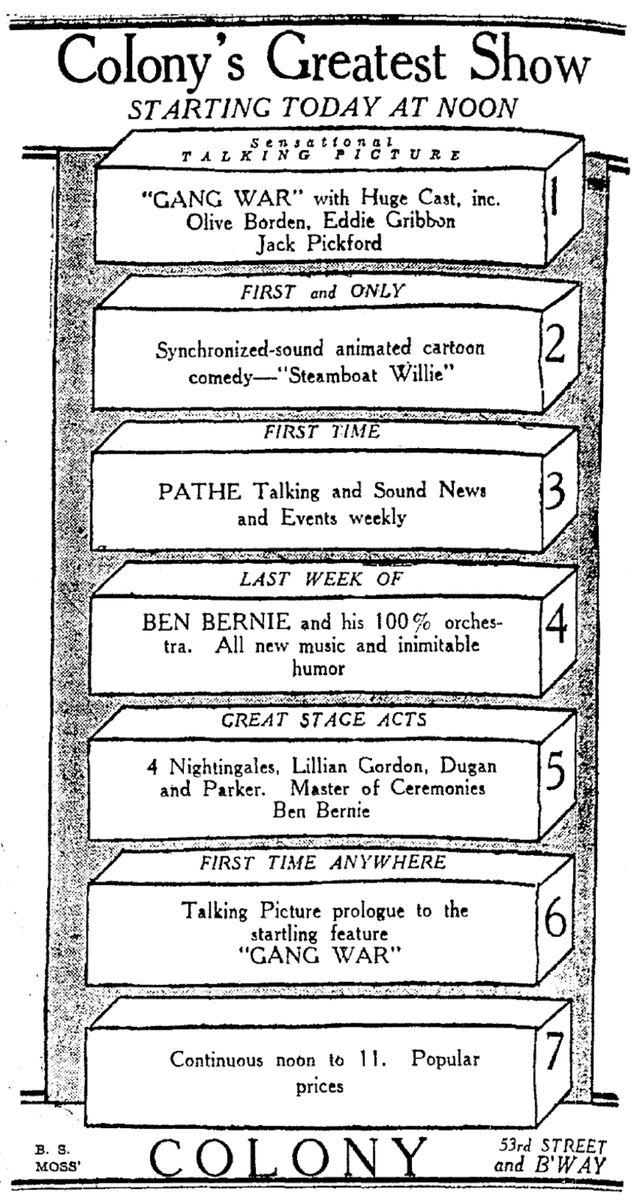

A Library of Congress essay by Walt Disney Company archivist Dave Smith says the Mickey Mouse series began with the release of Steamboat Willie at the Colony Theater in New York on November 18, 19281. The company's D23 archive entry calls that the date used for the birth of Mickey Mouse2. Wednesday, November 18, 2026, is the film's 98th anniversary.
Why sound mattered
Smith writes that in early 1928 Walt Disney went to New York to negotiate with his distributor and discovered it had taken over the rights to his Oswald the Lucky Rabbit cartoons1. Two silent Mickey cartoons, Plane Crazy and The Gallopin' Gaucho, had failed to find a distributor, and Disney reasoned that sound, which audiences had loved in The Jazz Singer the previous fall, would be the novelty that sold a series1. Steamboat Willie was the third Mickey cartoon made, and the first made strictly with sound in mind1.
Smith says Disney wanted every sound to match exactly what the viewer saw, and that animator Wilfred Jackson, whose mother taught music, suggested a metronome and made a chart that became known as a bar sheet1. The film's steamboat setting was a nod to Buster Keaton's Steamboat Bill, Jr.1, and D23 describes Mickey as a mischievous deckhand who plays “Turkey in the Straw” using an animal menagerie as his instruments, to the annoyance of the tyrannical Captain Pete2.
The recording
Smith says the first recording session, on September 15, 1928, used a 17-piece orchestra and three sound effects men, and went badly because the orchestra struggled to follow the action1. A bouncing ball was then added to the film print so the conductor could follow it, and a second session two weeks later was a success1. D23 says Disney contracted with the Powers Cinephone sound process after failing to make a deal through RCA or Western Electric2. Smith adds that Disney took out a new mortgage on his studio and sold his Moon automobile to pay for the work1.
Opening night at the Colony
According to Smith, Colony owner Harry Reichenbach offered to run the cartoon for two weeks, and it opened on November 18, 1928, as the first element on a bill, in Smith's account, with the feature Gang War, starring Olive Borden, Eddie Gribbon and Jack Pickford1. Smith writes that audiences were thrilled and that glowing accolades soon appeared in the press1. D23 calls it both the first Mickey Mouse cartoon released and the first cartoon with synchronized sound, though Duke's Center for the Study of the Public Domain calls it one of the first cartoons with fully synchronized sound2.
From 1928 to the public domain
Jennifer Jenkins, director of the Duke Center for the Study of the Public Domain, wrote that Steamboat Willie and the silent version of Plane Crazy would enter the US public domain on January 1, 20243. She also wrote that Disney was a prominent supporter of the law that extended the US copyright term to 95 years, which critics called the “Mickey Mouse Protection Act,” though she notes the measure passed because of a much broader lobbying effort3.
The same article says that what became free is the 1928 version of the characters, while Disney keeps copyright over newer versions such as the Mickey of Fantasia (1940) and keeps its trademarks over Mickey as a brand identifier3. Jenkins advises anyone reusing the character to avoid confusing consumers into thinking a new work is produced or sponsored by Disney3. Duke's 2024 Public Domain Day page lists Steamboat Willie among the 1928 works entering the US public domain, alongside Buster Keaton's The Cameraman and Charlie Chaplin's The Circus4.
Trivia
- At which New York theater did Steamboat Willie open? The Colony Theater, on November 18, 19281.
- Which feature shared the opening bill? Gang War, starring Olive Borden, Eddie Gribbon and Jack Pickford1.
- Which Buster Keaton film inspired the steamboat setting? Steamboat Bill, Jr.1
- What was added to the film print so the conductor could keep tempo? A bouncing ball1.
- On what date did Steamboat Willie enter the US public domain? January 1, 20243.
Sources
- Dave Smith, Steamboat Willie (essay), National Film Preservation Board, Library of Congress. Accessed November 16, 2026.
- Steamboat Willie (film), Disney A to Z, D23 (Walt Disney Archives). Accessed November 16, 2026.
- Jennifer Jenkins, Mickey, Disney, and the Public Domain: a 95-year Love Triangle, Duke Center for the Study of the Public Domain. Accessed November 16, 2026.
- Public Domain Day 2024, Duke Center for the Study of the Public Domain. Accessed November 16, 2026.