Suez Canal Opened November 17, 1869, With an Empress in the Lead
Key Points
- The Suez Canal Authority dates the inauguration of the Suez Canal to November 17, 1869, so Tuesday, November 17, 2026 is its 157th anniversary.
- The opening procession was led by L'Aigle and followed by 77 ships, 50 of them warships, by the Suez Canal Authority's count.
- Digging began on April 25, 1859, and the Suez Canal Authority puts the cost at 433 million francs, double the first estimate.
- Caroline Piquet gives London to Bombay as 10,721 nautical miles around the Cape of Good Hope and 6,260 through Suez.
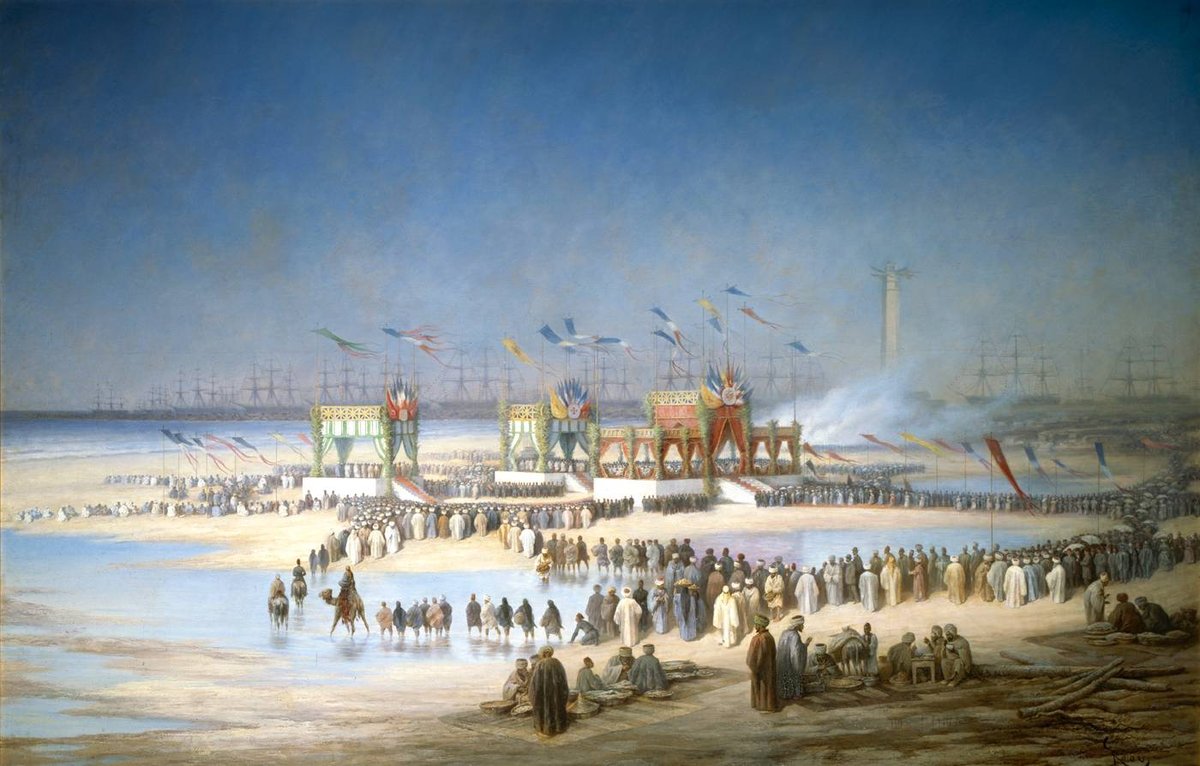

The Suez Canal Authority dates the inauguration of the Suez Canal to November 17, 18691, so Tuesday, November 17, 2026 is its 157th anniversary. The canal runs from Port Said on the Mediterranean Sea south to the city of Suez, and it lets ships sail between Europe and Asia without going around Africa5. It opened with a royal procession of ships, after ten years of digging and a bill that ran to double the plan.
The opening convoy
According to the Suez Canal Authority, six thousand guests attended the ceremony, among them Empress Eugenie of France, wife of Napoleon III, the Emperor of Austria, the Crown Prince of Prussia and Prince Tawfiq, the crown prince of Egypt1. Caroline Piquet, a historian at the University of Paris-Sorbonne, writes for the Bibliotheque nationale de France that France was the guest of honor, and that the two seas had already been joined at the Bitter Lakes in August 1869, before the November ceremony6.
The procession that entered the canal on November 17 was led by L'Aigle, carrying the most important guests, and followed by 77 ships, 50 of them warships, by the authority's count1. History.com describes L'Aigle as the imperial yacht of Empress Eugenie and names the British ocean liner Delta as the ship behind it5. Ismail Pasha, the khedive of Egypt, formally opened the canal5, and the Suez Canal Authority puts the cost of the celebrations to him at about one and a half million Egyptian pounds1.
Cairo was dressed up for the visitors as well. Jane Waldron Grutz writes in Saudi Aramco World that Ismail built the new Gezira Palace to house the empress, laid out a new quarter of Cairo modeled on Haussmann's Paris, and gave the city its first opera house8. The same article quotes the khedive as saying, "my country is no longer in Africa; we are now part of Europe."8
Ten years of digging
The first concession, issued on November 30, 1854, gave Ferdinand de Lesseps the right to form a company to dig the canal, and set the concession at ninety nine years from the opening1. The Universal Company of the Maritime Canal of Suez was founded in December 1858, with a capital of 200 million francs in 400,000 shares of 500 francs each1. When Britain, the United States, Austria and Russia did not take up the shares reserved for them, Egypt borrowed at high interest to buy them, which left it holding roughly half the company1.
Digging began on April 25, 1859, over objections from Britain and the Ottoman Empire1. History.com says the first digging was done by hand, with picks and shovels in the hands of forced laborers, and that European workers with dredgers and steam shovels arrived later4. History.com cites an estimate that 1.5 million people worked on the canal, many of them slave laborers, and says tens of thousands are believed to have died of cholera and other causes5. Labor disputes and a cholera epidemic slowed the work, and the canal was finished four years behind schedule4.
The Suez Canal Authority puts the soil removed at 74 million cubic meters and the cost at 433 million francs, double the first estimate1. Piquet notes that Egypt paid half the costs, and that in 1875 Khedive Ismail, close to bankruptcy, was forced to sell his 44 percent share of the company to Great Britain6.
How big it was in 1869 and after 2015
The Suez Canal Authority's table puts the 1869 canal at 164 kilometers long and 8 meters deep, able to take ships of 5,000 deadweight tons2. History.com gives the opening depth as 25 feet, with the channel 72 feet wide at the bottom and 200 to 300 feet wide at the surface4, and says fewer than 500 ships used it in its first full year4.
The same authority table, which runs to 2015, lists an overall length of 193.30 kilometers, a maximum water depth of 24 meters, a permitted draft of 66 feet and loaded ships of up to 240,000 deadweight tons2. History.com gives the length as 120 miles from Port Said to Suez, which is about 193 kilometers5.
A shorter way to India
The canal cut the trip between Europe and India roughly in half. Piquet gives London to Bombay as 10,721 nautical miles around the Cape of Good Hope and 6,260 through Suez6. In the early 1870s, she writes, a trip from Marseilles to Bombay that had taken two or three months around the Cape took about one month through the isthmus6. Great Britain, which had opposed the project, became the canal's main user as soon as it opened and stayed so until the 1950s6.
Sailing ships were slow to benefit. History.com says only steamships could use the canal at first, because sailing vessels struggled in the narrow channel and the region's winds5.
Verdi, Aida and a lighthouse that never was
Asked for a celebratory ode for the opening, Verdi declined, writing, "I regret that I must decline this honor, because of the number of my current activities and because it is not my custom to compose occasional pieces."8 Aida premiered later, at Cairo's Khedival Opera House on Christmas Eve 18718.
The sculptor of the Statue of Liberty had an Egyptian chapter too. The National Park Service says the sculptor Frederic-Auguste Bartholdi met Khedive Isma'il Pasha, the ruler overseeing and funding the canal's construction, and presented a figurine for a colossal lighthouse depicting an Egyptian fellah, a female serf, titled Egypt (or Progress) Carrying the Light to Asia7. The khedive rejected the design7.
Closed, widened and blocked
Traffic through the canal stopped after the war that began on June 5, 1967, and the canal reopened on June 5, 1975, eight years to the day, with President Anwar Sadat aboard the destroyer 6th of October, which sailed behind two minesweepers in the first convoy1. History.com notes that for those eight years the canal was the front line between the Egyptian and Israeli armies4.
The 2015 project, which the Suez Canal Authority says took 12 months, dug 35 kilometers of a new parallel channel and deepened and widened 37 kilometers of bypasses, 72 kilometers in all3. Among its stated goals was cutting the southbound convoy's transit time from 18 hours to 113.
On March 23, 2021, the container ship Ever Given ran aground in the canal on its way to the Netherlands, and the European Space Agency's radar images two days later showed the 400 meter ship blocking it10. NOAA says an international team dredged sand for six days and nights before a high spring tide helped refloat the ship at about 3 p.m. local time on Monday, and that its satellite images from early on March 29 showed more than 400 ships backed up on both sides9.
Trivia
- What was the first vessel to pass through the canal from south to north? The S.S. Dido5, according to History.com.
- Which Verdi opera opened Cairo's new opera house in November 1869? Rigoletto8, with 61 La Scala musicians conducted by Emanuele Muzio.
- Which Norwegian playwright was among the guests at the 1869 inauguration? Henrik Ibsen1, by the Suez Canal Authority's guest list.
- When did water first flow into Lake Timsah, midway along the route? November 18, 18621, when the lake was still a depression ringed by sand dunes.
- How many cargo ships were trapped inside the canal when it closed in 1967? 155, and History.com says they stayed there for years.
Sources
- Canal History, Suez Canal Authority. Accessed November 11, 2026.
- Canal Characteristics, Suez Canal Authority. Accessed November 11, 2026.
- New Suez Canal, Suez Canal Authority. Accessed November 11, 2026.
- Suez Canal opens, This Day in History, HISTORY.com Editors, History, last updated January 31, 2025. Accessed November 11, 2026.
- Suez Canal, HISTORY.com Editors, History, last updated February 27, 2025. Accessed November 11, 2026.
- Caroline Piquet, The Suez canal, Patrimoines Partages, Bibliotheques d'Orient, Bibliotheque nationale de France. Accessed November 11, 2026.
- Frederic-Auguste Bartholdi, Statue of Liberty National Monument, National Park Service, last updated March 26, 2026. Accessed November 11, 2026.
- Jane Waldron Grutz, An Opera for Egypt, Saudi Aramco World, September/October 2013. Accessed November 11, 2026.
- Earth from Orbit: Cargo Ship Backup Seen from Space, NOAA National Environmental Satellite, Data, and Information Service, April 2, 2021. Accessed November 11, 2026.
- Suez Canal traffic jam seen from space, European Space Agency, March 26, 2021. Accessed November 11, 2026.