The Sydney Opera House Turns 53: Shells, a Walkout and a Royal Opening
Key Points
- Queen Elizabeth II officially opened the Sydney Opera House on October 20, 1973, after construction that was expected to take four years but took 14.
- Jørn Utzon won the design competition in January 1957 and left Australia on 28 April 1966, never to return.
- Originally budgeted at $7 million, the building cost $102 million, and the Opera House Lottery raised $102 million from 1957 to 1986.
- Utzon won the Pritzker Architecture Prize in 2003, and the Opera House was added to the UNESCO World Heritage List on 28 June 2007.
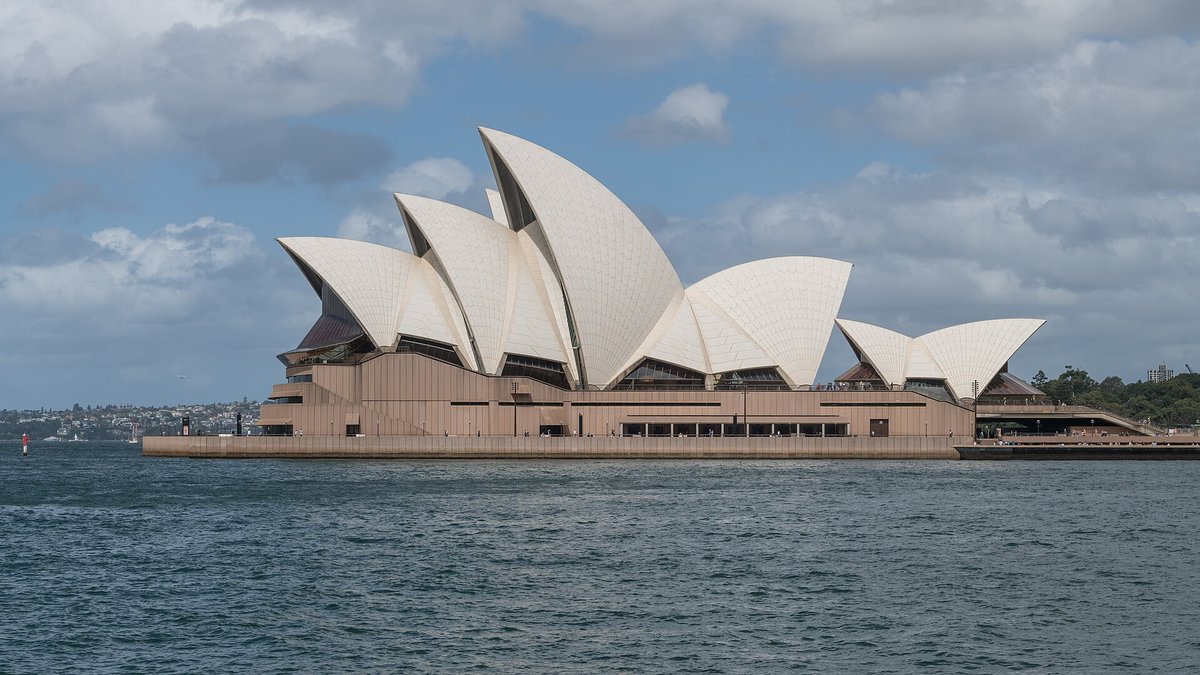

On October 20, 1973, Queen Elizabeth II officially opened the Sydney Opera House8 and told the crowd that "The Sydney Opera House has captured the imagination of the world, though I understand that its construction has not been totally without problems."7 Tuesday, October 20, 2026, marks 53 years since that day.
Design 218
On 15 February 1956, New South Wales Premier Joseph Cahill released an international competition for a National Opera House at Bennelong Point1, a site named for Woollarawarre Bennelong, a senior Eora man8. Entrants paid a 10 pound registration fee and worked from a 25 page brief that became known as the Brown Book. The judges, among them the architect Eero Saarinen1, began their work in January 1957.
On 29 January 1957, Cahill announced the winner, Design 218, by a 38 year old Dane from Hellebæk1 named Jørn Utzon, chosen from more than 220 entries. The judges admitted the design was controversial but said they were "absolutely convinced of its merits."1 The estimated cost was 3.5 million pounds1.
A site that fought back
Construction began in 19594, before key design questions were settled, because Cahill wanted the work under way. Bennelong Point turned out to be loose alluvial soil soaked with seawater rather than the sandstone everyone had assumed, and around 700 steel cased concrete shafts4 had to be bored to steady it. Nobody yet knew how much the roof would weigh, so its anchor points could not be properly designed. Stage One was finished in February 1963, about two years late4.
The spherical solution
Between 1958 and 19622, Utzon and his team tried parabolic, then ellipsoid, then spherical geometry for the shells. The engineers at Arup needed every curve defined mathematically, and because each shell in the early schemes was a different shape, formwork could not be reused, which pushed costs up.
The answer came in Utzon's office in Hellebæk. Stacking shell models, he noticed how alike they looked and realised every shell could be cut from a single, constant form, "such as the plane of a sphere."2 Shapes drawn from one sphere repeat, so parts could be prefabricated. Utzon set out the geometry in the Yellow Book, submitted in January 19622. The popular tale that he found it while peeling an orange is a myth, since the Opera House says Saarinen had used a grapefruit and an orange2 years earlier to explain the shells of his TWA building.
Costs climb and Utzon leaves
Roof construction began in 1963. By then the budget had already moved a long way, from an estimated 3.5 million pounds in 1959 to 13.7 million by mid 19623. A new coalition government took office in May 1965, and Public Works Minister Davis Hughes limited Utzon's payments to drawings only. Utzon needed money for plywood prototypes to finish the interiors, Hughes stopped the payments, and at a meeting on 28 February 19663 Utzon threatened to quit and walked out. Hughes announced that he had resigned. Utzon saw it differently. In the Opera House's own account, he was forced to resign, as he saw it, by circumstances involving1 the minister.
Sydney protested with a march of about 1,000 people and a petition with 3,000 signatures3, but the break held. A panel of Australian architects was appointed on 19 April 1966, and Utzon left Australia on 28 April 1966 and never returned3. The consortium of Hall, Todd and Littlemore5 took over the third and final stage, with Peter Hall as design architect. The last precast shell segment, number 2,194, went in on 17 January 19675, completing Stage Two.
The bill, and who paid it
In the NSW Treasury's words, "Originally budgeted at $7 million, the final cost of the Sydney Opera House was $102 million."9 The building came in 10 years late and 1,357 per cent over budget9. Construction was expected to take four years but took 148, with 10,000 workers involved. The Opera House Lottery ran from 1957 to 1986, and 496 lotteries and 86.7 million tickets raised $102 million9.
Opening day
Utzon was not in Sydney when the Queen opened the building, and for decades the story was that he had been snubbed. Museums of History NSW curator Scott Hill found a letter from Utzon to Premier Robert Askin showing that Utzon had politely declined an invitation to attend11, writing that it would be inappropriate because he was bound to criticise the decisions made after he left. Hill called it "extremely diplomatic."11
Reconciliation, a Pritzker and World Heritage
Utzon returned to the story in 1999, when he agreed to develop a set of guidelines6 for future changes to the building, and in September 2004 the Reception Hall reopened after his redesign and was renamed the Utzon Room6, with a 14 metre floor to ceiling woollen tapestry he designed. In 2003 he won the Pritzker Architecture Prize10, whose jury wrote, "There is no doubt that the Sydney Opera House is his masterpiece."10 On 28 June 20076, the Opera House was added to the UNESCO World Heritage List.
Visiting, as of October 17, 2026
Getting there. Circular Quay is served by buses, trains and ferries, and the Opera House is a six minute walk from it13 by one Opera House page and 7 to 10 minutes12 by another. Transport information is on 131 500. Cyclists must dismount at the site boundary, and bike parking is beneath the Monumental Steps13. The building draws more than 10.9 million visitors8 a year.
Taking the tour. The main Sydney Opera House Tour runs daily and lasts about an hour12, though it is not offered on 25 or 31 December 2026. It covers up to 2.5 km and about 300 stairs, with no lift and limited or no chance to sit and rest, so the step free Mobility Access Tour is the option for wheelchair and walker users. Tours start at the Welcome Centre on the Lower Concourse12. Book ahead, arrive 15 minutes early for check in, and know that arriving more than five minutes late forfeits the tour without a refund. Tours also run in French, German, Japanese, Korean, Mandarin and Spanish, and the venues you enter depend on availability.
Trivia
- How much prize money did Utzon receive for winning the competition? 5,000 pounds8.
- How many tiles cover the roof shells? 1,056,006, each 120mm square, developed by Höganäs of Sweden2.
- What was the first production in the opera hall, and when did its curtain rise? Prokofiev's War and Peace, by the Australian Opera, on 28 September 19737, more than three weeks before the official opening.
- Which bodybuilder won his final Mr Olympia title in the Concert Hall in 1980? Arnold Schwarzenegger7.
- At what temperature must the Concert Hall be kept when the Sydney Symphony Orchestra plays? 22.5 degrees8, to keep the instruments in tune.
- What helps cool the building? Seawater from the harbour, pumped through 35 kilometres of pipes8.
- Where was the 2003 Pritzker ceremony held? The Royal Academy of Fine Arts of San Fernando in Madrid, on May 20, 200310.
- What did Utzon bring to the start of construction, and where is it now? A bronze plaque, which Premier Cahill fixed in place where the axes of the two halls meet. It is still on the steps4.
Sources
- Jørn Utzon AC, Our story, Sydney Opera House. Accessed October 17, 2026.
- The spherical solution, Our story, Sydney Opera House. Accessed October 17, 2026.
- Utzon departs the House, Our story, Sydney Opera House. Accessed October 17, 2026.
- Construction begins, Our story, Sydney Opera House. Accessed October 17, 2026.
- Peter Hall and the completion of the Opera House, Our story, Sydney Opera House. Accessed October 17, 2026.
- Conserving and celebrating our heritage, Our story, Sydney Opera House. Accessed October 17, 2026.
- 50 years of extraordinary moments, Our story, Sydney Opera House. Accessed October 17, 2026.
- Interesting facts about Sydney Opera House, Sydney Opera House. Accessed October 17, 2026.
- 9. The House the Lotteries Built, Walking a Tightrope, NSW Treasury Bicentenary, NSW Government. Accessed October 17, 2026.
- Danish Architect Jørn Utzon Becomes 2003 Pritzker Architecture Prize Laureate, The Pritzker Architecture Prize. Accessed October 17, 2026.
- Ursula Malone, Sydney Opera House celebrates 50 years as one of the greatest masterpieces of the 20th century, ABC News, August 13, 2023, updated October 5, 2023. Accessed October 17, 2026.
- Sydney Opera House Tour, Sydney Opera House. Accessed October 17, 2026.
- Public transport, riding or walking, Getting here, Sydney Opera House. Accessed October 17, 2026.