Volvo Cars Loses SEK 5.6 Billion in the Third Quarter, Cuts 2,500 Jobs
Key Points
- Volvo Cars reported third quarter 2026 revenue of SEK 66.9 billion, down from SEK 86.4 billion, and an operating loss of SEK 5.6 billion, against a profit of SEK 6.4 billion a year earlier.
- The company announced about 2,500 job reductions worldwide, roughly 2,000 of them in Sweden, as part of a plan to cut an additional SEK 5 billion in costs.
- Volvo said its revenues in China fell by almost 50 percent year on year, and Reuters reported that its shares fell 24 percent on October 23 to a record low.

Volvo Cars published its results for July through September 2026 on Friday, October 231. Revenue fell to SEK 66.9 billion from SEK 86.4 billion a year earlier, and operating income swung to a loss of SEK 5.6 billion1, against a profit of SEK 6.4 billion in the third quarter of 2025. The same release announced about 2,500 job reductions worldwide, roughly 2,000 of them in Sweden1. In Stockholm, the shares fell 24 percent and hit a record low3, Reuters reported.
Two ways to count the loss
Headlines carried two different loss figures, and both come from the same report. The SEK 5.6 billion is reported operating income. Volvo Cars also gives EBIT excluding joint ventures, associates and items affecting comparability of minus SEK 3.7 billion, against SEK 5.8 billion a year earlier1, a measure that leaves out one-off items and its share of companies it only partly owns. Reuters used that second figure, describing a third-quarter operating loss of 3.7 billion Swedish crowns ($373 million)3, and noted that Citi analysts said consensus had expected a loss of 724 million crowns3.
The company's EBIT margin was minus 8.4 percent, down from 7.4 percent1, and basic earnings per share were minus SEK 1.63, against SEK 1.751. AFP put the net loss at 5.7 billion kronor, compared with a net profit of 4.5 billion kronor a year earlier4. Free cash flow, the cash left after running the business and paying for investment, was minus SEK 8.9 billion, against minus SEK 4.3 billion1 a year before.
Three items outside car sales added to the loss. Volvo Cars listed a negative revaluation of SEK 1.1 billion in CAFE credits due to legislation changes in the US1 (CAFE is the American fuel economy rule, and carmakers that beat it earn credits they can sell), negative raw material developments1 and a hit of SEK 0.9 billion from recognising the losses of Polestar1, the electric car brand in which it holds a stake.
China
The sharpest drop came in China, which Reuters called its key market3. The company said its revenues in China fell by almost 50 percent year on year1, which it put down to competition from Chinese brands and severe price pressure. Its sales release three weeks earlier had shown the volume side, with 20,284 cars sold in Greater China in the third quarter, down 40.6 percent2.
Reuters reported that the company will prioritise margins over market share rather than join a price war3 in China, and quoted the chief executive: “We should have maybe realised earlier that we need to be more regional in China.”3 The results release says Volvo expects the next two years in China to remain tough1 and plans six China-tailored cars, developed in closer cooperation with Geely1, with the first two revealed in mid-2027.
The United States and Europe
In the United States, the release cites continued negative effects from tariffs and the removal of consumer incentives for electrified cars1. Volvo's sales release reported 30,777 cars sold in the Americas in the quarter, down 14 percent2, a region that includes the United States. The company says it is fast-tracking plug-in hybrid versions of the XC90 and XC60 for American buyers, and that in Q1 2027, it will localise XC60 production in Charleston1, South Carolina.
Europe held up better. Sales in Europe and the rest of the world rose 2 percent to 90,548 cars2, and the company called the region resilient, with fully electric cars at 45 percent of its European sales in the quarter1. Worldwide, Volvo sold 141,609 cars, down 10.7 percent from 158,6152, and fully electric cars made up 32 percent of its sales, up from 22 percent1.
The cuts
The 2,500 jobs come on top of a programme Volvo Cars has already finished. The Wall Street Journal reported that the company completed a cost-saving plan last year that included 3,000 job cuts5, and put the new round at about 6 percent of the workforce5. AFP reported that Volvo Cars employs about 39,300 people worldwide, including 19,500 in Sweden4.
The release says the reductions will come through ended consultant contracts, natural attrition and targeted exit packages1, as part of a plan to cut an additional SEK 5 billion in indirect spend and variable costs1. It expects the full effect by the end of 2027, when indirect spend should be almost 25 percent lower than in 20241, and says investment levels are about 30 percent lower than in 20241.
In the release, the chief executive, Håkan Samuelsson, said that “in the short term, with severely challenged volumes, we need to reinforce our turnaround plan”1, and that the company would act by “lowering our break-even point and improving cash flows to make us more resilient”1.
Who owns Volvo Cars
The car business has been separate from its former parent, AB Volvo, since 19996, and its largest owner is Geely Holding6 of China. Reuters described Volvo as majority-owned by Geely Holding3, and noted that the company had already scrapped its full-year sales volume and cash flow guidance earlier in October 20263.
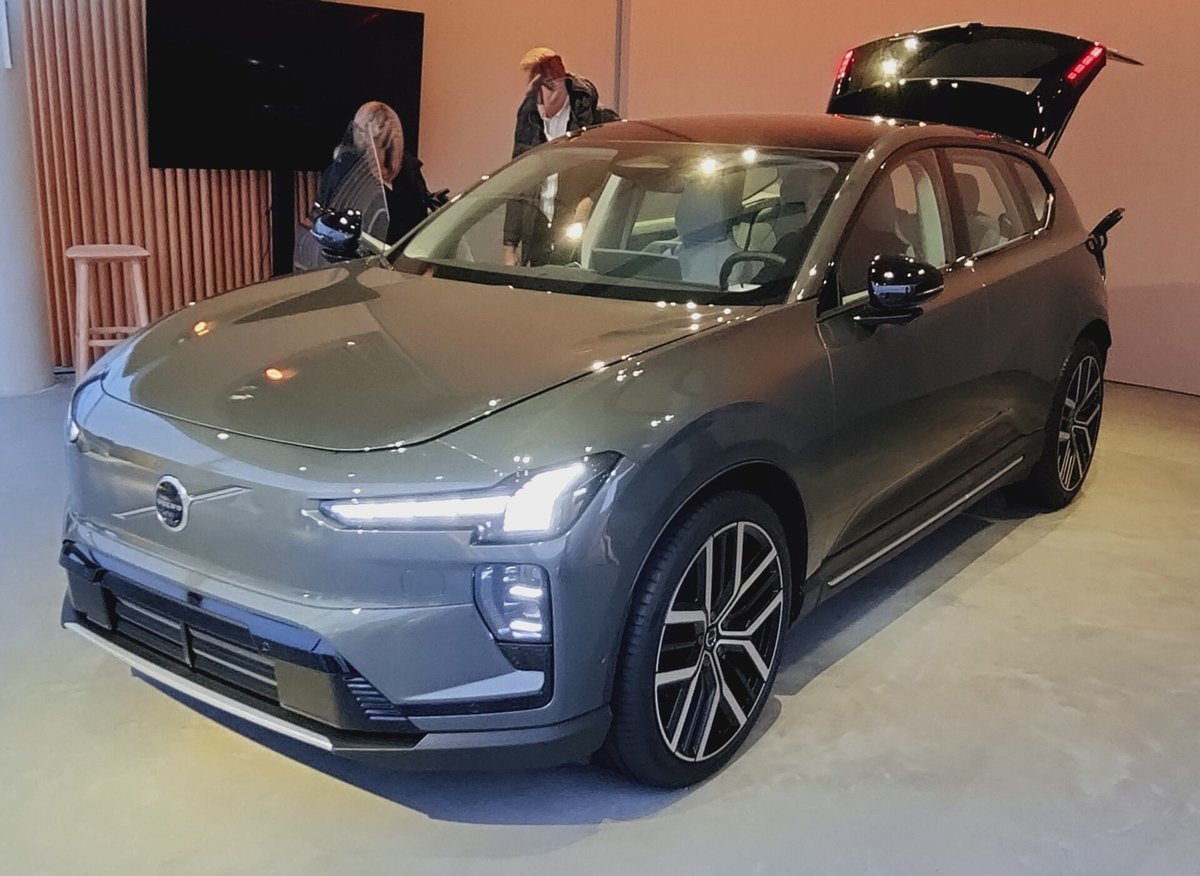
In 2021 Volvo Cars set out to sell only electric cars by 2030, and in 2024 it scrapped its goal of becoming fully electric by 20306. Its new EX60, the car in the photo above, has over 50,000 European orders1, but the company says it is taking longer than planned to ramp up production1. The release lists 13 new cars between now and the end of 20301, including three reveals in 2027.
Trivia
- When did the first Volvo car leave the assembly line, and what was it called? On 14 April 1927, and it was the Volvo ÖV 4, sometimes nicknamed “Jakob”6.
- What does the name Volvo mean? It is Latin for “I roll”6.
- Which company first registered the Volvo trademark, and when? SKF, the bearing maker, in 1915; the car company began as one of its subsidiaries6.
- Which safety device, invented by Volvo engineer Nils Bohlin, did Volvo begin fitting as standard in 1959? The modern three-point safety belt, a design whose patent Volvo made open for other carmakers to use6.
- From which carmaker did Geely buy Volvo Cars, and when was the deal signed? Ford, in March 20106.
- On which stock exchange were Volvo Cars shares listed in October 2021? Nasdaq Stockholm, where about 18 percent of the shares were listed6.
- In which Gothenburg district is Volvo Cars headquartered? Torslanda6.
Sources
- Volvo Cars, third quarter 2026 results press release, 23 October 2026. Accessed October 24, 2026.
- Volvo Cars, “Volvo Cars reports Q3 2026 sales”, press release, 2 October 2026. Accessed October 24, 2026.
- Marie Mannes, “Volvo Cars shares slump on big loss, 2,500 more jobs to go”, Reuters via Euronext, 23 October 2026. Accessed October 24, 2026.
- AFP, “Volvo Cars shares plunge on losses, job cuts”, France 24, 23 October 2026. Accessed October 24, 2026.
- Dominic Chopping, “Volvo Car Shares Plunge as Automaker Slashes More Jobs”, The Wall Street Journal via Yahoo Finance, 23 October 2026. Accessed October 24, 2026.
- “Volvo Cars”, Wikipedia. Accessed October 24, 2026.