How Well Do You Know the Stock Market?
Published .

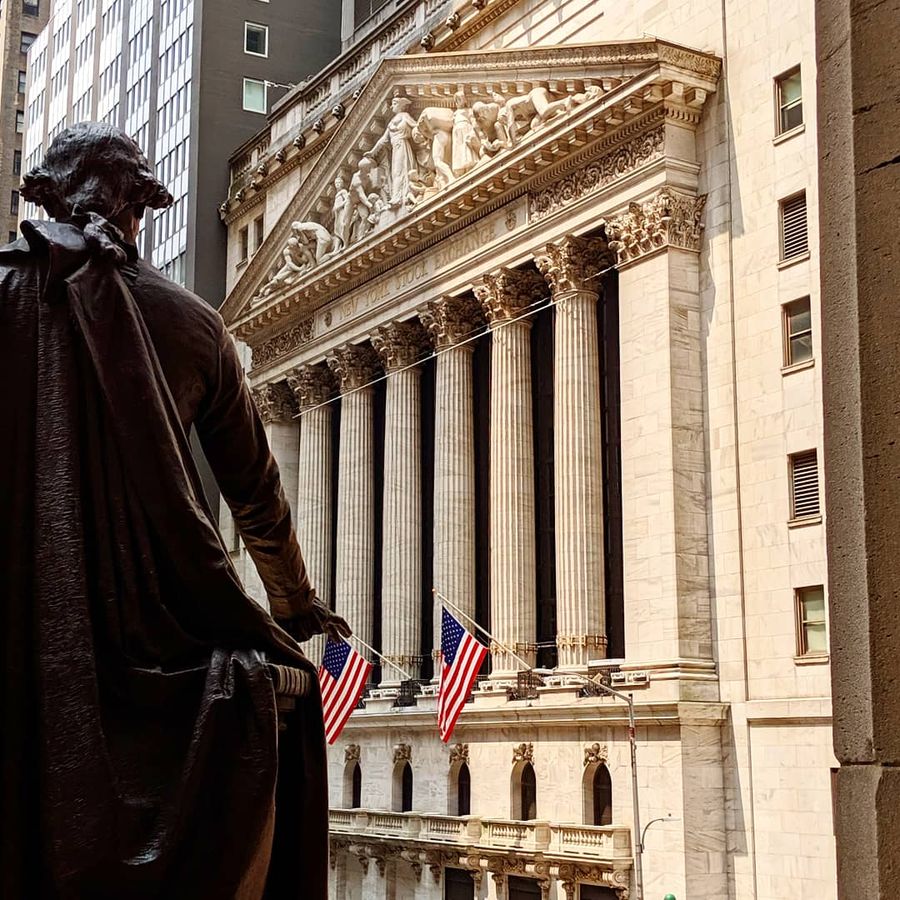
The columned facade of the New York Stock Exchange building, with a sculpted pediment and two American flags on poles, seen past the back of a bronze statue of George Washington in the foreground.
The New York Stock Exchange, seen from Federal Hall, June 2019. Photo: M.M.Dwyer, CC BY-SA 4.0, via Wikimedia Commons, resized, photo source.

Twelve questions on the stock market's history, its famous crash days and the vocabulary you hear on the evening news. Expect a few gimmes, a few stumpers, and at least one surprising fact about a penny.

Scoring runs in your browser with JavaScript, which is turned off here or did not load. Every answer and its explanation is still on this page, under Answer after each question.

How many stockbrokers signed the Buttonwood Agreement of May 17, 1792, the pact the New York Stock Exchange traces its roots to?
Answer

24. Twenty-four stockbrokers signed it, and the New York Stock Exchange counts that agreement as its official founding.1

October 29, 1929, the day the market dropped nearly 12 percent, is remembered by what name?
Answer

Black Tuesday. That was Black Tuesday, which followed a Black Monday drop of nearly 13 percent. By mid-November the Dow had lost almost half its value.2

On Black Monday, October 19, 1987, how far did the Dow Jones Industrial Average fall in that single day?
Answer

22.6 percent. It finished down 508 points, or 22.6 percent, which the Federal Reserve's history site calls the largest one-day stock market decline in history.3

The Federal Reserve's Federal Open Market Committee (FOMC) sets a target range for which interest rate?
Answer

The federal funds rate. The committee sets a target range for the federal funds rate, the overnight rate at which banks and other depository institutions lend reserve balances to each other.4, 13

A Level 1 market-wide circuit breaker is triggered by a single-day drop of how much in the S&P 500?
Answer

7 percent. Level 1 is a 7 percent drop, followed by Level 2 at 13 percent and Level 3 at 20 percent. A Level 1 or 2 drop before 3:25 p.m. halts trading for 15 minutes, while Level 3 ends trading for the day.18, 5, 14

An institutional investment manager has to file a quarterly Form 13F with the SEC once the Section 13(f) securities it has investment discretion over reach at least what value?
Answer

$100 million. The line is $100 million, tested on the last trading day of any month in a calendar year. Each report is due within 45 days after the quarter it covers ends, so the holdings it shows can be about six weeks old by the time it is filed.6, 15

You own 100 shares of a stock trading at $100, and the company declares a two-for-one split. Right afterward, what do you hold?
Answer

200 shares at $50 each. You'd have twice the shares at half the price. A split changes the slicing, not the size of the pie, so your total value stays the same.7

A stock's P/E ratio is its current price divided by what?
Answer

Its earnings per share. P/E is price over earnings per share. Put simply, it shows how much investors are paying for each dollar of a company's earnings.8

The Dow Jones Industrial Average weights its companies by what?
Answer

Share price. The Dow is price-weighted, so a stock with a higher share price counts for more, whatever the company's overall size. It was first published in 1896 with 12 companies and now has 30.16, 9

During the May 6, 2010 flash crash, some trades went off at prices as extreme as what?
Answer

A penny or less, or as high as $100,000. Some trades printed at a penny or less and others at $100,000 before prices returned to their pre-crash levels. Over 20,000 trades in more than 300 securities went off more than 60 percent away from their values just moments before.10

What sets an exchange-traded fund (ETF) apart from a traditional mutual fund?
Answer

Its shares trade on an exchange throughout the day. ETF shares are listed on an exchange and trade like stocks, at prices that move during the trading day. Like mutual funds, they're pooled products.11, 17

When a company goes public, it usually does so through an IPO. What does IPO stand for?
Answer

Initial Public Offering. It's an initial public offering, when a company sells shares of stock to the public. For a standard IPO, the Securities Act requires a registration statement filed with the SEC before the shares are offered.12

Market Watch reports what happened and what was reported about it. It is not investment advice, and nothing here is a recommendation to buy, sell or hold any security.

Sources

  1. NYSE, History of NYSE. Accessed October 16, 2026.
  2. Federal Reserve History, Stock Market Crash of 1929. Accessed October 16, 2026.
  3. Federal Reserve History, Stock Market Crash of 1987. Accessed October 16, 2026.
  4. Board of Governors of the Federal Reserve System, Open Market Operations. Accessed October 16, 2026.
  5. U.S. Securities and Exchange Commission, Investor Bulletin: New Measures to Address Market Volatility. Accessed October 16, 2026.
  6. U.S. Securities and Exchange Commission, Frequently Asked Questions About Form 13F. Accessed October 16, 2026.
  7. U.S. Securities and Exchange Commission, Stock Splits. Accessed October 16, 2026.
  8. FINRA, Evaluating Stocks. Accessed October 16, 2026.
  9. JPMorgan Chase, The Dow Jones Industrial Average (DJIA). Accessed October 16, 2026.
  10. CFTC and SEC staffs, Findings Regarding the Market Events of May 6, 2010, September 30, 2010. Accessed October 16, 2026.
  11. FINRA, Exchange-Traded Funds and Products. Accessed October 16, 2026.
  12. U.S. Securities and Exchange Commission, Going Public. Accessed October 16, 2026.
  13. Federal Reserve Bank of New York, Effective Federal Funds Rate. Accessed October 16, 2026.
  14. New York Stock Exchange, Trading Information. Accessed October 16, 2026.
  15. 17 CFR 240.13f-1, Reporting by institutional investment managers, via Cornell Law School Legal Information Institute. Accessed October 16, 2026.
  16. SPDR Dow Jones Industrial Average ETF Trust, Prospectus (Form 497), filed with the SEC, February 2025. Accessed October 16, 2026.
  17. U.S. Securities and Exchange Commission, Investor.gov, Mutual Funds and Exchange-Traded Funds (ETFs). Accessed October 16, 2026.
  18. U.S. Securities and Exchange Commission, Investor.gov, Stock Market Circuit Breakers. Accessed October 16, 2026.