Agios Efstratios, the Greek Island Running Mostly on Wind and Sun
Key Points
- On 8 July 2026 HEDNO said renewable penetration on Agios Efstratios "reached up to 98% on a monthly basis" in March, April and May 2026.
- Euronews reported on 12 October 2026 that renewables covered 91% of the island's electricity demand and 85% of its heating demand in the first ten months.
- The hybrid system pairs a 900 kW wind turbine and a 225 kW solar farm with batteries, an electric boiler and district heating.
- Before the project, the head of CRES told Euronews, "100% of electricity was produced from diesel, using diesel engines", at about three or four times the mainland cost per kilowatt hour.
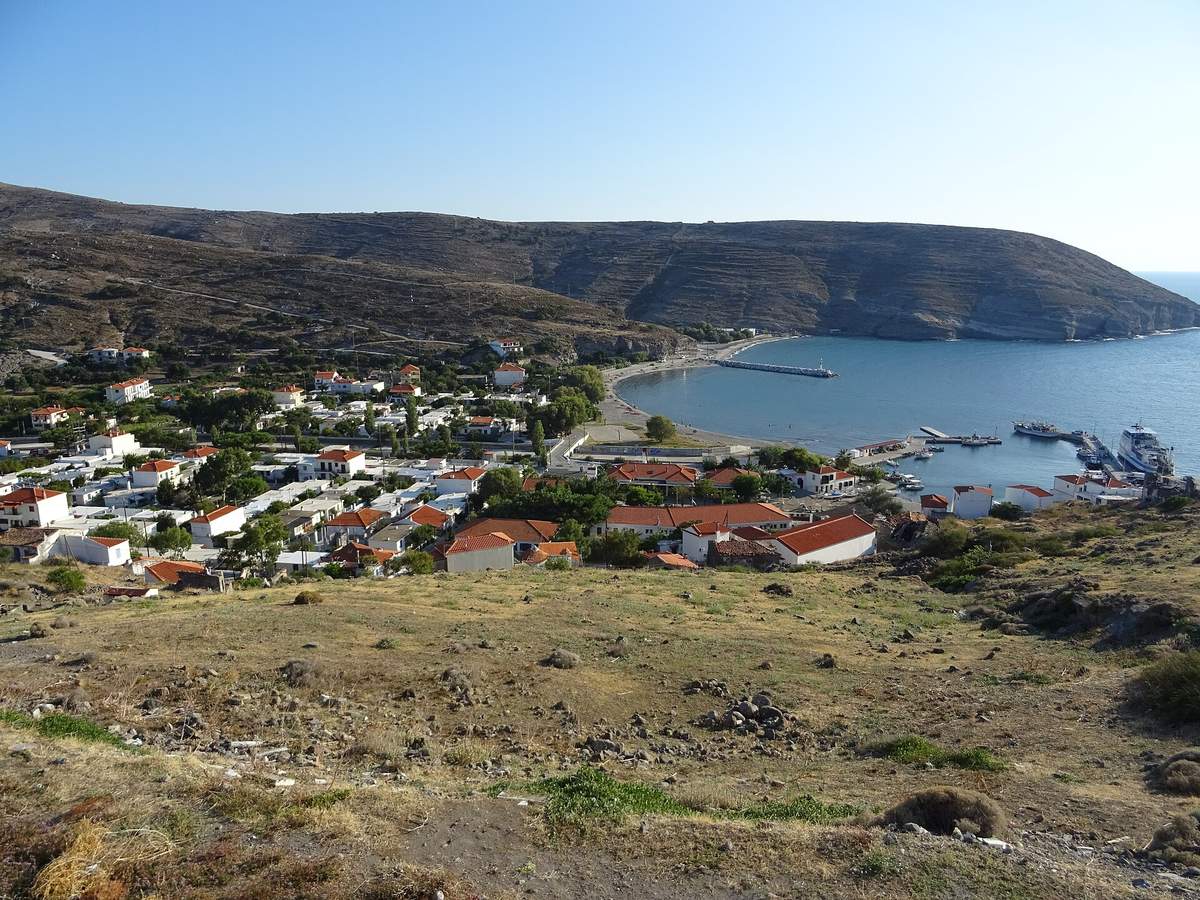

A small volcanic island in the north-eastern Aegean now makes most of its electricity from wind and sun. Agios Efstratios, also called Ai Stratis, has about 250 residents, and on 12 October 2026 Euronews reported that it went from total dependence on fossil fuels to producing over 90% of its electricity from renewables1 in ten months. Three months earlier, on 8 July 2026, the island's grid operator said renewable penetration had reached up to 98% on a monthly basis3 during March, April and May 2026.
The two numbers measure different things. The 98% is the best monthly result of the spring, published by the Hellenic Electricity Distribution Network Operator (HEDNO). The 91% that Euronews gives is the share of electricity demand covered over the first ten months2, against a target of 85%.
An island with no cable to the mainland
HEDNO defines Greece's non-interconnected islands as those whose network is not connected to the Transmission System5 or to the mainland's distribution network, and it manages the electricity systems of all of them. A HEDNO presentation from May 2025 counted 28 electrical systems6 of this kind, with Ai Stratis among the 16 small ones, each with a peak demand of up to 5 MW. Across those systems, the same presentation listed 30 thermal power plants with a total capacity of about 1 GW, against roughly 170 MW of renewable installations.
Without a cable, every kilowatt-hour has to be made on the island itself. Before the project, Ai Stratis produced 100% of its electricity with diesel engines2, and the cost per kilowatt-hour was about three or four times the mainland's, according to Euronews. Residents mostly heated their homes with heating-oil boilers8, Balkan Green Energy News reported in 2020. Many non-interconnected islands cannot meet their power demand in the tourist season. Some also struggle with water supply, which calls for desalination, and desalination needs electricity. These islands rely on fuel oil generators7.
What was built
The project, called Ai Stratis Green Island, was led by the Centre for Renewable Energy Sources and Saving (CRES) on behalf of the island's municipality, with Terna Energy as the contractor7. Its core is a hybrid system of a 900 kW wind turbine, a 225 kW solar farm, a battery system1 and automated real-time energy management. HEDNO's project page gives the solar park as 226.8 kW4 and the storage as 1,280 kW and 2,560 kWh. Balkan Green Energy News describes the battery as a Tesla Megapack rated 1.25 MW with two-hour duration7, or 2.5 MWh, and puts the combined annual output of the wind and solar units above 3 GWh.
Heat is the other half of the design. When the island produces more renewable power than it needs, the surplus runs a 1 MW electric boiler7 that heats water held in storage tanks, and a district heating network of about 4 km carries it to homes. Terna Energy says the heat was designed to cover heating and hot water needs across the whole residential area9. Its control system can run the hybrid station alone, run it together with the local power station, or leave the local station to run by itself.
HEDNO wrote the automated operating procedures and control algorithms that hand the island between the old thermal station and the hybrid one. Commissioning tests commenced in July 20253, and commercial operation began in November 2025. An earlier trial, on a Saturday in October 2024, ran the island on green power alone for 2.5 hours10, The Greek Herald reported.
Results after the first year
Renewables were to cover 85% of electricity needs and 75% of heating needs2. Over the first ten months, Euronews reported, they covered 91% of electricity demand and 85% of heating demand. The project avoids about 1,000 tonnes of CO₂ emissions per year1, the same report said.
The chairman and chief executive of CRES told Euronews that total production costs had fallen to levels almost equal to those on the mainland2. Generation costs are now steady and predictable, he said, so islanders no longer have to follow oil markets or the Strait of Hormuz1. Oil has not disappeared. On rare stretches of low wind and cloud the island still needs diesel, and the goal is to keep it to less than 10%2 over the year. An oil-fired generator run by Public Power Corp. can operate alongside the hybrid plant7.
A long road to the switch
The European Commission's Clean Energy for EU Islands secretariat says the project was initiated in 201111 and was relaunched in 2020 under Greece's National Strategic Reference Framework for 2014 to 2020. In October 2020 Balkan Green Energy News reported a budget of EUR 7.7 million8 (about US$8.6 million) and a 12-year operation and maintenance contract for Terna. Euronews gives the total budget as €7.23 million1 (about US$8.07 million), 85% from EU Cohesion Policy and 15% from Greek national funds. Both conversions use the European Central Bank reference rate of US$1.1165 per euro13 on 6 November 2026.
After the Asia Minor Catastrophe the island became a place of exile, and To Vima reports that from 1928 to 1963 thousands were exiled there12, at times more than twice the local population. On 20 February 1968 an earthquake of magnitude 7.1 struck just south of the island12 and, To Vima reports, killed 20 people. To Vima puts the injured at 39 and Euronews at about 401, and Euronews says the quake destroyed most of the old town.
Other islands on the same path
On Tilos, part of the Kos-Kalymnos system, a hybrid station with an 800 kW wind turbine and 160 kWp of solar6 has run since October 2019, according to HEDNO's 2025 presentation. Ikaria combines wind with two small hydro stations and water reservoirs, and the same presentation described an Astypalea pilot built around about 3 MWp of solar and 7.2 MWh of batteries, with electric vehicles as flexible loads. Euronews names Tilos, Ikaria and Astypalea1 as islands following Ai Stratis.
For larger islands the answer is often a cable. Greece's transmission operator has linked Syros, Paros and Mykonos7 to the mainland and plans subsea links to the Dodecanese and the North Aegean. The government has also launched an Islands Decarbonization Fund with European Investment Bank financing, and together they aim to provide at least EUR 1.6 billion7 (about US$1.79 billion at the same ECB rate). The head of CRES told Euronews that decarbonising electricity across Greece is achievable within ten years2 if storage is added while renewables keep their current pace.
Trivia
- How tall is the wind turbine on Agios Efstratios? 77 metres1, according to Euronews, and it weighs close to 30 tonnes and stands on the island's highest point.
- Which manufacturer and model is the turbine? An Enercon E447.
- How hot is the water kept in the island's heat storage tanks? 120°C7, Balkan Green Energy News reports, in tanks holding 500 cubic metres, equal to about 25 MWh of heat.
- How often does HEDNO's dispatch program recalculate the island's generation? Every 20 minutes3, based on demand and operating conditions.
- Which landmark on the hill above the bay predates the 1968 earthquake? The circular cemetery1, Kiklikó Koimitírio.
- What kind of batteries does the Tilos hybrid station use? Sodium nickel chloride (NaNiCl2)6 batteries, with 2.4 MWh of storage in HEDNO's 2025 listing.
- Which island does HEDNO's 2025 presentation class as its one small interconnected island? Crete6, with peak demand of at least 650 MW.
- What European conservation status does Ai Stratis hold? It is a Natura 2000 protected area8.
Sources
- Aurora Velez, Agios Efstratios: the first Greek island to get all its electricity from renewables, Euronews, 12 October 2026. Accessed November 7, 2026.
- Aurora Velez, On Agios Efstratios, each kilowatt-hour of electricity is cheaper thanks to renewable energy, Euronews, 12 October 2026. Accessed November 7, 2026.
- HEDNO, Agios Efstratios: Greece's flagship green island achieves up to 98% Renewable Energy Penetration, press release, 8 July 2026. Accessed November 7, 2026.
- HEDNO, Hybrid energy project of Ai Stratis: Ai Stratis Green Island (pilot project page). Accessed November 7, 2026.
- HEDNO, HEDNO S.A. as NII Operator. Accessed November 7, 2026.
- HEDNO Islands Network Operation Department, Non-Interconnected Islands, presentation, 15 May 2025. Accessed November 7, 2026.
- Igor Todorović, Agios Efstratios becomes Greece's first energy-autonomous island, Balkan Green Energy News, 22 August 2025. Accessed November 7, 2026.
- Igor Todorović, Terna hires Tesla, Schneider Electric for its green energy island project, Balkan Green Energy News, 23 October 2020. Accessed November 7, 2026.
- Terna Energy, Ai Stratis: the first energy-independent island of Greece. Accessed November 7, 2026.
- The Greek Herald, Agios Efstratios becomes Greece's first fully green, energy-autonomous island, 25 October 2024. Accessed November 7, 2026.
- Clean energy for EU islands secretariat, European Commission, R and D policies: Ai Stratis Green Island. Accessed November 7, 2026.
- Yannis T. Diamantis, The Day a Small Greek Island Fell Silent, To Vima, 20 February 2025. Accessed November 7, 2026.
- European Central Bank, Euro foreign exchange reference rates: US dollar (USD). Accessed November 7, 2026.