Antarctic Blue Whales Now Number About 4,018, Study Estimates
Key Points
- A population assessment in Endangered Species Research estimates there were 4,018 Antarctic blue whales in 2024 (95% credible interval 1,874 to 8,395).
- The same model puts the population at 418 after the last reported catch in 1973, with an intrinsic rate of increase of 4.5% a year.
- The 2024 estimate is 1.9% of pre-whaling levels; the model puts the pre-whaling population at 205,905.
- The paper's title describes the subspecies as Critically Endangered, and the new estimate is 1.9% of the pre-whaling population.
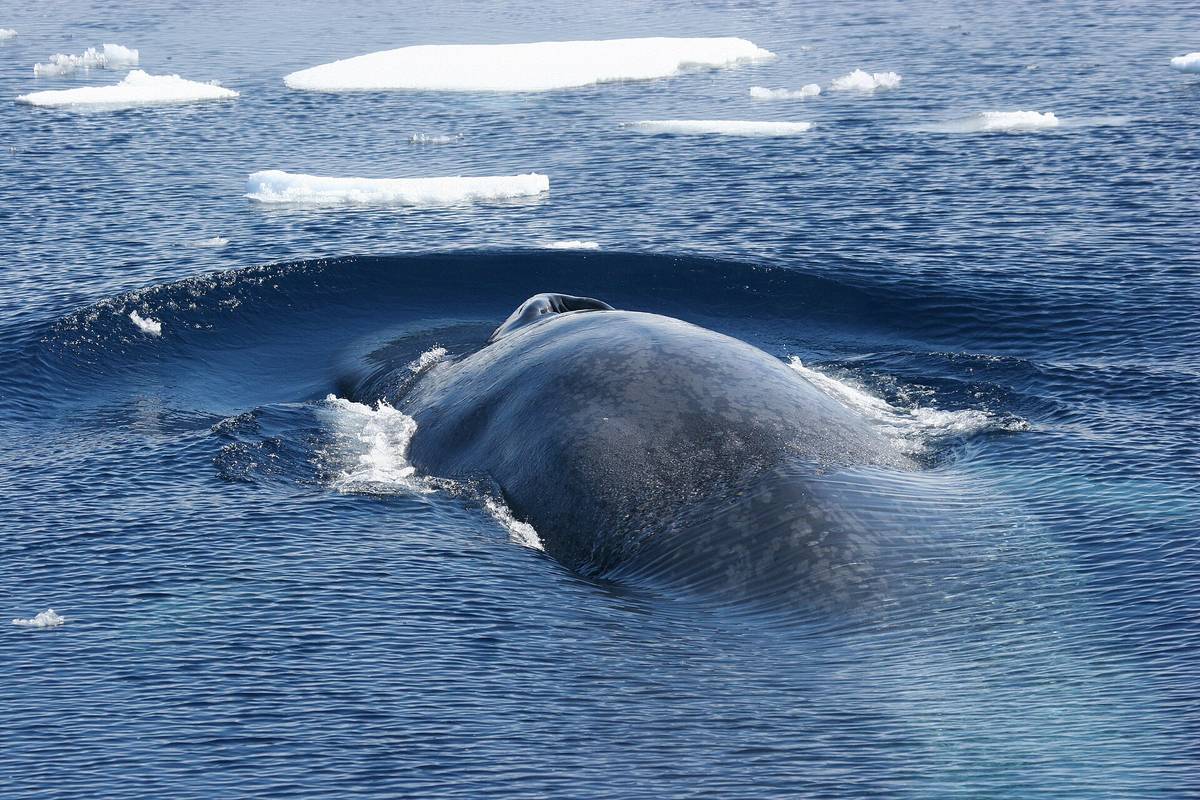

The biggest blue whales on the planet are slowly coming back. A population assessment in Endangered Species Research estimates that there were 4,018 Antarctic blue whales in 20241, up from about 418 after the last reported catch in 1973. That figure is 1.9% of the number that lived in the Southern Ocean before commercial whaling began, which is why the paper's title describes them as increasing "but still far from pre-whaling levels."
The paper is by Zoe R. Rand of the University of Washington and seven co-authors from the University of Washington, the US National Oceanic and Atmospheric Administration, the Australian Marine Mammal Centre, Japan's Institute of Cetacean Research and the University of Pretoria. The authors call it the first population assessment in over 20 years1 for this whale.
The largest of the blue whales
The Antarctic blue whale, Balaenoptera musculus intermedia, is one of several blue whale subspecies. According to NOAA Fisheries, Antarctic blue whales are generally larger than other blue whale subspecies4. In the North Atlantic and North Pacific, blue whales grow to about 90 feet, while in the Antarctic they can reach about 110 feet and weigh more than 330,000 pounds.
Their size made them valuable to whalers. The paper counts a total catch of 347,662 Antarctic blue whales from 1904 to 19731, with harvest rates between 10 and 40% of the population in many years, well above sustainable levels. According to the University of Washington's release, whaling reduced the population by 99.8%2.
Protection came in stages. The paper dates the International Whaling Commission's moratorium on the commercial catch of Antarctic blue whales1 to 1963 and the end of illegal Soviet catches of the whales to 1973. The University of Washington release dates the ban to 1964. "No whale was hunted quite to the extent that Antarctic blue whales were hunted," Rand, a postdoctoral scholar in the University of Washington School of Marine and Environmental Affairs, said in the university's release2.
The numbers in the new assessment
The team used a Bayesian population model that runs from 1904 to 2024. It starts from the historical catch records and is fitted to abundance estimates from ship-based line-transect surveys and to a capture-recapture estimate built from photo identification. The abstract gives the central figures1, each with a 95% credible interval.
- Pre-whaling population (the model's carrying capacity): 205,905 (168,473 to 276,342).
- Population after the last reported catch in 1973: 418 (147 to 1,099), or 0.20% of pre-whaling levels.
- Population in 2024: 4,018 (1,874 to 8,395), or 1.9% (0.7 to 4.8%) of pre-whaling levels.
- Intrinsic rate of increase: 4.5% a year (1.6 to 7.3%).
The ranges are wide, and the authors say why. The 2024 figure is largely driven by the photo-ID abundance estimate1, and they list several reasons the counts behind the model may run low, such as whales on a survey line that observers never see because they are underwater. Those biases, they write, mean the current size and the growth rate may be underestimated, without changing the overall conclusion.
The growth rate is lower than in the last published assessment, from 2004, which estimated an increase of 7.3% a year1 and put the population in 1996 at less than 1% of pre-exploitation levels. The paper attributes the difference to revised Japanese survey estimates and the new photo identification estimate. The university quotes Rand on the pace of recovery2: "I think this is relatively realistic for the kind of population growth we would expect from them."
How do you count a whale that spends little time at the surface?
Antarctic blue whales are large enough to be seen from space, the University of Washington release notes, but they spend limited time on the surface2. In a line-transect survey a ship travels a straight line and records each sighting and its distance from the vessel, from which density and then abundance can be calculated. The International Whaling Commission surveyed the whole Southern Ocean in three sets of expeditions, from 1978 to 1984, 1985 to 1991 and 1991 to 2004, and few such surveys have been completed since.
Photo identification relies on the mottled pattern on each whale's skin, which can be used to identify individuals4. When the same whale is photographed again in a later year, the record of first sightings and resightings can be turned into a population estimate. The new paper's photo catalogue covers 2003 to 20191 and gave a circumpolar estimate of 2,889 whales south of 60 degrees south for the 2018/2019 season.
Both methods have limits. The authors write that line-transect surveys for Antarctic blue whales have largely ceased or are limited to small regions1, that photo identification has not had consistent coverage across the Southern Ocean, and that simulations suggest mark-recapture work needs more than 12 years of effort to give a reliable count. Passive acoustic monitoring, which listens for the whales' calls, already helps survey ships find them. Turning calls into a head count, though, still depends on linking call rates to whale numbers.
Why the slow pace matters
Blue whales do not breed fast. The university release notes that Antarctic blue whales give birth to just one calf at a time2, and only every two to three years. If the population keeps growing on the model's path, the paper projects that it would reach 60% of pre-whaling abundance only by 21021, a timeline the authors caution depends on an uncertain estimate of the original population.
Other whale populations have done better. The paper lists eastern North Pacific blue whales, eastern North Pacific gray whales, North Pacific humpback whales and some Southern Hemisphere humpback populations among exploited cetacean populations1 that have returned to or exceeded their pre-whaling levels in the past decade, while noting that most of them were not as heavily depleted. For the California blue whales, a University of Washington analysis in 2014 put the population at about 2,2005, likely 97 percent of its historical level.
The paper also raises the possibility that a full return may be out of reach. Antarctic krill, the whales' main prey, faces pressure from a krill fishery projected to grow, from warming and sea ice loss, and from competition with humpback, Antarctic minke and fin whales, which feed on the same krill and may be returning to pre-whaling levels faster1. Other threats named in the paper include ship strikes and noise from human activity.
Still Critically Endangered
The paper's title describes the subspecies as Critically Endangered1. The International Whaling Commission's species page puts the Antarctic blue whale at still less than 1% of its original pre-whaling size3. The new estimate of 1.9% is above that figure.
"I think it's probably an open question whether they will make it back to pre-whaling levels," Rand said in the release2, adding: "We really need more monitoring and continued monitoring to figure out what is going to happen to this species in the future." The paper calls for additional line-transect surveys, passive acoustic monitoring, and increased photo-ID effort1 to keep track of the population as it grows.
Trivia
- According to the International Whaling Commission, how long was the largest blue whale ever recorded? 33 m3.
- Which blue whale subspecies is smaller and generally restricted to the Southern Hemisphere, including the Indian Ocean? The pygmy blue whale3, B. m. brevicauda.
- What is the only known natural predator of blue whales? The killer whale3.
- What is the name of the song type that Antarctic blue whales share across the Southern Ocean? The Z-call1.
- How much krill can some of the biggest blue whales eat in a day, according to NOAA Fisheries? Up to 6 tons4.
- About how many California blue whales were caught between 1905 and 1971? Approximately 3,4005.
Sources
- Zoe R. Rand, Paula A. Olson, Douglas Kinzey, Michael C. Double, Brian S. Miller, Koji Matsuoka, Ken Findlay and Trevor A. Branch, Critically Endangered Antarctic blue whales are increasing but still far from pre-whaling levels, Endangered Species Research 61:esr01557, 2026, doi:10.3354/esr01557. Accessed November 8, 2026.
- University of Washington, As Antarctic blue whales advance along the road to recovery, continued oversight is key, UW News, 5 November 2026. Accessed November 8, 2026.
- International Whaling Commission, Blue whale, IWC species page. Accessed November 8, 2026.
- NOAA Fisheries, Blue Whale, species page. Accessed November 8, 2026.
- University of Washington, California blue whales rebound from whaling; first of their kin to do so, UW News, 5 September 2014. Accessed November 8, 2026.