Apollo 12: Struck by Lightning Twice on 14 November 1969
Key Points
- Apollo 12 launched at 11:22 a.m. EST on 14 November 1969 into a rainstorm, and the rocket was hit by lightning twice, the second time at 52 seconds.
- The first strike disconnected the spacecraft's three fuel cells, and the second sent the guidance platform tumbling.
- Flight controller John Aaron's call to switch the SCE to Auxiliary, a switch Bean flipped, made the data in Mission Control make sense again.
- Conrad and Bean landed in the Ocean of Storms close to Surveyor 3 and removed its camera and scoop to bring back to Earth.
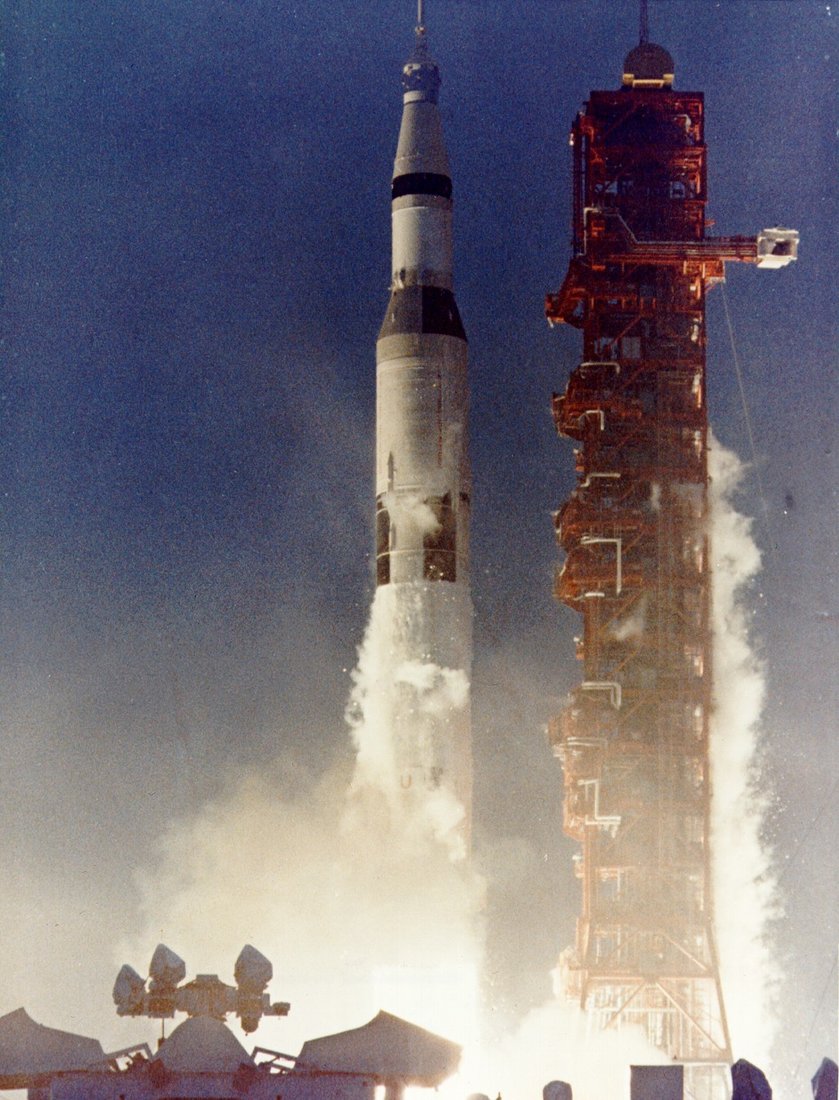

Apollo 12 left Pad A of Launch Complex 39 at the Kennedy Space Center at 11:22 a.m. EST on 14 November 19694, carrying Charles "Pete" Conrad Jr., Richard F. Gordon Jr. and Alan L. Bean toward the second crewed landing on the Moon. NASA's history office describes the Saturn V launching into a dark and rainy sky1. Less than a minute later the rocket had been hit by lightning twice, and NASA's history office credits one flight controller's quick action1 with saving the launch. The 57th anniversary falls on Saturday, 14 November 2026.
A launch in the rain
The weather was a known problem on launch morning. The Apollo 12 Flight Journal records that with a front approaching, the launch team decided at T minus 30 minutes to continue this countdown at least down to the 10-minute mark2 and look again. NASA's statistical reference on the Apollo flights says Apollo 12 became the first Saturn vehicle launched during a rainstorm3, after a launch rule on weather, Rule 1-404, was waived.
Two strikes in 52 seconds
At 22 seconds, the Flight Journal2 shows, Conrad radioed, "It's a lovely liftoff. It's not bad at all."1 NASA's history office says the flight proceeded normally for the first 36 seconds1. Then, with the rocket at about 6,600 feet (another NASA page says about 6,000) and flying through clouds, NASA's history article says observers on the ground noted lightning striking the launch pad1, and the crew saw a bright flash. NASA's science site puts that first strike 36.5 seconds after liftoff7. NASA's statistical reference concludes that the first discharge was triggered by the vehicle3, and that the second may have been a lesser one.
Inside the Command Module, the electrical system lurched. The Flight Journal explains that the discharge caused the spacecraft's three fuel cells to be disconnected from the power buses2, leaving the 75 amps the spacecraft was drawing to come from its main batteries. Nine sensors were knocked out for good. Gordon asked what had just happened. Conrad's words, as the journal records them, were we had everything in the world drop out2.
A second strike came at 52 seconds. This one, NASA's history article says, caused the spacecraft guidance navigation system to go offline1. The guidance platform, the reference that tells the spacecraft which way it is pointing, lost its alignment and began to tumble, and the Flight Journal has Conrad reporting a few seconds later that he had just lost the platform2.
SCE to AUX
In Mission Control in Houston, the spacecraft data on the consoles turned into nonsense. Watching the spacecraft's systems through both strikes was a young engineer named John W. Aaron1. He reasoned that the spacecraft's Signal Conditioning Equipment (the Flight Journal calls it Signal Conditioning Electronics), which handles the sensor readings sent to the ground, must have suffered some unknown upset1.
Aaron had seen something like it before. In a 2000 oral history quoted in the Flight Journal, he recalled being on the third shift one night watching a test of the Command Module2 at Kennedy, when power was dropped to battery and the readings came back as odd numbers instead of zeros. The next morning he went through the circuitry with an engineer from North American Aviation to work out why. At 1 minute 36 seconds into the flight, capsule communicator Jerry Carr passed up the fix: "Try SCE to Auxiliary."2 Conrad's first reply was "Try FCE to Auxiliary,"2 and Carr repeated the call. About 14 seconds after the first one, the onboard recorder caught Conrad saying "SCE to Aux."
It was Bean who found it. NASA's history article says he flipped a seldom-used switch from its Normal to its Auxiliary position1, and, as the Flight Journal puts it, the data on the controllers' screens starts to make sense again2. The journal quotes Aaron's own account of the moment, that he recognized a pattern and how to get out of it2. At 3 minutes 17 seconds, Conrad radioed Houston, "I think we need to do a little more all-weather testing."1 Carr then asked the crew to reset the fuel cells, and by 3 minutes 46 seconds Conrad reported all fuel cells reset and every bus back on line, according to the Flight Journal2.
In the technical debrief after the flight, Conrad said, "I never considered any kind of an abort."2 The third stage shut down at 11 minutes 33 seconds, and the journal gives orbital insertion about ten seconds later. With the systems confirmed working, the crew got the go for the burn toward the Moon.
A pinpoint landing
Conrad and Bean set the Lunar Module down in the Ocean of Storms at 1:54:35 a.m. EST on 19 November 19694. The target sat beside Surveyor 3, an uncrewed NASA probe that had landed there two and a half years earlier, and NASA's history article says the lander came down only 538 feet from Surveyor 31, just northwest of the crater that holds it. (NASA's statistical reference gives 535 feet3.) NASA's mission page calls Apollo 12 "The Pinpoint Mission."5
Conrad stepped off the ladder with a nod to Neil Armstrong's line four months earlier, and to his own short stature: "Whoopie! Man, that may have been a small one for Neil, but that's a long one for me."1 The crew made two moonwalks. The first lasted 3 hours 56 minutes 3 seconds3 and included setting up the Apollo Lunar Surface Experiment Package, a set of science instruments left on the Moon. The second lasted 3 hours 49 minutes 15 seconds, and over both the two astronauts covered about 7,600 feet, according to the NASA reference3.
Visiting Surveyor 3
The second moonwalk took Conrad and Bean down into Surveyor Crater, which NASA's history office puts at about 600 feet wide. They photographed the old probe from every side and found its trenches and footpad marks looking as fresh as in its own pictures from 1967. Then Conrad got out the cutters. NASA's history article says he removed the craft's camera, scoop, and other parts for return to Earth1, so scientists could study what 31 months on the lunar surface had done to them. NASA's reference adds that the crew found that its glass parts were not broken, only warped slightly on their mountings3, so they were not brought back.
After about 31 and a half hours on the surface, the lunar module lifted off and rejoined Gordon in orbit. Its empty ascent stage was then sent crashing into the Moon on purpose, and the seismometer the crew had left behind recorded signals for nearly one hour after the impact1. Apollo 12 splashed down in the Pacific on 24 November 19695, and NASA's reference gives the mission duration as 244 hours, 36 minutes, 25 seconds3.
Trivia
- What were the names of the Apollo 12 Command Module and Lunar Module? The Command and Service Module was Yankee Clipper1 and the Lunar Module was Intrepid.
- How much lunar rock and soil did Apollo 12 bring back? 75.73 pounds (34.35 kg)3 in total.
- When did Surveyor 3 land on the Moon, and what went wrong on the way down? It touched down on April 20, 19676 (UTC; the evening of April 19 in U.S. Eastern time). Its engine did not cut off on time, and the lander bounced twice, the first time to about 33 feet, before settling.
- What cut short the live color television from the lunar surface? Bean accidentally pointed it at the Sun1, which damaged the camera's vidicon tube.
- Which ship recovered the Apollo 12 crew? The USS Hornet5, after a splashdown about 375 miles east of Pago Pago, American Samoa.
- How long did Apollo 12's solar wind collector stay out, compared with Apollo 11's? Nearly 19 hours, against a short 77-minute exposure during Apollo 111.
- What did President Nixon do for the three astronauts after the flight? He field-promoted all three from U.S. Navy Commanders to Captains1.
- Where can visitors see the Yankee Clipper capsule today? At the Virginia Air and Space Center in Hampton1.
Sources
- 55 Years Ago: Apollo 12 Makes a Pinpoint Landing on the Moon, John Uri, NASA History, 14 November 2024. Accessed November 13, 2026.
- Apollo 12 Flight Journal, Day 1, part 1: Launch and Reaching Earth Orbit, W. David Woods, Johannes Kemppanen and Lennox J. Waugh, eds. Accessed November 13, 2026.
- Apollo 12, in Apollo by the Numbers: A Statistical Reference (NASA SP-2000-4029), Richard W. Orloff, NASA History. Accessed November 13, 2026.
- Apollo 12, NASA Space Science Data Coordinated Archive. Accessed November 13, 2026.
- Apollo 12, NASA Missions. Accessed November 13, 2026.
- Surveyor 3, NASA Science. Accessed November 13, 2026.
- Lightning Strikes Twice, NASA Science, 12 November 2019. Accessed November 13, 2026.
- File:Apollo 12 Saturn V launch.jpg, Wikimedia Commons file page. Accessed November 13, 2026.