SpaceX Catches Starship Ship 42 From Orbit as Booster 22 Is Lost
Key Points
- Starship Flight 15 launched from Starbase, Texas, on November 13, 2026, and Ship 42 was caught by the launch tower the next day, the first tower catch of a Starship upper stage.
- Before coming home, the ship released 26 Starlink V3 satellites and completed 14 orbits over about 22.5 hours.
- Booster 22 aborted its own catch and was lost over the Gulf. Early indications point to a boostback burn that ended early after a low fuel alarm, and as of SpaceQ's November 16 report SpaceX was still looking for the root cause.
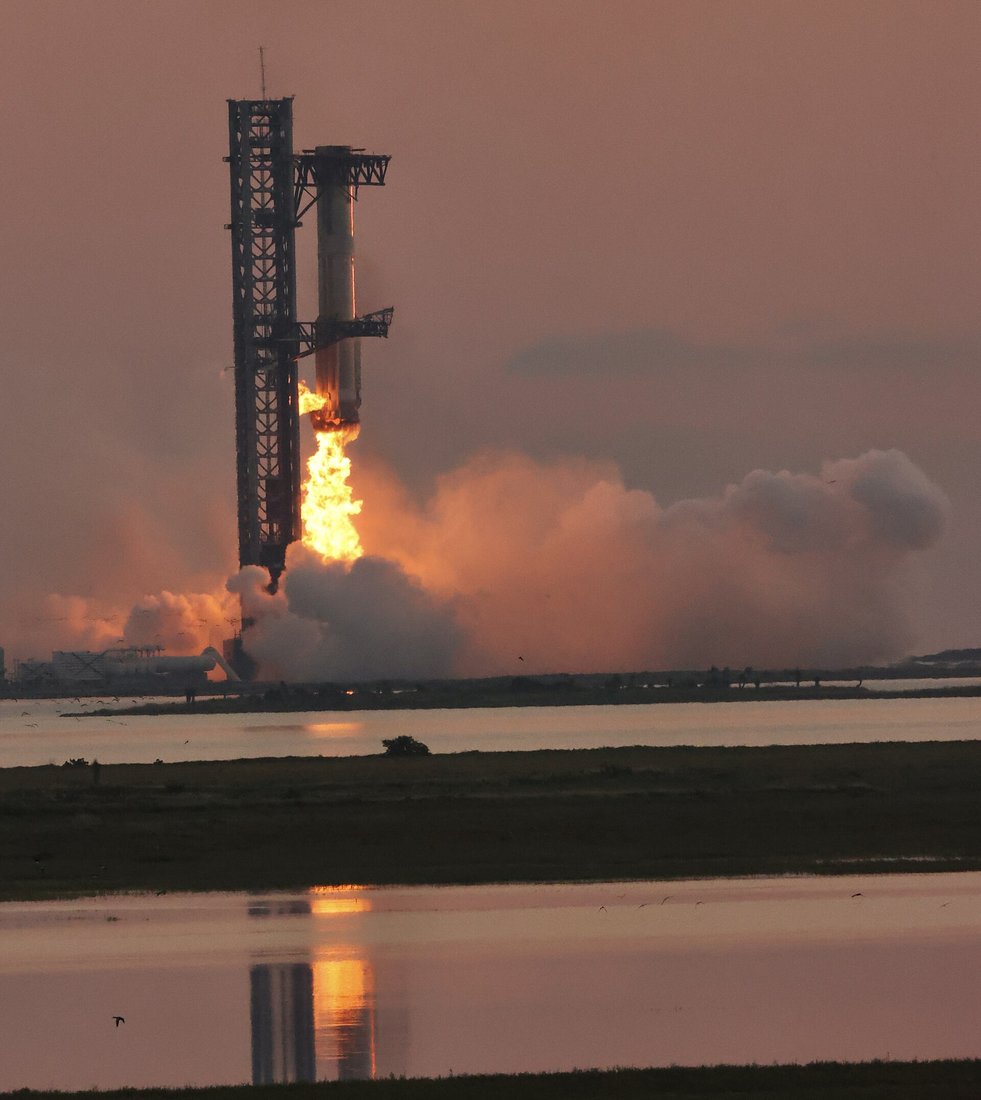

SpaceX launched Starship Flight 15 from Starbase, Texas, at 4:47 p.m. Central on Friday, November 13, 20264. Ship 42 was caught by the launch tower, the first time a Starship upper stage has been caught there, while Booster 22 aborted its own catch7. The flight was the first attempt to catch both stages on one mission1, and it ended with one stage in the tower's arms and the other lost over the Gulf.
The plan going in
The flight would lift off from Pad 2 at Starbase3, and the Super Heavy booster would return to Starbase about 6.5 minutes after liftoff to be caught by the tower's chopstick arms3. The ship would orbit Earth about 14 times at roughly 171 miles (275 km) and release 26 Starlink V3 satellites3, then fly back for its own catch about 22.5 hours after launch. If flight controllers could not confirm that the reentry, landing burn and final approach systems were healthy, the ship would splash down at preplanned Pacific locations near Hawaii or off Chile instead3.
Flight 14 in September ended in a Pacific splashdown after about three hours, short of its planned duration, and was the first flight to carry operational satellites into orbit5. Flight 15 would be only the second time a Starship has orbited Earth4.
What happened to the booster
All 33 Raptor 3 engines fired at liftoff, and one engine in the outer ring was out for the boostback burn1, which SpaceX said would not affect the landing. SpaceX's Dan Huot confirmed that 32 of the booster's 33 engines remained operational5.
According to SpaceQ, the booster's automated systems called off the catch and steered toward an offshore landing zone1, where it hovered over the water and its flight termination system activated just before impact1. Aerospace America reports that the booster headed toward the Gulf of Mexico and exploded just before splashdown4. Early reports described the outcome more gently, as a controlled splashdown in the Gulf5.
SpaceX's explanation shifted over the weekend. On Friday the company said the guidance, navigation and control system had detected a problem. On Saturday it said that system worked as designed and aborted because the booster was not where it needed to be for a catch1. Kate Tice of SpaceX said early indications point to the boostback burn ending early after a low fuel mass alarm4, and that the booster appropriately and autonomously followed safety protocols4. Elon Musk attributed the low fuel to slight engine underperformance1. As of SpaceQ's November 16 report, SpaceX was still looking for the root cause1.
SpaceQ counts the four V3 boosters flown on Flights 12 through 15 as all lost, carrying 132 engines between them1, and notes that losing a booster also means losing the inspection data a recovered one would provide1. Three earlier first generation boosters had been caught, and two of them later flew again6.
The ship's day in orbit
All 26 Starlink V3 satellites were released by about 1 hour 17 minutes into the mission6, and the ship completed 14 orbital revolutions4. Before committing to come home, SpaceX had three Starlink satellites photograph the ship's heat shield tiles, and said the shield was in good shape for reentry1.
The return began on Saturday afternoon. A reentry burn on one of the ship's six Raptor engines lasted about 10 seconds, a short relight compared with the booster's 334, and the ship's path carried it over Baja and northern Mexico, followed by a swoosh maneuver, a belly flop and a landing burn4. The tower's arms closed around it about 22.5 hours after liftoff1. SpaceQ puts the catch at about 3:20 p.m. Central on Saturday, November 141; Aerospace America gives 3:29 p.m4.
Why the catch matters
A ship that lands back at the pad can, in principle, be inspected and flown again instead of being lost at sea. Wells Fargo called the catch "a huge step toward full vehicle reusability," which CNBC notes would vastly lower the cost of space expeditions2. Bernstein said the heat shield appeared to be in good condition and that, if it is found to be, the ship may be reused on the next flight, Flight 162. That condition matters, because, as Wells Fargo noted, SpaceX is investigating the root cause of the booster's early boostback cutoff2. So the flight leaves SpaceX with a ship it can study up close and a booster whose loss it still has to explain.
Aerospace America notes that SpaceX plans to retire Falcon 9 and depends on Starship for Starlink expansion4, and that NASA has awarded SpaceX 2.9 billion dollars in contracts for Starship lunar lander variants4. Closer to the next launch, SpaceQ reports that the Starship tower at Launch Complex 39A at Kennedy Space Center is expected to be ready later this month, with the first Florida vehicles to ship from Starbase on a new barge1.
Trivia
- On which Starship test flight, and on what date, did a launch tower first catch a returning Super Heavy booster? Flight 5, on October 13, 20248.
- What nickname did SpaceX give the tower that catches its rockets? Mechazilla8.
- About how many hexagonal ceramic tiles make up Starship's heat shield? About 18,0004.
- On what date did the first full Starship stack fly, on Flight 1? April 20, 202310.
- How tall is the Block 3 Starship stack, booster and ship together? 124.4 meters (408 feet)11.
- By what vote did residents approve making Starbase an official Texas city in May 2025? 212 to 69.
Sources
- Starship Flight 15: Ship Catch Success, Booster Lost, Marc Boucher, SpaceQ, November 16, 2026. Accessed November 17, 2026.
- Analysts are awed by SpaceX's Starship catch. Here's why, Liz Napolitano, CNBC, November 16, 2026. Accessed November 17, 2026.
- How to watch Starship Flight 15, Brooks Mendenhall, Astronomy, November 13, 2026. Accessed November 17, 2026.
- SpaceX achieves first Starship tower catch, Jon Kelvey, Aerospace America, November 14, 2026. Accessed November 17, 2026.
- SpaceX skips Starship booster catch for Gulf of Mexico splashdown, Aamir Khollam, Interesting Engineering, November 13, 2026. Accessed November 17, 2026.
- Starship Flight 15: Historic Spacecraft Catch, Successful Satellite Deployment and a Lost Booster, New Space Economy, November 14, 2026. Accessed November 17, 2026.
- Starship Flight 15 (Starlink Group 31-2) launch details, Next Spaceflight. Accessed November 17, 2026.
- SpaceX catches Super Heavy booster on Starship's fifth test flight, collectSPACE, October 13, 2024. Accessed November 17, 2026.
- Voters in Texas approve SpaceX rocket launch site as new city of Starbase, PBS NewsHour, May 4, 2025. Accessed November 17, 2026.
- SpaceX Starship flight tests, Wikipedia. Accessed November 17, 2026.
- SpaceX Starship, Wikipedia. Accessed November 17, 2026.