Apollo 4: The First Saturn V Launch, 9 November 1967
Key Points
- NASA's history account says the first Saturn V lifted off as the uncrewed Apollo 4 at 7 a.m. on November 9, 1967, and the 59th anniversary falls on Monday, 9 November 2026.
- Apollo 4 was an all-up test: all three stages flew together for the first time, with an uncrewed Command and Service Module on top.
- The third stage restarted after two orbits in a simulated translunar injection burn, and the Command Module's heat shield was tested at about 25,000 miles per hour.
- NASA never used the numbers 2 and 3 for a flight, and the first Saturn V mission was numbered 4.
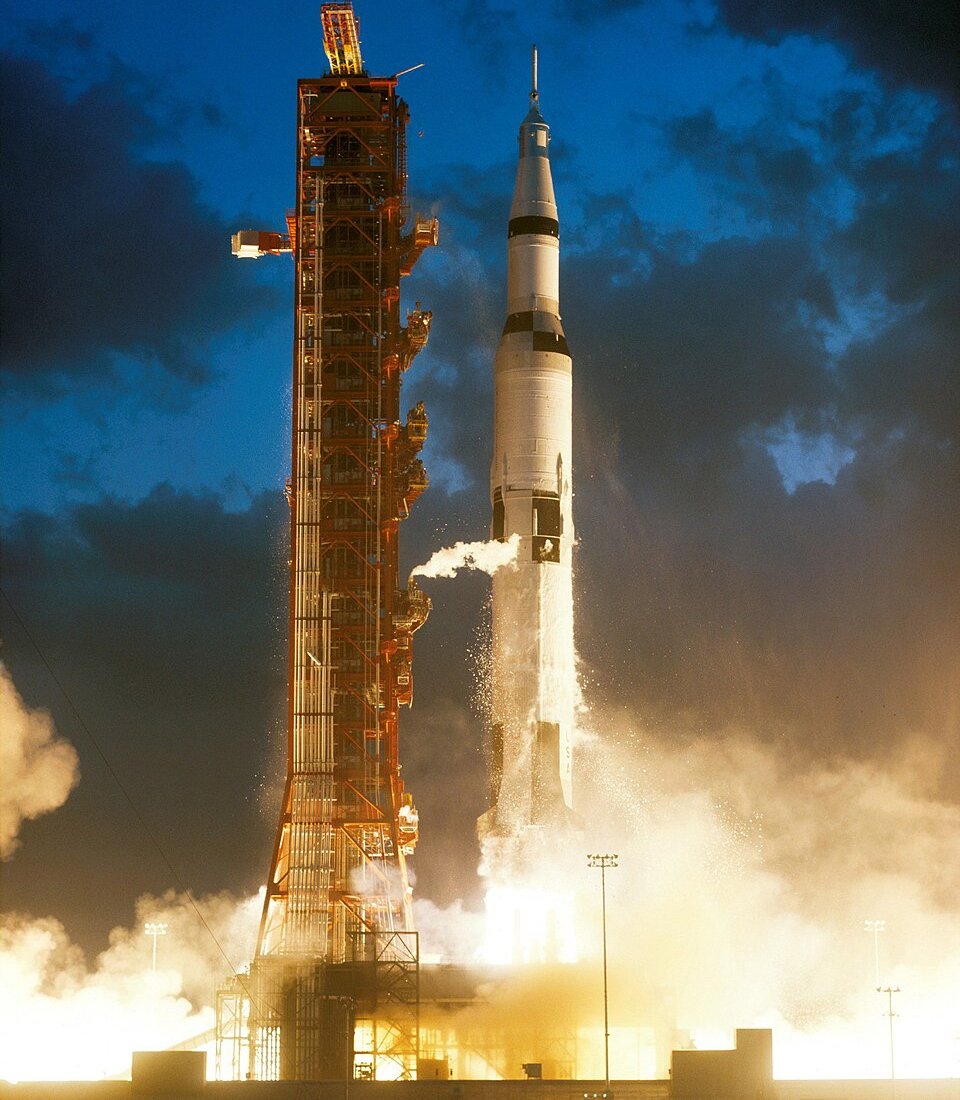

The first Saturn V left Launch Complex 39A at the Kennedy Space Center in Florida on the morning of November 9, 1967, and NASA's account says it lifted off at 7 a.m.2 The mission, called Apollo 4, carried no crew. Its job was to test the rocket and the Apollo spacecraft on top of it together in one flight. The 59th anniversary falls on Monday, 9 November 2026.
Why NASA flew the whole rocket at once
NASA's history article says the Saturn V stood 363 feet tall2 and had rolled out to Pad 39A on August 26, 1967. Earlier rockets had been flown stage by stage before a full stack was launched. For this one, the same article says, managers used an all-up approach, testing all three stages for the first time on a single launch2. That included the restart ability of the third stage, which later Moon flights would need to send astronauts toward the Moon.
The rocket was not the only thing under test. According to the NASA mission page, the flight was meant to exercise structural integrity, compatibility of launch vehicle and spacecraft, heat shield and thermal seal integrity, overall reentry operations, launch loads and dynamic characteristics, stage separation, launch vehicle subsystems, the emergency detection system, and mission support facilities and operations4. The spacecraft was an uncrewed Apollo Command and Service Module. NASA's history article adds that no Lunar Module flew, but a test article called LTA-10R flew inside the adapter to gather loads and dynamics data2 and burned up on reentry with the empty third stage.
A rehearsal that ran long
Getting to the launch date took longer than planned. The NASA history article says a Countdown Demonstration Test began on September 29 as a planned six-day rehearsal, but because of numerous unexpected problems it did not end until October 142. One of the bigger problems was a malfunction of the power-producing fuel cells in the Service Module, which had to be replaced. Additional problems, the article says, pushed the planned launch date from Nov. 7 to Nov. 92. Controllers in Firing Room 1 of the Launch Control Center then monitored a three-day countdown, and the same article says the lessons from the rehearsal led to a fairly trouble-free countdown2.
Liftoff, and the noise
At liftoff, the five F-1 engines of the first stage produced 7.5 million pounds of thrust2, according to NASA's history article. NASA's Kennedy Space Center account says that power reached the Launch Control Center, the press site and spectators, all about three miles away, shocking even veteran launch viewers3. It describes the launch as one of the loudest-ever human-made sounds3, and quotes a television commentator reporting that the building was shaking and that he and a producer were holding the window behind him. Another person quoted in that account recalls dust and debris from the ceiling of the new Launch Control Center falling at liftoff.
The first Saturn V was also the first launch from the new Launch Complex 39. The Kennedy account says Apollo 4 was the first to take off from the new Launch Complex 393, and NASA's mission page lists the launch site as Launch Complex 39A4. The mission page gives the launch time as 7:00:01 a.m. EST (12:00:01 UT).
Three stages, two orbits and a restart
NASA's history article gives the sequence. About two and a half minutes after liftoff, at an altitude of 40 miles, the first stage exhausted its propellant, shut down its engines and separated2. The second stage's five J-2 engines then burned for six minutes, raising the altitude to 120 miles, and the third stage's single J-2 engine burned for two and a half minutes to place the vehicle in a near circular orbit the article gives as 114 by 116 miles2. Two orbits followed, over about three hours, while controllers in Houston checked every system.
Then came the test that mattered most for a lunar trip. The third stage's engine restarted on schedule and burned for five minutes, raising the high point of the orbit. The NASA mission page describes this as a simulated translunar injection burn4, the push that would send a crewed spacecraft toward the Moon. The Command and Service Module separated from the empty stage and fired its own Service Propulsion System engine twice. The first burn, the history article says, lasted 16 seconds2. The second lasted four minutes and 40 seconds2, increasing the spacecraft's velocity to approximate a return from the Moon.
Near the top of the arc, an automatic camera in the Command Module took pictures of Earth. The history article says it took 715 high-quality color images2, and the Kennedy account captions one of them as showing coastal Brazil, the Atlantic Ocean, West Africa, the Sahara and Antarctica from an altitude of 11,200 miles3.
The reentry test
The heat shield was the second big question. NASA's history article says the Command Module met Earth's atmosphere at about 25,000 miles per hour, and that the shield absorbed the heat of reentry, reaching a temperature of 5,000 degrees Fahrenheit2 while the cabin stayed comfortable enough for a crew. The module also dipped to an altitude of 35 miles, used aerodynamic lift to skip back out to 45 miles, and then continued down. NASA describes this double-skip reentry2 as one that reduced deceleration and heat loads on the spacecraft.
Parachutes slowed the capsule, and it splashed down in the Pacific Ocean about eight miles from the prime recovery ship, the USS Bennington, according to the same article. The Smithsonian's National Air and Space Museum summarizes the mission as lasting 8 1/2 hours5. NASA's history article adds that the capsule remained upright after splashdown2, that Navy frogmen attached a flotation collar within 20 minutes, and that the whole recovery took about two hours.
Why it is called Apollo 4
The name has its own story. The Smithsonian's page says that after the Apollo 1 crew died during a preflight test, NASA's Associate Administrator for Manned Space Flight announced that the mission originally known as AS-204 would be known as Apollo 1, and that the first Saturn V launch would be known as Apollo 45. The eventual launch of AS-204 became Apollo 5, and no missions or flights were ever designated Apollo 2 and 35. NASA's history article also says the flight reinvigorated the Moon landing program after the Apollo 1 fire earlier in 1967.
What came next
NASA's Kennedy account says that less than two years later, the Apollo 11 crew landed on the Moon on July 20, 19693, and that five more missions landed by the end of 1972. It also draws a line to the present, saying NASA is preparing flights of the Space Launch System with the Orion spacecraft from the same Launch Complex 39. The Apollo 4 Command Module is on display at the INFINITY Center at NASA's Stennis Space Center in Mississippi, according to the history article.
One note on the figures: NASA's own pages do not agree on every number. The history article puts the high point of the flight at 11,244 miles, the Smithsonian page gives 11,234 miles, the Kennedy account says 11,200 miles and the mission page gives 18,216 km, which is about 11,300 miles (converted here). The pages also differ on the length of the flight, at 8 hours 27 minutes in the history article and 8 hours 36 minutes in the Kennedy account and on the mission page, and the count of 715 images comes from the history article alone. This article uses the 11,200 mile figure from the Kennedy account and attributes each other number to the page that gives it.
Trivia
- What was special about the Apollo 4 launch on November 9, 1967? It was the first all-up test of the three stage Saturn V rocket4, flown with no crew.
- Which engines powered the Saturn V first stage? Five F-1 engines2, which produced 7.5 million pounds of thrust, according to NASA.
- What did the third stage do after two orbits that later Moon missions would depend on? It restarted, in a simulated translunar injection burn4.
- What temperature did NASA say the Command Module's heat shield reached during reentry? 5,000 degrees Fahrenheit2, with the cabin staying comfortable enough for a crew.
- Which mission numbers were never used for a flight? Apollo 2 and Apollo 35. The first Saturn V mission took the number 4 and the later AS-204 flight became Apollo 5.
Sources
- This Week in NASA History: First Launch of Saturn V, Nov. 9, 1967, NASA. Accessed November 8, 2026.
- 55 Years Ago: Apollo 4, the First Flight of the Saturn V, NASA History, 2022. Accessed November 8, 2026.
- Apollo 4 Was First-Ever Launch from NASA's Kennedy Space Center, NASA. Accessed November 8, 2026.
- Apollo 4, NASA Missions. Accessed November 8, 2026.
- Apollo 4, Smithsonian National Air and Space Museum. Accessed November 8, 2026.
- File:Apollo 4 liftoff - GPN-2006-000038.jpg, Wikimedia Commons file page. Accessed November 8, 2026.