Bank of Canada Raises Its Rate to 2.5%, First Hike Since 2023
Key Points
- The Bank of Canada raised its target for the overnight rate by 25 basis points to 2.5% on 28 October 2026, with the Bank Rate at 2.75% and the deposit rate at 2.45%.
- The Bank's Governor said it was the first interest rate increase since July 2023.
- The Bank says CPI inflation has been around 3% since April and is expected to rise to about 3½% by the end of the year, and that inflation excluding gasoline was 2.2% in September.
- The Bank expects the economy to grow 1% in 2026 and 2% in 2027 and 2028, and names 9 December 2026 as the next scheduled rate announcement.
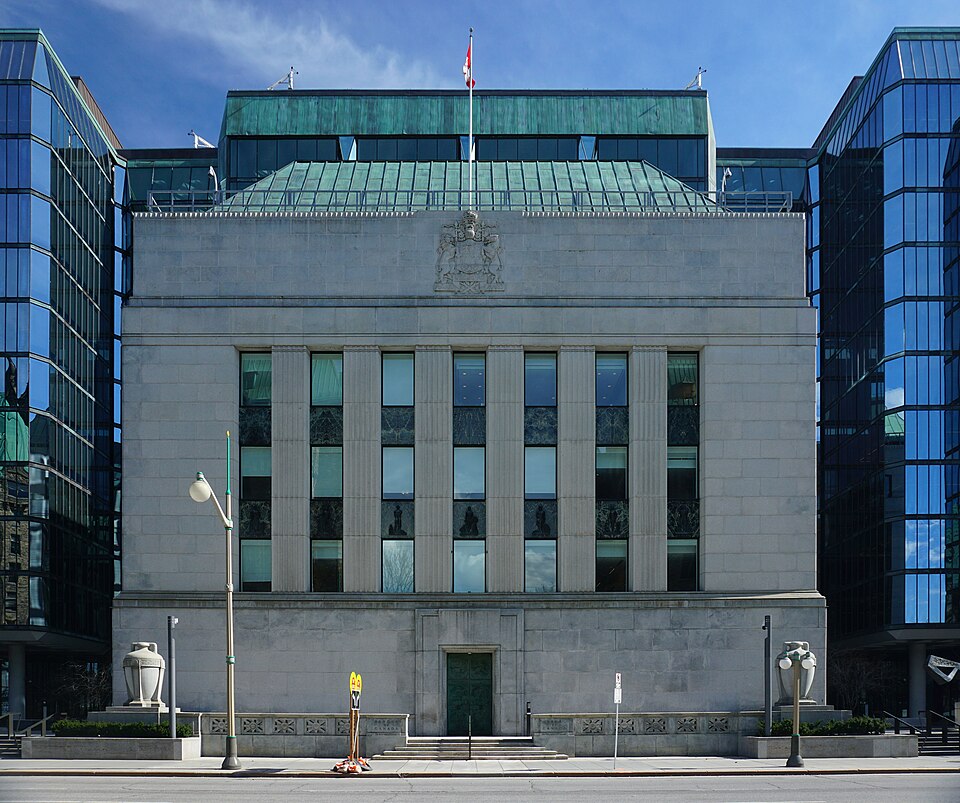

Canada's central bank raised its main interest rate on Wednesday, 28 October 2026. The Bank of Canada increased its target for the overnight rate by 25 basis points to 2.5%1, with the Bank Rate at 2.75% and the deposit rate at 2.45%. A basis point is one hundredth of a percentage point, so the move was a quarter of a point. The Bank's Governor said in his opening statement that it was the first interest rate increase since July 20232.
What the Bank said drove the decision
The Bank's press release says that, with persistently elevated oil prices and refinery margins, inflation has risen in most countries1. It describes the conflict in the Middle East as now in its eighth month with no clear path to resolution1. In Canada, the Bank says CPI inflation has been around 3% since April and is expected to rise to about 3½% by the end of the year1. Excluding gasoline, inflation was 2.2% in September1, and the Bank says measures of core inflation remain close to 2%.
The Governing Council said it decided to raise the rate to reduce the risk that continuing high energy prices spread broadly to the prices of other goods and services1. The Bank's October Monetary Policy Report projects that inflation remains above 3% through much of 20273. The press release has CPI inflation averaging 3% in 2027, then coming down to 2% in the middle of 20281.
The economy the Bank described
The Bank's release says growth picked up in Canada through the middle of the year1: it gives GDP growth of 3.3% in the second quarter (the release does not state a basis, but Statistics Canada’s release for the second quarter reports a 0.8% quarterly change in real GDP6, so the 3.3% reads as an annualized rate) and says recent indicators point to growth of about 2% in the third quarter. The unemployment rate has been around 6½% for several months1. For the year, the Bank expects the Canadian economy to grow 1% in 2026, and 2% in 2027 and 20281, a somewhat stronger projection than in its July report. The Bank also says growth is expected to slow in the fourth quarter of 20261 because of new US tariffs, before picking up again in 2027.
Globally, the Bank revised up its estimate of world GDP growth slightly, to 3.1% in 20261, with 3.2% in 2027 and 2028 unchanged from July.
Hold or hike
The Governor said Governing Council considered two policy options: hold or hike2. The main argument for holding, as he put it, was that the rise in inflation had so far been concentrated in energy prices and in services that rely heavily on energy inputs, such as airfares, and that economic slack remained. The main argument for an increase was that energy prices are higher, are expected to stay higher, and that cost pressures are building. He added that the Bank would take future decisions one meeting at a time2.
The press release says there could be a need to increase the policy rate further1, but that given the uncertainties the Council agreed to proceed carefully. It names the next scheduled announcement of the overnight rate target as 9 December 20261, and the next Monetary Policy Report as 27 January 2027.
Trivia
- In what year did the Bank of Canada begin operations? On 11 March 19354, after being chartered on 3 July 1934 under the Bank of Canada Act.
- The bank was first set up as a privately owned corporation. In what year did it become a federal Crown corporation? In 19384, with the minister of finance holding all its issued share capital.
- Which bird gave Canada's one dollar coin its nickname, and in what year did the coin replace the one dollar bill? The common loon gave us the loonie5, and the coin replaced the bill in 1987.
- What is the nickname of Canada's two dollar coin, and in what year was it introduced? The toonie5, a play on "two loonies," introduced in 1996.
- Which denomination was the first Canadian polymer note to circulate, and on what date? The $100 bill, on 14 November 20115, the first of the Frontier series.
Sources
- Bank of Canada raises the policy rate by 25 basis points to 2½%, Bank of Canada press release, 28 October 2026. Accessed October 29, 2026.
- Opening statement (Monetary Policy Report press conference), Bank of Canada, 28 October 2026. Accessed October 29, 2026.
- Monetary Policy Report, October 2026, Bank of Canada, 28 October 2026. Accessed October 29, 2026.
- Bank of Canada, Wikipedia. Accessed October 29, 2026.
- Canadian dollar, Wikipedia. Accessed October 29, 2026.
- Gross domestic product, income and expenditure, second quarter 2026, The Daily, Statistics Canada, August 28, 2026. Accessed October 29, 2026.