Bank of England Raises Bank Rate to 4% on an 8 to 1 Vote
Key Points
- The Bank of England said its Monetary Policy Committee voted 8 to 1 to raise Bank Rate by 0.25 percentage points, to 4%, at a meeting that ended on 4 November 2026.
- The Bank said UK CPI inflation increased to 3.5% in September and is expected to rise to around 5% by the middle of 2027 before falling.
- One member preferred a rise of 0.5 percentage points, to 4.25%, and the Bank said policy is not on a pre-set path.
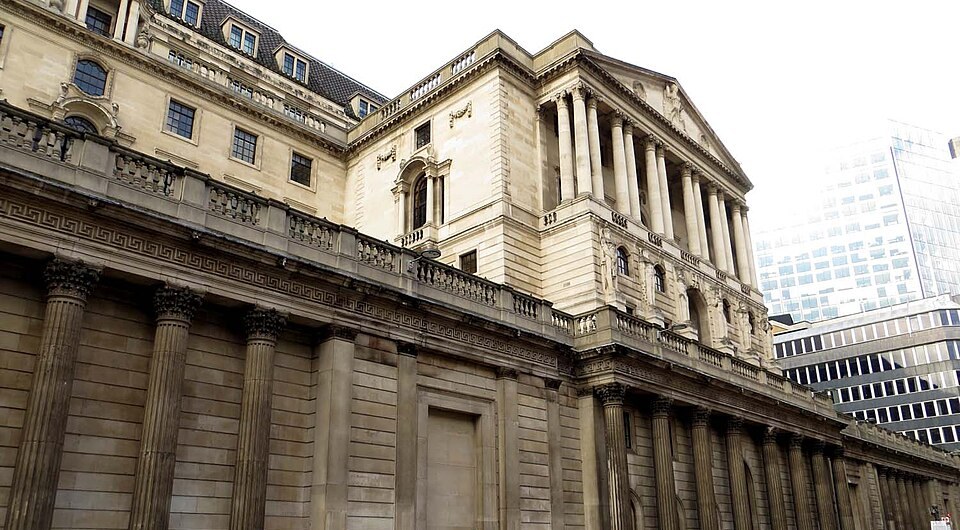

The Bank of England raised its main interest rate on Thursday, 5 November 2026, from 3.75% to 4%. The Bank said its Monetary Policy Committee (MPC) voted by a majority of 8 to 1 to increase Bank Rate by 0.25 percentage points1, at a meeting that ended on 4 November 2026, and published its summary and minutes on 5 November. One member wanted a bigger rise, of 0.5 percentage points, to 4.25%.
The decision is a useful window into how a central bank weighs an energy price shock against an economy that has held up better than expected. This piece sets out what the Bank said, with every figure taken from its summary and minutes or from the Office for National Statistics (ONS).
What the Committee decided
Bank Rate is the Bank's policy interest rate, and it sets the starting point for borrowing costs across the economy. The Committee's summary1 says the vote was 8 to 1: eight members preferred a rise of 0.25 percentage points, and one preferred 0.5 percentage points. The minutes name each member's vote; this article does not name them.
The Bank's page also lists the Committee's previous decision, in September 2026, as Bank Rate maintained at 3.75%1. The minutes state that the minutes of the meeting ending on 16 December will be published on 17 December 20261.
Why the Bank moved
The summary opens with the energy backdrop. It says the conflict in the Middle East is now in its ninth month1, that global energy prices have continued to rise from an already elevated level, and that UK consumer price inflation increased to 3.5% in September. The Bank says it is now expected to rise to around 5% by the middle of 2027, and then to fall as the effect of rising energy prices on 12-month inflation rates fades.
The minutes give the energy figures. The front-month Brent crude oil futures contract averaged $108 per barrel1 over the 15 UK working days ending 27 October, and the UK front-month natural gas futures contract averaged 216 pence per therm. The minutes put those levels at 38% and 81% above where they stood at the time of the July Monetary Policy Report.
The Committee also wrote that, in the September inflation figure, direct energy effects had contributed around 1 percentage point, most of which was driven by fuels1. Bank staff projections in the minutes have headline inflation reaching around 4.5% in the first quarter of 2027 and around 5% in the second quarter, with the first of those figures about 1.25 percentage points higher than at the time of the July report.
What the inflation data showed
The ONS, which produces the official figures, reported on 21 October 2026 that the Consumer Prices Index (CPI) rose by 3.5% in the 12 months to September 2026, up from 3.1% the previous month2. On a monthly basis, CPI rose by 0.4% in September 2026. The ONS said transport, particularly motor fuels, made the largest upward contribution to the monthly change in the annual rate, and restaurants and hotels made the largest partially offsetting downward contribution.
The ONS also reported that core CPI, which leaves out energy, food, alcohol and tobacco, rose by 2.8% in the 12 months to September 2026, up from 2.6% in August2. In the same release, the CPI services annual rate rose from 3.4% to 3.7%, and the goods rate from 2.7% to 3.2%. The ONS also compared the UK's 3.5% with France (3.4%) and Germany (3.3%) for September 2026. Its next release is due on 18 November 20262.
An economy that held up
The summary says there remains limited evidence of knock-on effects on other prices and wages1, but that the degree of inflationary pressure in the pipeline is now sufficient to warrant an increase. It adds that activity data in recent months have generally been stronger than expected, which added to the case for modestly tighter policy.
The minutes describe the strength in more detail. They say there was further evidence of the resilience of activity despite higher energy prices, with momentum from the impact of global growth on UK exports and some positive impact from the deployment of artificial intelligence. They also say members judged that growth was likely to fall back somewhat in the coming quarters1.
On borrowing costs, the minutes record that benchmark two-year mortgage rates had risen by nearly 50 basis points since the beginning of September1. The Bank's Market Participants Survey showed the median expected path for Bank Rate reaching 4% in November and 4.25% in February. The minutes also note that growth rates of lending to businesses had remained strong while new mortgage approvals for households had been falling.
The Budget and the scenarios
The Committee was briefed on the Budget on 28 October. The minutes say the new measures were expected to have a downward impact of a quarter of a percentage point on CPI inflation by the second quarter of 2027 and a small impact on activity1.
The Bank's November Monetary Policy Report sets out a central projection and two scenarios. In the minutes' words, an adverse scenario explored the risk of persistently higher energy prices and an additional mechanism for larger second-round effects1, while a weaker demand scenario assumed that the recent resilience of domestic growth would falter. The minutes add that these scenarios would all require different monetary policy responses if any of them were to materialise.
The dissent
The minutes record that the one member who voted for a rise of 0.5 percentage points argued, from a risk management and credibility perspective1, that an activist approach was needed to prevent persistent inflationary dynamics becoming embedded. That member's own projection put CPI inflation at 4.9% by mid-2027, conditioned on a significant decline in energy prices.
The summary stresses that the path is open. It says that monetary policy is not on a pre-set path1 and that the Committee will adjust Bank Rate as necessary to ensure CPI inflation returns to the 2% target in the medium term.
What to keep in mind
The projections in this article are the Bank's own central projection, based on energy futures prices over the 15 working days to 27 October, and not forecasts by this site. Futures prices and inflation estimates change, as the Bank's scenarios show. This article is a news summary and gives no advice.
Trivia
- To what level did the Bank of England raise Bank Rate in its November 2026 decision? To 4%, up 0.25 percentage points from 3.75%1.
- What was the vote split on the Monetary Policy Committee? 8 to 11, with one member preferring a rise of 0.5 percentage points.
- What did the ONS report for UK annual CPI inflation in September 2026? 3.5%, up from 3.1% in August2.
- Which two countries did the ONS compare the UK's September 2026 rate with, and were they higher or lower? France (3.4%) and Germany (3.3%)2. Both were lower than the UK's 3.5%.
- What inflation rate does the Committee aim to return CPI to in the medium term? 2%1.
Sources
- Bank of England, Bank rate increased to 4% - November 2026 Monetary Policy Summary and Minutes, 5 November 2026. Accessed November 6, 2026.
- Office for National Statistics, Consumer price inflation, UK: September 2026, 21 October 2026. Accessed November 6, 2026.