Bank of Korea Holds Its Base Rate at 3% After Two Summer Hikes
Key Points
- The Bank of Korea kept its Base Rate at 3.00% on 22 October 2026, after quarter point increases in July and August.
- “All seven Monetary Policy Board members unanimously supported the decision” to keep the rate unchanged.
- Consumer price inflation was 2.9% in September and core inflation 2.8%, above the bank's 2 percent target.
- In his opening remarks, Governor Shin Hyun Song said the bank “will determine the timing and pace of further Base Rate hikes while closely monitoring incoming data”.

South Korea's central bank kept its main interest rate unchanged in October 2026. On 22 October 2026 the Bank of Korea's Monetary Policy Board decided to leave the Base Rate unchanged at 3.00%1 until its next decision. The pause follows two increases in a row. In July the board raised the rate by 25 basis points to 2.75%5, its first hike since January 2023, and in August it raised it by another 25 basis points6 at a meeting on 27 August. A basis point is one hundredth of a percentage point, so each move was a quarter of a point.
The hold was no surprise. All 34 analysts in a Reuters poll had predicted the hold2, and in a survey by the Seoul Economic Daily of 20 economists, professors and financial experts, taken on 18 October, 19 expected the rate to stay put4.
What the Base Rate is
The Bank of Korea describes the Base Rate as “the reference policy rate applied in transactions between the Bank of Korea and financial institutions”8. The bank applies it in repurchase agreements, which are short loans backed by securities, and in its liquidity adjustment deposits and loans. Reuters describes the benchmark as the seven day repurchase rate2.
The rate serves an inflation target. The bank has set its inflation target at 2 percent9, measured by the year on year change in the Consumer Price Index, and aims to keep inflation there over the medium term. It reviews that framework with the government every two years9.
Who decides
The decision belongs to the Monetary Policy Board, which has seven members10, including the Governor, who chairs it, and the Senior Deputy Governor. Decisions are “adopted through a simple majority with at least five members attending”10. The current chair is Shin Hyun Song, whose term as Governor runs from 21 April 2026 to 20 April 203010. “All seven Monetary Policy Board members unanimously supported the decision”1 to keep the rate unchanged, the bank said.
The board sets the rate eight times a year. Its 2026 calendar lists meetings on 16 July, 27 August, 22 October and 26 November11, among others, which makes November's meeting the last of the year.
Why the board paused
The bank gave two reasons for waiting. It wants time to judge outside risks, citing growing uncertainties1 abroad, including monetary and fiscal policy in major economies, and to see “the effects of the two prior rate hikes”1. It also said the chance that growth and inflation run higher than expected has increased since its August forecasts, but that it would not be too late to assess that once third quarter GDP and October inflation figures are in.
It did not say it was finished. In his opening remarks, Shin said the bank “will determine the timing and pace of further Base Rate hikes while closely monitoring incoming data”1. At the press conference, he said the bank would keep responding “until we are confident that inflation is on a stable path toward our target”3, according to the Korea JoongAng Daily.
The numbers behind it
Inflation eased in September but is still above target. The bank put September's figures at 2.9% for consumer prices and 2.8% for core inflation1, the measure that leaves out food and energy. Trading Economics reported that the headline rate slowed to 2.9% in September from 3.1% in August7, and that core inflation eased from 3.4%. The bank expects this year's inflation to be broadly in line with its August forecasts of 2.7% for consumer prices and 2.5% for core1, and next year's to run above its earlier forecasts.
The economy has grown faster than the bank expected, led by exports and investment. It now expects growth for this year and next to be considerably higher than its August forecasts of 3.3% and 2.9%1. Exports in September “reached a record high of over 120 billion US dollars”1, and the bank projects customs based exports for the year to pass US$1 trillion. It also expects the current account surplus to beat its August forecast of US$450 billion1. Consumer spending slowed for a while, which the bank put down mainly to falling share prices and strikes at carmakers.
The currency has strengthened. The bank said “the Korean won to US dollar exchange rate fell significantly”1, which means it takes fewer won to buy one dollar. The won stood at 1,324.2 per dollar3 at 3:30 p.m. on 22 October, according to the Korea JoongAng Daily, up from the mid 1,500s in June.
Housing is the other pressure point. The bank said home price increases picked up again, particularly for lower and mid priced homes1 in Seoul and parts of Gyeonggi Province, and that housing loans kept rising even as total household loans declined. It said financial risks from the Seoul area housing market and household debt need continued attention.
What forecasters expect next
Several forecasters read the message as pointing to more increases. In the Seoul Economic Daily survey, 18 of the 20 respondents4 expected another increase in November. The Korea JoongAng Daily reported that Kong Dong-rak of Daishin Securities expects the next hike in November3 and a peak rate of 3.5 percent, while Samsung Securities, where Kim Ji-man is a senior analyst, kept its forecast of a 3.75 percent peak. The bank itself named no date.
Trivia
- On what date was the Bank of Korea founded? On 12 June 195012, about five weeks after its governing law was passed on 5 May 1950.
- Since which year has a candidate for Governor of the Bank of Korea had to pass a National Assembly confirmation hearing? Since 201212.
- Which mandate did a 2011 revision of the law add after the Global Financial Crisis? Financial stability12, alongside the primary objective of price stability.
- What currency did the won replace when it was reintroduced on 10 June 1962, and at what rate? The hwan, at a rate of 1 won to 10 hwan14.
- Who appears on the 50,000 won note, worth about US$37.76 at the 22 October 2026 rate of 1,324.2 won per dollar reported by the Korea JoongAng Daily? Shin Saimdang14, a 16th century artist and calligrapher. The note came out on 23 June 2009.
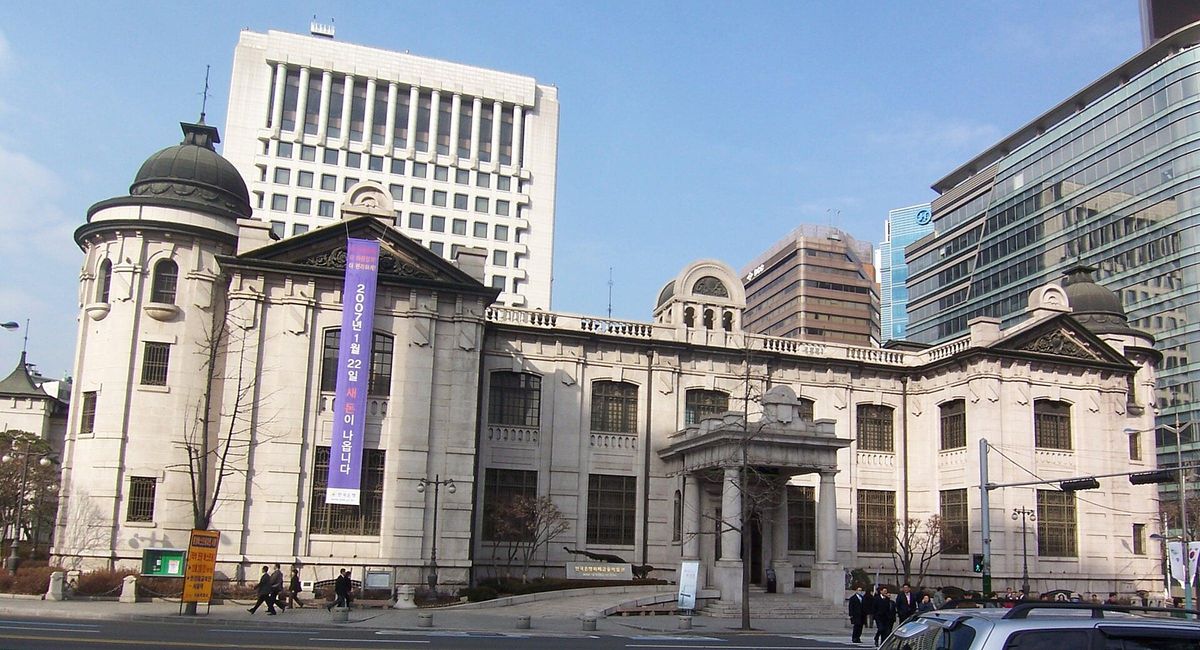
- Which architect designed the old Seoul head office of the Bank of Korea, now the Bank of Korea Money Museum, and which Tokyo landmark did he also design? Tatsuno Kingo13, who also designed Tokyo Station. The building was completed in January 1912.
- What number does that building carry as a National Historic Site of South Korea? No. 28013, a designation it received in 1981.
Sources
- Bank of Korea, Monetary Policy Decision & Opening Remarks to the Press Conference (October 22, 2026), 22 October 2026. Accessed October 24, 2026.
- Cynthia Kim and Jihoon Lee, Bank of Korea holds rates as expected, Reuters via Yahoo Finance, 22 October 2026. Accessed October 24, 2026.
- Jin Min-ji, BOK holds rate steady, signals further tightening as inflation rises and growth strengthens, Korea JoongAng Daily, 22 October 2026. Accessed October 24, 2026.
- Kim Hye-ran, Bank of Korea Holds Base Rate at 3.00 Percent, Seoul Economic Daily, 22 October 2026. Accessed October 24, 2026.
- Renju Jaya, Bank Of Korea Hikes Policy Rate For First Time Since 2023, RTTNews, 16 July 2026. Accessed October 24, 2026.
- Money Today, BOK raises base rate to 3.00%, second straight hike, 27 August 2026. Accessed October 24, 2026.
- Joshua Ferrer, South Korea Inflation Rate Slows in September, Trading Economics, 1 October 2026. Accessed October 24, 2026.
- Bank of Korea, The Bank of Korea Base Rate. Accessed October 24, 2026.
- Bank of Korea, Inflation Targeting. Accessed October 24, 2026.
- Bank of Korea, Monetary Policy Board. Accessed October 24, 2026.
- Bank of Korea, Meeting Dates. Accessed October 24, 2026.
- Bank of Korea, History and Mission. Accessed October 24, 2026.
- Bank of Korea Money Museum, Wikipedia. Accessed October 24, 2026.
- South Korean won, Wikipedia. Accessed October 24, 2026.