Bengaluru Metro Opens the First Stretch of Its Pink Line
Key Points
- The first 7.5 km elevated section of Bengaluru's Namma Metro Pink Line was inaugurated on 13 November 2026, PTI reported, and trains started at 6 a.m. on Saturday, 14 November, according to IANS.
- The section has six stations from Kalena Agrahara to Tavarekere, since renamed SG Palya, with an interchange to the Yellow Line at Jayadeva Hospital.
- PTI put the cost of the elevated section at Rs 3,470 crore, about $368 million at the 13 November 2026 reference rate.
- Swarajya reported in October that the underground stretch of the Pink Line was slated to open by May 2027, with final timelines depending on testing and clearances.
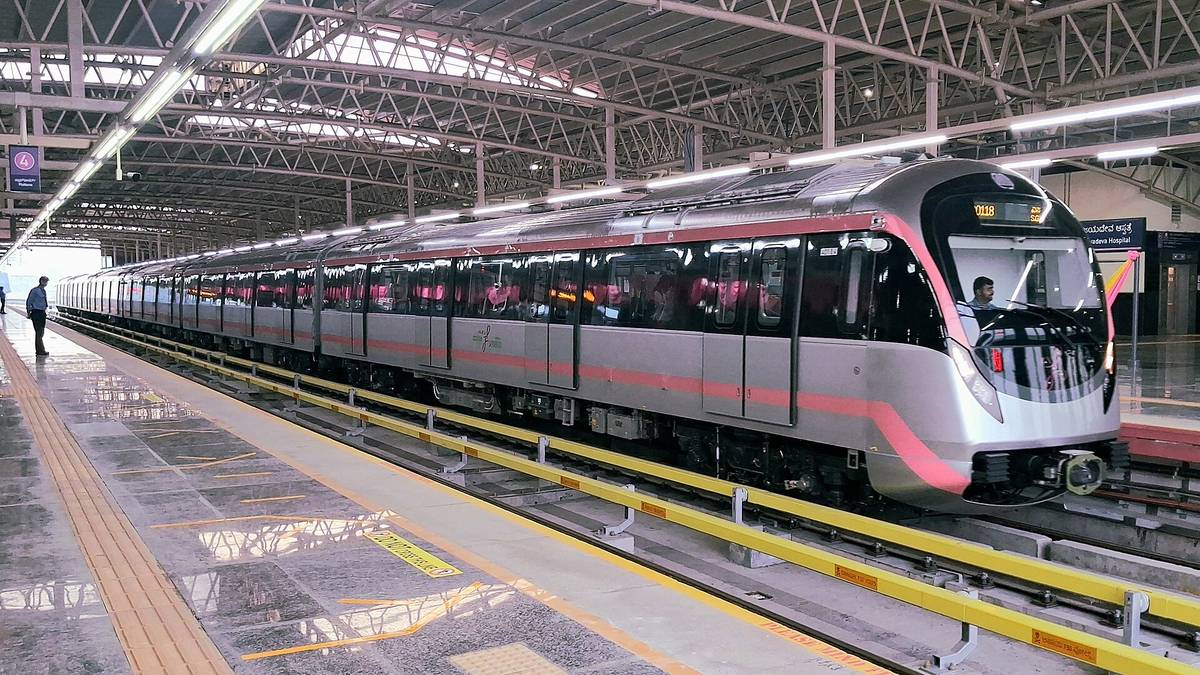

The first section of the Pink Line of Bengaluru's Namma Metro, a 7.5 km elevated stretch in the south of the city, was inaugurated by Prime Minister Narendra Modi on Friday, 13 November 2026, and the Press Trust of India (PTI) reported that it would begin operating for public use from 6 a.m. on 14 November1. Trains on the stretch from Kalena Agrahara to SG Palya (formerly Tavarekere) began at 6 a.m. sharp2 on Saturday, 14 November, the news agency IANS reported, for residents who had waited more than three years for it. PTI put the cost of the elevated section at Rs 3,470 crore1, about $368 million at the Reserve Bank of India reference rate of 94.1997 rupees per US dollar on 13 November 20268.
What opened
The section has six stations, running from Kalena Agrahara through Hulimavu, IIM Bangalore, JP Nagar 4th Phase and Jayadeva Hospital to Tavarekere, according to the IANS report on the first day2. Three of those names changed in the days before the opening. Metro Rail News reported that the Union Ministry of Housing and Urban Affairs approved new names for IIMB (now Bilekahalli-IIMB), JP Nagar 4th Phase (now NS Palya-JP Nagar 4th Phase) and Tavarekere (now SG Palya)4. The order behind the change said the Tavarekere locality sits some distance from the station, while SG Palya, a Greater Bengaluru Authority ward, is the name better known in the area.
Jayadeva Hospital is where the new line meets the existing network. IANS reported that the station will provide an interchange facility with the Yellow Line2, the corridor PTI describes as the Electronic City line1. The Yellow Line was inaugurated in August 20256, The Week reported, and added a 19 km, 16 station corridor towards Bommasandra.
How the service runs
Before the launch, PTI reported that services would initially run every eight minutes, with five trains allocated to the line3, four in service and one on standby. According to IANS, trains run every eight minutes at peak hours2, and every 10 minutes off peak and on Sundays. From Tuesday to Saturday the first trains leave both terminal stations at 6 a.m. On Mondays they leave Kalena Agrahara at 4.55 a.m. and SG Palya at 5 a.m., and on Sundays service starts at 7 a.m.
The Bangalore Metro Rail Corporation Limited (BMRCL), which runs the network, set fares for the section at 10 to 30 rupees depending on distance11, Asianet Newsable reported on 13 November 2026, with the full ride between SG Palya and Kalena Agrahara costing 30 rupees. That is about 11 to 32 US cents at the 13 November reference rate8.
The section serves the Bannerghatta Road corridor, an area with heavy traffic and many technology companies. Commuters said, IANS reported, that trips between the stations had taken between 20 and 30 minutes2 on congested roads, and that the same journey by Metro now takes around nine to 10 minutes.
The full Pink Line
What opened is a little over a third of the line. According to PTI, the total length of the Pink Line is 21.25 km, comprising 18 stations1, and the underground section will have 12 stations and is still under construction. Karnataka minister Krishna Byre Gowda described the complete line as a 7.5-km elevated section and a 13.7-km underground section3, in PTI's account. Underground, the route continues from Dairy Circle through Shivajinagar to Nagawara, part of what Swarajya calls the 21-km Pink Line from Kalena Agrahara to Nagawara5.
The elevated section was inspected by the Commissioner of Metro Railway Safety from 6 to 8 October5, Swarajya reported, and on 21 October The Week reported that the section was still awaiting safety clearance6.
How big Namma Metro is now
Namma Metro marked 15 years of passenger service in October 2026 at about 96 km6, The Week reported. Metro Rail News says the Pink Line section takes the operational network from 96.1 km to 103.6 km4, and PTI reported Byre Gowda as saying it would bring the network to about 103 km, crossing the 100-km mark3.
For comparison, Business Today reported in August 2026 that the Delhi Metro spans 416.5 km across 12 lines and 303 stations7, about four times the length of Bengaluru's network after this opening.
What comes next
Swarajya reported in October 2026 that the Pink Line's underground stretch and the Outer Ring Road corridor of the Blue Line were both slated to open by May 20275, and that BMRCL aims to finish work by March 2027, though final timelines depend on testing and clearances. Swarajya called signalling the key hurdle, and BMRCL Managing Director PC Jaffer told Moneycontrol, in remarks Swarajya reported, "Signalling integration will take a lot of time."5 Platform screen doors must also be integrated with the signalling system5, Swarajya added.
On the first morning, Byre Gowda told IANS, "Of course, we will keep up our efforts to operationalise Pink Line up to MG Road and then Nagawara."2 For the network as a whole, PTI reported on 11 November 2026 that the nearer term target is to exceed 170 km within the next 18 months3, with a longer term vision of 400 km to 500 km.
Trivia
- On what date did Namma Metro make its inaugural run? October 20, 20116, according to The Week.
- How long was Namma Metro's first corridor? 6.7 km6.
- How long was Namma Metro's first phase when it began operations in 2017? 42.3 km6.
- How many tunnel boring machines did BMRCL deploy to drill the Pink Line's underground section? Nine9, according to BMRCL.
- Which Pink Line tunnel boring machine was the first of them to break through, and where? Urja, at Shivajinagar station on 22 September 2021, after an 855 m drive from Cantonment10.
- How many of its original metro trains is BMRCL overhauling? 576, according to The Week.
Sources
- Agencies (PTI), PM Modi inaugurates Bengaluru Metro's Pink Line stretch, services to begin on November 14, The Federal, 13 November 2026. Accessed November 15, 2026.
- IANS, Pink Line Metro thrown open to public in Bengaluru, minister Byre Gowda welcomes commuters with roses, MENAFN, 14 November 2026. Accessed November 15, 2026.
- PTI, Metro rail pink line inauguration on Nov 13: Karnataka Minister Gowda, The Week, 11 November 2026. Accessed November 15, 2026.
- Narendra Shah and Editorial Team, Bengaluru Metro Pink Line: Centre Renames Three Stations Ahead of PM Modi's Inauguration, Services From 14 November, Metro Rail News, 12 November 2026 (updated 14 November). Accessed November 15, 2026.
- Arun Dhital, Bengaluru Metro Eyes November Trials On Pink Line Underground And ORR Corridor, Both Set To Open By May 2027, Swarajya, 15 October 2026. Accessed November 15, 2026.
- Nitin SJ Asariparambil, Namma Metro at 15: Bengaluru's prized transit system looks to expand its network beyond 100km, The Week, 21 October 2026. Accessed November 15, 2026.
- Business Today Desk, 99.95% punctuality record: How Delhi Metro beat New York & Paris subways at the reliability game, Business Today, 9 August 2026. Accessed November 15, 2026.
- Metropolitan Stock Exchange of India, RBI Reference Rate (Archives), USD/INR, 13 November 2026. Accessed November 15, 2026.
- TNM Staff, Watch: Tunnelling machine Urja completes drilling for Bengaluru's longest metro line, The News Minute, 22 September 2021. Accessed November 15, 2026.
- Namma Metro: TBM URJA Tunnel Breakthrough at Shivajinagar metro station, Tunnelbuilder, 24 September 2021. Accessed November 15, 2026.
- Keerthika MV, Bengaluru Namma Metro Pink Line To Open On November 14: Check Fares, Timings And Schedule, Asianet Newsable, 13 November 2026. Accessed November 15, 2026.