Brazil Inflation Slows to 0.14% in October as Annual Rate Edges Up
Key Points
- Brazil's IPCA rose 0.14% in October 2026 after 0.82% in September, while the 12 month rate edged up to 4.63% from 4.58%; prices rose 4.10% from January to October.
- Residential electricity fell 1.92% and airfares fell 9.21%, while food and beverages rose 1.04%, the largest increase of the nine groups.
- The inflation target is 3.00% with a tolerance of 1.50 percentage points either way, so both September's 4.58% and October's 4.63% sit above the 4.5% ceiling.
- Copom held the Selic at 13.75% a year at its meeting of 3 and 4 November 2026; the minutes read “O Copom decidiu manter a taxa Selic em 13,75% a.a.”, or “Copom decided to keep the Selic rate at 13.75% a year.”
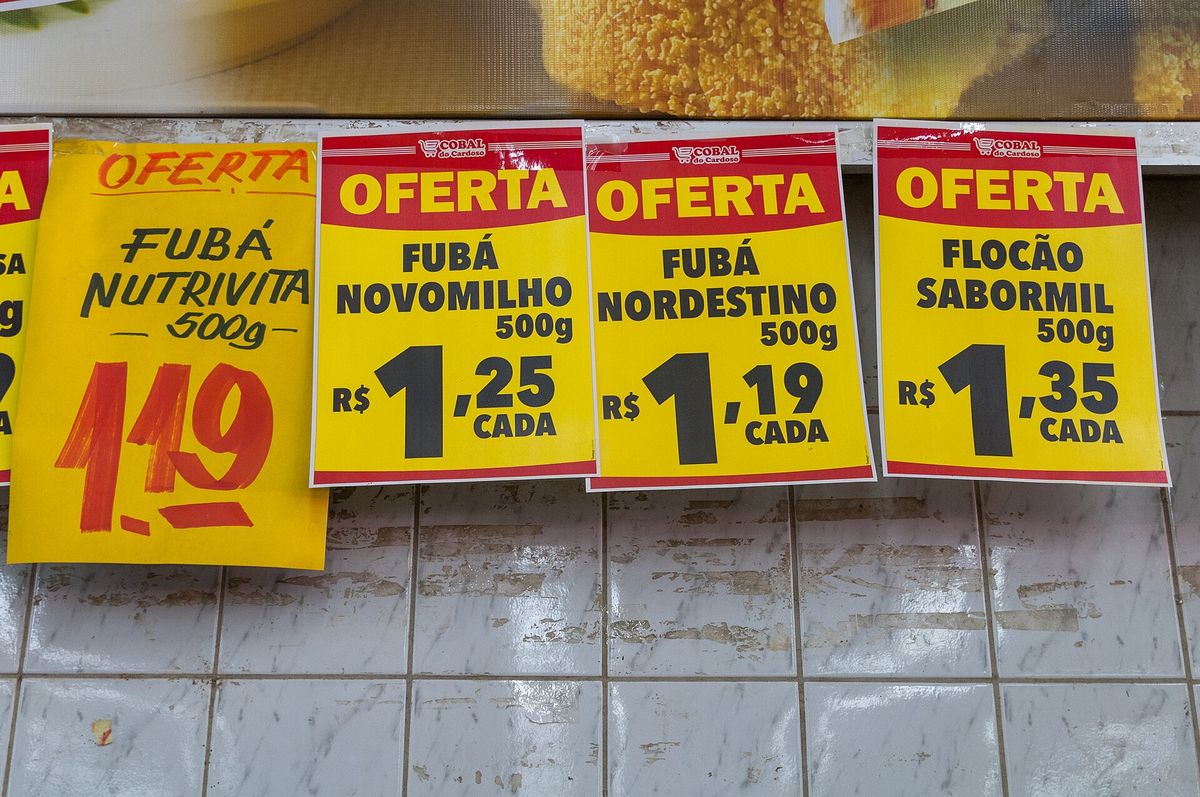

Consumer price growth in Brazil slowed sharply in October 2026. The official IPCA index rose 0.14% in the month, after 0.82% in September1, according to a Reuters report on the figures the statistics agency IBGE released on Thursday, 12 November 2026. Over 12 months the rate edged up to 4.63% from 4.58%. Economists polled by Reuters had expected 0.25% for the month and 4.73% for the year. From January to October, the index rose 4.10%3.
What the IPCA measures
The Índice Nacional de Preços ao Consumidor Amplo, or IPCA, tracks the average change in the prices of goods and services consumed by Brazilian families7, and IBGE has calculated it every month since 1980. It covers families earning 1 to 40 minimum wages3, and prices are sorted into nine groups such as food and beverages, housing and transport.
It is also the yardstick for the inflation target: the Banco Central do Brasil judges the target against 12 month inflation measured by the IPCA6.
What fell and what rose in October
Energy and travel pulled the index down. Residential electricity fell 1.92% after rising 7.98% in September2, the largest single downward influence on the month at minus 0.08 percentage points, as the tariff flag on power bills moved from yellow to green; IBGE notes that the green flag carries no additional charge on the electricity bill13. Airfares fell 9.21%1, reversing a 9.66% rise the month before. Fuels slipped 0.31%, with gasoline down 0.56% and vehicle gas down 0.46%, while diesel rose 1.66% and ethanol 1.02%. The transport group fell 0.59% and housing fell 0.51%.
Food pushed the other way. Food and beverages rose 1.04%, up from 0.83% in September2, the largest increase of the nine groups and the largest contribution at 0.22 percentage points. Food eaten at home rose 1.31%, up from 0.96%. Tomatoes jumped 19.57%, onions 11.29%, rice 4.81% and meat 2.27%, while carrots fell 9.72%, potatoes 2.95% and ground coffee 1.03%. Fernando Gonçalves, who manages the IPCA at IBGE, linked the food rises to weather, including excess rain, and to higher diesel costs along supply chains. Reuters reported that he said the index would have fallen 0.11% without food1. Services rose just 0.11% in October, down from 0.61%, and 5.66% over 12 months.
Why the monthly rate fell while the annual rate rose
The monthly rate compares October with September. The 12 month rate compounds the last twelve monthly changes, so each new month enters the window and the same month a year earlier leaves it.
September's 12 month figure of 4.58% still included October 2025, when the IPCA rose 0.09%4. October's window swaps that 0.09% for the new 0.14%. Because the month coming in was a little higher than the month going out, the annual rate rose even though the monthly rate dropped from 0.82%. The arithmetic: 1.0458 × 1.0014 ÷ 1.0009 comes to about 1.0463, or 4.63%. Economists call this a base effect. September's large 0.82% stays inside the window until it is replaced by September 2027.
The target and its ceiling
The National Monetary Council (CMN) sets the target and the central bank pursues it. Under the continuous target system created by Decree 12,079 of 2024, the target is 3.00% with a tolerance of 1.50 percentage points either way6, and it counts as missed when inflation stays outside that band for six consecutive months. That puts the ceiling at 4.5%. When the target is missed, the central bank must publish an open letter explaining why. The most recent miss was confirmed when 12 month inflation reached 5.35% in June 2025, its sixth month above the ceiling; the letter to the Finance Minister followed on 10 July 2025, and the rate returned inside the band at 4.46% in November 2025.
Both September's 4.58% and October's 4.63% sit above the ceiling. Gonçalves said that for 2026 to end at 4.5%, November and December together would have to come to 0.39%. With 4.10% already recorded through October, a further 0.39% compounds to about 4.51% on these rounded figures, so the year would end right at the ceiling.
The Selic decision
The Selic is the central bank's overnight rate8, and the Copom minutes note5 that keeping it restrictive holds lending rates on non-earmarked credit, to both households and companies, quite high. The central bank's monetary policy committee, Copom, sets the target for the Selic9.
At its 282nd meeting, held on 3 and 4 November 2026, Copom kept the Selic at 13.75% a year5, with all seven voting members in favor. Its minutes note that 12 month inflation, both the headline index and the average of core measures, was above the upper limit of the tolerance band. They put market expectations from the weekly Focus survey at 5.2% for 2026 and 4.8% for 2027. The committee's own reference projections were 5.6% for 2026, 4.7% for 2027 and 3.5% for the second quarter of 2028, which it calls the relevant horizon for policy. It named four supply shocks behind higher expected inflation: higher oil prices, El Niño weather effects on farm output and energy costs, labor costs from the end of the 6x1 work schedule, and a weaker exchange rate.
After the October figures, Marcela Kawauti, chief economist at Lifetime Gestora de Recursos, told Reuters that the result does not change the outlook for Copom holding the Selic1.
What it means for prices people pay
Lower income families felt the food rise more. The INPC, which covers families earning 1 to 5 minimum wages, rose 0.22% in October and 4.49% over 12 months3, up from 4.29%. Food weighs about 25% in the INPC against about 21% in the IPCA, and INPC food prices rose 1.10% while nonfood prices fell 0.07%, so families on lower incomes saw a slightly faster rise than the headline.
The 12 month figure also reaches contracts. QuintoAndar, a rental platform, notes that leases adjusted by the IPCA in December 2026 use the 12 months to October, 4.63%4.
Trivia
- On what date was the modern Brazilian real introduced? 1 July 199410, under the Plano Real, replacing the cruzeiro real.
- How many cruzeiros reais was one new real worth? 2,75010, the same value as the Unidade Real de Valor (URV), a unit that never circulated as cash.
- What was the highest 12 month inflation rate in Brazil's records, as listed by Trading Economics? 6,821.31%, in April 199012.
- And the lowest? 1.65%, in December 199812.
- When was Copom created? 20 June 19969. It has met eight times a year since 2006.
- Which decree brought inflation targeting to Brazil, and when? Decree 3,088, of 21 June 19999.
- When was the Banco Central do Brasil established, and when did it gain formal autonomy? It was established on 31 December 196411, and Complementary Law No. 179 of 24 February 2021 gave it autonomy.
- How did transport's 0.59% fall in October 2026 compare with history? Reuters reported it was the weakest result for the group in that month since the Plano Real1.
Sources
- Reuters, IPCA desacelera em outubro com alívio em energia e passagens aéreas, CNN Brasil, 12 November 2026. Accessed November 13, 2026.
- InfoMoney, IPCA: inflação sobe 0,14% em outubro, abaixo do esperado, com queda em energia, 12 November 2026. Accessed November 13, 2026.
- Danielle Ruas, O que subiu e o que caiu: como o IPCA de outubro afeta o seu orçamento, Consumidor Moderno, 12 November 2026. Accessed November 13, 2026.
- QuintoAndar Guias, IPCA: inflação varia 0,14% em outubro de 2026, 12 November 2026. Accessed November 13, 2026.
- Banco Central do Brasil, Ata da 282ª Reunião do Comitê de Política Monetária (Copom), 3 e 4 de novembro de 2026. Accessed November 13, 2026.
- Banco Central do Brasil, Nota sobre o descumprimento da meta para a inflação, Relatório de Política Monetária, December 2025. Accessed November 13, 2026.
- Índice Nacional de Preços ao Consumidor Amplo, Wikipédia. Accessed November 13, 2026.
- SELIC, Wikipedia. Accessed November 13, 2026.
- Comitê de Política Monetária, Wikipédia. Accessed November 13, 2026.
- Brazilian real, Wikipedia. Accessed November 13, 2026.
- Central Bank of Brazil, Wikipedia. Accessed November 13, 2026.
- Trading Economics, Brazil Inflation Rate. Accessed November 13, 2026.
- IBGE, IPCA e INPC, Outubro de 2026 (monthly release), November 2026. Accessed November 13, 2026.