China Electric Car Share Hits Record 67% as Overall Sales Fall
Key Points
- The CPCA put new energy vehicle retail penetration in China at "a record 67.0%" in September 2026, up 9.1 percentage points from a year earlier.
- Passenger car retail fell 28.0% to 1.618 million, and NEV retail fell 16.7% to 1.084 million, its ninth monthly fall in a row from a year earlier.
- Gasoline vehicle retail fell 43%, much faster than NEV retail, so the NEV share rose while NEV volume fell.
- NEV exports reached 558,000 in September, up 163.5% from a year earlier.
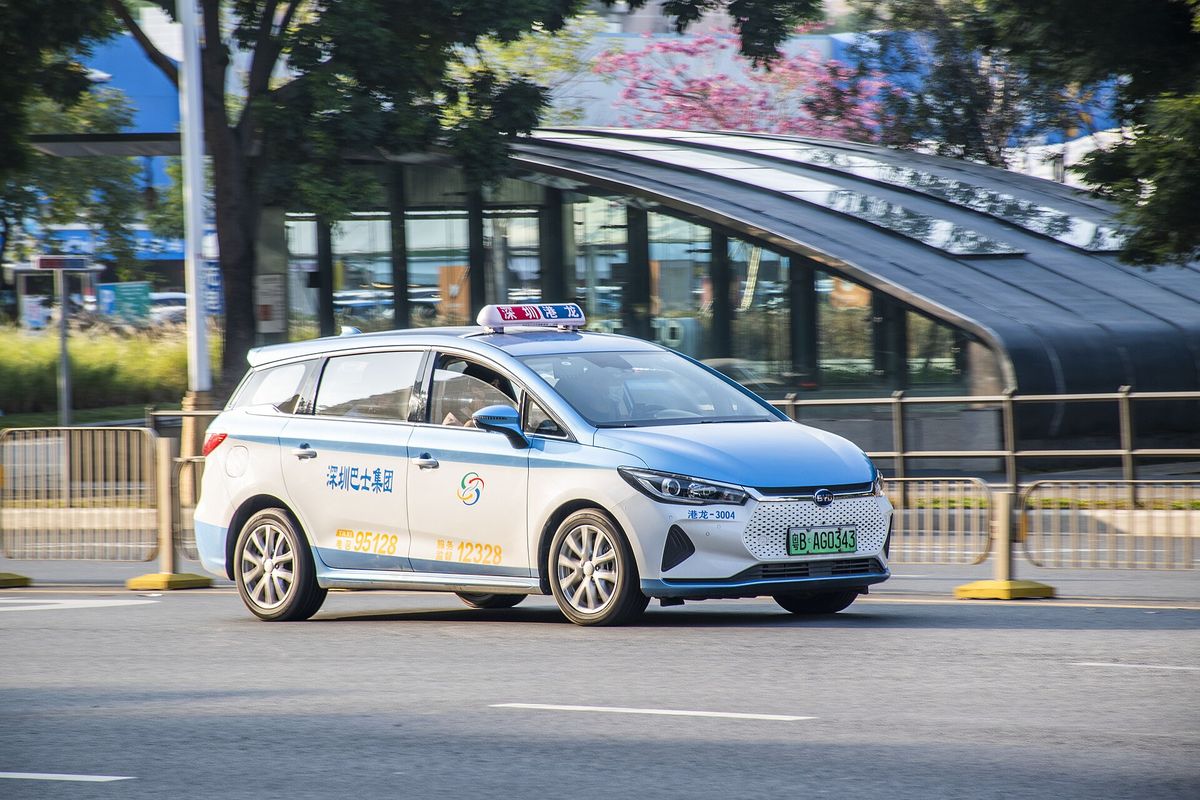

Two out of every three new passenger cars sold to buyers in China in September 2026 plugged in. The China Passenger Car Association (CPCA) put the retail penetration of new energy vehicles, meaning battery electric cars and plug-in hybrids (China also counts extended range models in the group), at a record 67.0%1, up 9.1 percentage points from a year earlier, according to CnEVPost's report on the association's data. The same month, the overall market shrank hard. CPCA figures reported by Yiche show passenger car retail of 1.618 million units2, down 28.0% year on year, with new energy vehicle (NEV) retail at 1.084 million, down 16.7%. MarkLines reported the same retail totals3 and a penetration of 67%.
What penetration means
Penetration is a share: NEV sales divided by all passenger car sales in the same channel. Divide 1.084 million by 1.618 million and the result is about 67%. The CPCA publishes two versions. Retail counts cars sold to buyers in China. Wholesale counts what manufacturers ship, which Yiche's report on the CPCA data labels manufacturer wholesale2. In September, NEV wholesale penetration was a record 65.4%1, up 12 percentage points from a year earlier, CnEVPost reported, on NEV wholesale of 1.666 million, up 11.3%.
CnEVPost reported that retail penetration had already reached a record 65.2% in August6, when NEV retail fell 10.1% year on year and total passenger car retail fell 23.6%.
How the share rose while sales fell
The share climbed because gasoline car sales fell much faster than electric ones. CnEVPost's breakdown of the CPCA figures puts gasoline vehicle retail down 43%1 year on year in September, with conventional gasoline cars down 49% and conventional hybrids up 25%. When the larger part of a market shrinks faster than the smaller part, the smaller part's share grows even as its own volume falls. CnEVPost made the same point about August, writing that "a near-halving of gasoline car sales pushed NEV penetration to a record high."6
Fuel costs are part of the CPCA's explanation. According to CnEVPost, the association said high oil prices continued to dampen demand1 for gasoline vehicles and would keep accelerating the shift toward NEVs. Yiche's report says gasoline cars from domestic, joint venture and luxury brands alike were hit hard by high oil prices2.
The fall in NEV volume has its own causes in the same reporting. CnEVPost listed the Mid-Autumn Festival in late September1, which weakened sales that week; a high base from a rush in some provinces in September 2025, before local subsidies ran out; and shortages and rising prices for memory and other chips, which slowed new NEV models. It was the ninth consecutive month1 in which NEV retail fell from a year earlier. The tax break also shrank this year: under a policy the Ministry of Finance announced in June 2023, NEVs bought in 2026 and 2027 pay vehicle purchase tax "at half the normal rate"9, after an exemption in 2024 and 2025.
Who is selling the cars
Averages hide a split by brand. CnEVPost reported retail penetration of 84.5% for domestic brands1 in September, against 44.9% for luxury brands and 15.9% for mainstream joint venture brands. BYD led NEV retail sales with 246,816 cars, followed by Geely Auto, Leapmotor, Tesla and Changan. By powertrain, battery electric retail was 765,000, down 7.38%, while plug-in hybrid retail fell 35.56% to 232,000.
Exports surge
Exports are growing far faster than home sales. CnEVPost reported NEV exports of 558,0001 in September, up 163.5% from a year earlier and 60.8% of all passenger vehicle exports. Total passenger vehicle exports reached 917,000, up 73.7%.
The China Association of Automobile Manufacturers (CAAM) counts differently, so its numbers are larger. Its NEV figures "cover both passenger and commercial vehicles"4 and include exports, CnEVPost noted. On that basis, NEV sales were 1.823 million in September, up 13.6%, and 61.6% of all vehicle sales, while domestic passenger NEV sales fell 12.1% to 1.142 million. NEV exports were 571,000 by CAAM's count, against the CPCA's 558,000 for passenger vehicles.
From one in twenty to two in three
Six years ago the share was small. An annual report released by the Ministry of Industry and Information Technology, carried by Xinhua and China Daily, put China's NEV market penetration at 5.4% in 20207, on sales of 1.37 million units. By CAAM's measure, NEVs reached 47.9% of sales in 20258, when NEV sales totalled 16.49 million. In January 2026 CAAM forecast 19 million NEV sales for the year, which CnEVPost said implied a penetration of 54.7%. The CAAM and CPCA rates are measured on different bases, so the monthly retail record and the annual figures are not directly comparable, though both point the same way.
What comes next
The CPCA expects the share to stay near its peak while volumes stay weak. In a forecast released on 23 October 2026, CnEVPost reported, the association expected October NEV retail of about 1.07 million5, down 16.5% from a year earlier, and penetration of 66.9%, a dip of 0.1 point from September's record. It also expected total passenger car retail of about 1.6 million, down 28.9%. Among the reasons the CPCA gave were a seasonal lift that has "weakened significantly"5, weak household income expectations, and automakers' caution, with most having reached less than 60% of their annual targets in the first three quarters.
Trivia
- BYD was founded in Shenzhen in February 1995. What did it make at first? Batteries10: it began as Shenzhen BYD Battery Company, producing rechargeable nickel cadmium batteries.
- In what month and year did BYD end production of pure combustion engine vehicles? March 202210.
- Which car is described as the world's first mass produced plug-in hybrid, and when did it go on sale in China? The BYD F3DM, on 15 December 200812, first to government agencies and corporations.
- In which city and province is the battery maker CATL headquartered? Ningde, Fujian11. It was founded in 2011 as a spin off of Amperex Technology Limited (ATL).
- Retail deliveries of which small SAIC-GM-Wuling electric car began in China in July 2020? The Wuling Hongguang Mini EV13.
- Which Shenzhen operator retired all its diesel buses in 2017 to run what Wikipedia calls the world's first fully electric bus fleet? Shenzhen Bus Group14, with 5,698 electric buses.
Sources
- Phate Zhang, China NEV retail sales, September 2026 (CPCA data), CnEVPost, 12 October 2026. Accessed November 1, 2026.
- Yiche, CPCA: September national passenger car retail 1.618 million, NEV penetration 67% (in Chinese), ifeng Auto, 13 October 2026. Accessed November 1, 2026.
- China's NEV penetration reaches 67%; NEV exports up 164%, MarkLines, 15 October 2026. Accessed November 1, 2026.
- Lei Kang, China NEV sales hit year-to-date high in September as export surge offsets domestic decline, CAAM data shows, CnEVPost, 12 October 2026. Accessed November 1, 2026.
- Phate Zhang, CPCA forecasts weak China NEV retail in October 2026, CnEVPost, 23 October 2026. Accessed November 1, 2026.
- Lei Kang, China's August NEV retail sales fall 10%, but penetration hits record 65.2%, CnEVPost, 8 September 2026. Accessed November 1, 2026.
- Xinhua, China's NEV market penetration rate at 5.4% in 2020, China Daily, 27 August 2021. Accessed November 1, 2026.
- Phate Zhang, CAAM forecasts China NEV sales to grow 15.2% to 19 million units in 2026, CnEVPost, 14 January 2026. Accessed November 1, 2026.
- Phate Zhang, China's Ministry of Finance explains in detail how consumers will enjoy NEV tax breaks in 2024-2027, CnEVPost, 27 June 2023. Accessed November 1, 2026.
- BYD Company, Wikipedia. Accessed November 1, 2026.
- CATL, Wikipedia. Accessed November 1, 2026.
- BYD F3DM, Wikipedia. Accessed November 1, 2026.
- Wuling Hongguang Mini EV, Wikipedia. Accessed November 1, 2026.
- Shenzhen Bus Group, Wikipedia. Accessed November 1, 2026.