D-rex, the Giant Fungus From Yunnan With a Royal Name
Key Points
- Dianjunus rex, nicknamed D-rex, was described from Yunnan, China, in Frontiers in Fungal Biology on September 29, 2026, as a new species, genus and family.
- Its fruiting bodies grow up to 50 cm high and individually 2.2 kg in weight, which the authors call the largest fructifications documented within the Ascomycota.
- It is not the heaviest: the same paper describes a Kenyan Engleromyces goetzei specimen of approximately 3.2 kg.
- The team dates the new family to about 65 million years ago, in the early Paleocene, after the extinction that ended the dinosaurs.
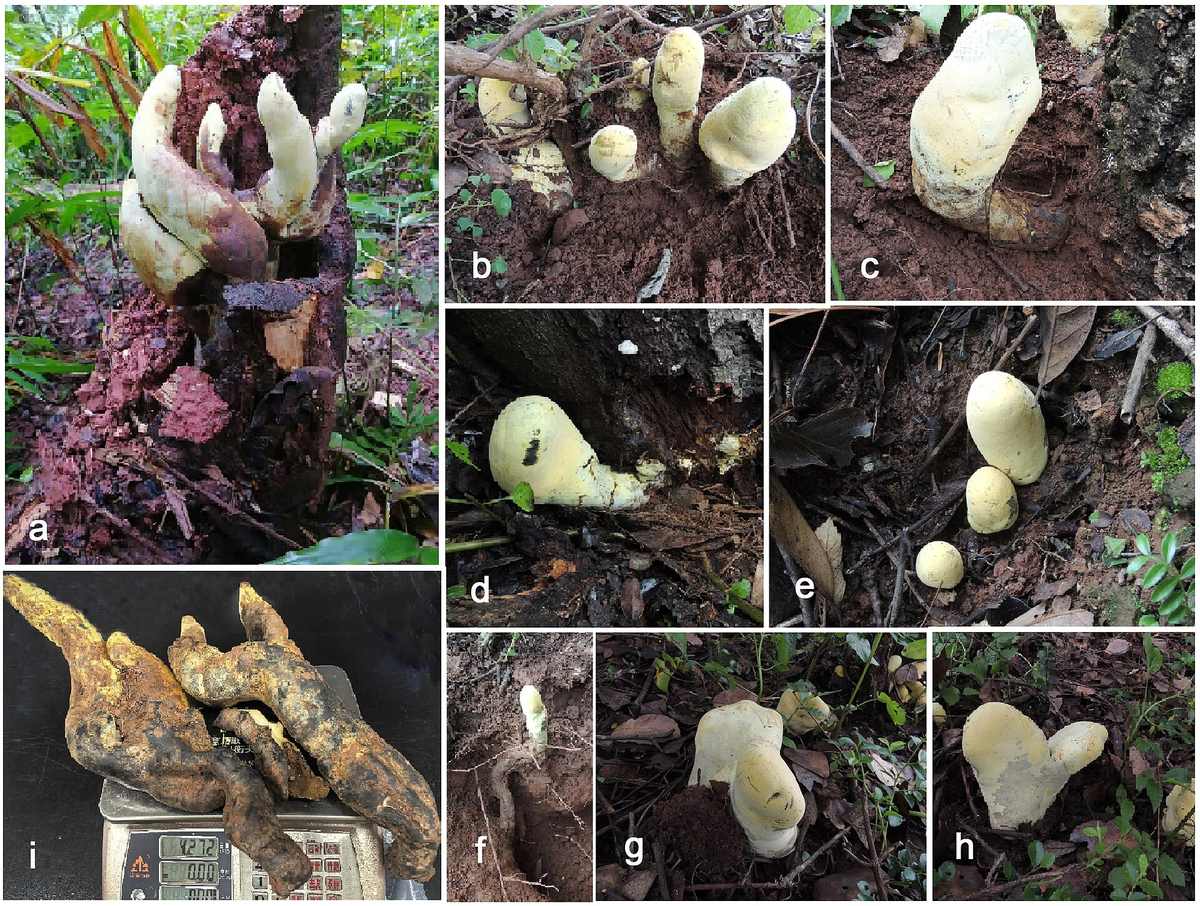

A pale, club shaped fungus from southwest China has been given a royal name. An international team of researchers has described Dianjunus rex, nicknamed D-rex, from forests in Yunnan Province, in a paper published in Frontiers in Fungal Biology on September 29, 20261. Its fruiting bodies reach up to 50 cm high and individually 2.2 kg in weight1, about 20 inches, and Popular Science puts the weight at close to five pounds3.
A whole new branch, not only a new species
D-rex is new at three levels at once. The team named a new species, a new genus and a new family, Dianjunaceae1, placed within the order Xylariales. The fungus was found during fieldwork by researchers from the Kunming Institute of Botany2, and Indunil C. Senanayake, a study co-author and mycologist3 there, said in a statement that the species represents a new fungal family3.
The genus honors the Dian Kingdom1, an ancient kingdom in what is now Yunnan, joined to the Chinese word jūn, for mushroom or fungus. Popular Science notes the Dian Kingdom peaked in the 2nd and 1st centuries BCE3. The species epithet is another nod: rex is Latin for king1, chosen for the large size and majestic appearance of its stromata.
What it looks like
The paper describes the fruiting structures, called stromata, as 20 to 50 cm in total height1, ranging in shape from cylindrical and spindle shaped to top shaped and palm shaped1. The outer surface is whitish when young and turns progressively dark yellow at maturity1, the stalk is black and smooth, and the inside is spongy and off-white to yellow. Fresh stromata are very fleshy and dehydrate rapidly after being detached1. The formal description gives fertile parts 10 to 20 cm high and 250 to 600 g in weight1. The authors also noted that tropical collections were larger than subtropical ones1.
Where it was found
The paper lists five collections1 from three parts of Yunnan. The type specimen came from near Damaidi Village in Luquan County, Kunming, collected on August 5, 20241. Further specimens came from Nanbang Village in Mengla County, Xishuangbanna, and Yipinglang Town in Lufeng, Chuxiong, in July 20251. Popular Science describes the sites as temperate coniferous forests near Damaidi and Yipinglang and a tropical rainforest near Nanbang3.
The type was associated with the roots of Quercus variabilis1, the Chinese cork oak, and Popular Science says the fungus typically grows on woody roots of Chinese cork oak trees3. The paper says the stromata come from roots of dying host plants and arise from rhizosphere soil1, the soil right around the roots, and one collection was attached to the trunk and root of a decaying, unidentified tree1. The authors frame its lifestyle as a working hypothesis of an endophyte to saprotroph lifestyle transition1: living inside a tree first, then feeding on its dead wood.
Largest, with a footnote
The authors write that the stromata of D-rex represent the largest fructifications documented within the Ascomycota1. Discover Wildlife calls Ascomycota the largest group of fungi, with over 64,000 species2.
Largest does not mean heaviest, though. The same paper describes a Kenyan specimen of Engleromyces goetzei with two lobes measuring 30 cm in diameter and a mass of approximately 3.2 kg1, about a kilogram more than the 2.2 kg D-rex figure. So the claim rests on size, not weight.
A family born after the dinosaurs
The team also estimated when the family split from its relatives. Their divergence analysis puts the origin of Dianjunaceae at approximately 65 (50 to 80) million years ago, in the early Paleocene1, the epoch that followed the Cretaceous to Paleogene extinction. Discover Wildlife frames that as only one million years after the mass extinction of dinosaurs2.
Why would a giant fungus lineage show up then? The paper suggests the timing may reflect an adaptive radiation or the exploitation of newly available ecological niches1. Senanayake offered a picture of how that could work, pointing to the sudden availability of large amounts of dead plant material2 in forests after the extinction. As for the height, the team thinks height might help the wind disperse spores better in dense forests3, and Discover Wildlife describes the advantage of a fruiting body towering over the surrounding vegetation2.
For Senanayake the larger point is how much is still out there. “The discovery illustrates how much fungus biodiversity remains to be discovered in East Asian forests3,” he said.
Trivia
- Which fungus holds the Guinness record as the largest by area? An Armillaria ostoyae honey mushroom in the Malheur National Forest, Oregon4.
- How much ground does that Oregon fungus cover, and how old might it be? 965 hectares (2,385 acres), and at least 2,400 years old, perhaps as much as 8,650, per Guinness4.
- What is the estimated weight of that same fungus, per Guinness? 6,800 to 31,750 metric tons5.
- On what does Engleromyces goetzei form its large, roughly round stromata? Bamboo culms1, the stems of bamboo.
- Which fungal family did the analysis place as the closest relative of Dianjunaceae? Graphostromataceae1, its sister clade.
- About how many fungal species have been documented in Yunnan? Over 6,000, and scientists estimate there are more than 100,0002.
- Roughly how many fungal species are known worldwide? About 150,000 to 157,0003.
Sources
- Song J., Yan Z., Pérez-Moreno J., et al., Senanayake I. C., Yu F., “Unearthing a fungal giant: Dianjunaceae fam. nov., a novel Paleocene lineage of Xylariales harboring Dianjunus rex gen. et sp. nov,” Frontiers in Fungal Biology 7, September 29, 2026, doi:10.3389/ffunb.2026.1940464. Accessed October 27, 2026.
- Magda Patynska, “Experts discover ancient, ‘extreme’ species in Chinese forest, and name it ‘D-rex’,” Discover Wildlife, October 22, 2026. Accessed October 27, 2026.
- Laura Baisas, “When ‘T. rex’ died, a new giant fungus named ‘D-rex’ took over,” Popular Science, October 14, 2026. Accessed October 27, 2026.
- Largest fungus, Guinness World Records. Accessed October 27, 2026.
- Heaviest fungus, Guinness World Records. Accessed October 27, 2026.