Euro Zone Flash PMI Slips to 51.9 in October as Growth Continues
Key Points
- The Flash Eurozone PMI Composite Output Index was 51.9 in October 2026, down from 53.1 in September and a “4-month low,” but still above the 50 level that separates growth from contraction.
- Services business activity read 51.7 and the Manufacturing PMI 52.4, from 53.0 and 52.9 in September.
- Chris Williamson of S&P Global Market Intelligence said the flash PMI is “consistent with GDP growing at a 0.3% quarterly cadence.”
- The ECB Governing Council holds a monetary policy meeting on 28 and 29 October 2026, after euro area inflation of 3.8% in September.
).jpg)
The euro area economy kept growing in October 2026, at a slower pace than in September. Provisional survey data published by S&P Global on Friday, October 23, 2026, put the Flash Eurozone PMI Composite Output Index at 51.9 in October, down from 53.1 in September1. The release called it a “4-month low”1, which makes it the lowest reading since June, and it remains above 50, the level that separates growth from contraction in this survey. The release said the index signalled “a fourth consecutive monthly increase in business activity in the euro area, albeit one that was the slowest in this sequence.”1
Both halves of the economy cooled. The services business activity index came in at 51.7, from 53.0 in September1, a two month low. In manufacturing, the output index fell to 52.4 from 53.61, and the headline Manufacturing PMI eased to 52.4 from 52.91, its lowest in three months.
What a PMI is
PMI stands for Purchasing Managers’ Index. S&P Global runs these surveys in over 40 countries and also for key regions including the eurozone1, and describes them as “the most closely watched business surveys in the world”1. The eurozone version is built from questionnaires sent to manufacturers in Germany, France, Italy, Spain, the Netherlands, Austria, Ireland and Greece, and service providers in Germany, France, Italy, Spain and Ireland1, around 5,000 companies in all. The panels are stratified by detailed sector and company workforce size1, based on contributions to GDP.
Each firm says whether a measure such as output, new orders or employment was higher, the same or lower than a month earlier. For every question the index is the sum of the percentage of “higher” responses and half the percentage of “unchanged” responses1. It runs from 0 to 100, with a reading above 50 indicating an overall increase compared to the previous month, and below 50 an overall decrease1. The national results are seasonally adjusted and then weighted together1 using annual value added figures from Eurostat, the statistics office of the European Union.
Several numbers carry the PMI name, and they are not all alike. The composite figure is a weighted average of the Manufacturing Output Index and the Services Business Activity Index1. The headline Manufacturing PMI blends five indices: new orders (30%), output (25%), employment (20%), suppliers’ delivery times (15%) and stocks of purchases (10%)1, with the delivery times index inverted. In October the manufacturing output index and the Manufacturing PMI both happened to read 52.4, though S&P Global says the composite figure “is not comparable with the headline Manufacturing PMI.”1
How early and how exact
A flash PMI is an early cut. The October responses were collected 12 to 21 October 20261, and the composite was based on approximately 85% of usual survey responses1. Since flash data were first processed, the final composite has differed from the flash by 0.1 on average, with an average absolute difference of 0.31. As of the release, final October data were scheduled for 2 November for manufacturing and 4 November for services and composite indicators1.
The survey records the direction of change, not its size. A reading of 51.9 points to an overall increase in activity, without saying by how much output grew. Chris Williamson, chief business economist at S&P Global Market Intelligence, translated it into growth terms, saying the flash PMI is “consistent with GDP growing at a 0.3% quarterly cadence”1. He added that while this is below the pace of September, “it is still among some of the best performances seen over the past three years.”1
Inside the October survey
New orders increased at the slowest pace in the current four-month sequence of expansion1, and the rate of growth was only slight. Export orders, which include trade between euro area countries, rose for the third consecutive month1. That followed almost four-and-a-half years in which new export business had fallen continuously on a monthly basis1, and in October the rise in export orders was stronger than that seen for total new business1.
Employment was broadly unchanged1. Job creation in services eased to a five-month low1, while manufacturing employment ticked down following two months of improvement1. Staff numbers kept rising in Germany, while France saw a further fall in staffing levels1.
French private sector output moved back into contraction in October, following a first rise in 10 months during September1, and Williamson named “a renewed drop in business activity in the French services sector”1 as a key drag on growth. Germany and the rest of the eurozone as a whole continued to record growth of activity, albeit with rates of expansion easing1.
Costs moved the other way from activity. Manufacturers reported a sharp and accelerated increase in input prices1, often linked to higher costs for energy, fuel and transportation, and the rise was the steepest since May1. Output price inflation slowed, though. Business confidence waned to the lowest in five months1, falling particularly sharply in manufacturing.
Germany’s ifo index, three days later
A separate German survey, from the ifo Institute, gave a mixed picture. On October 26, 2026, the institute reported that its Business Climate Index rose to 90.2 points in October, up from 89.9 points in September2. The rise came from more optimistic expectations2; companies assessed their current situation as slightly worse2. In services the business climate “suffered a setback,”2 though expectations there were more positive2, while in manufacturing the index rose significantly2.
The ECB meets October 28 and 29
The European Central Bank says its job is “to maintain price stability”5 for the euro, which is legal tender in 21 of the 27 Member States of the European Union6. It targets an inflation rate of 2% over the medium term5. Its Governing Council holds a monetary policy meeting in Frankfurt on 28 and 29 October 2026, followed by a press conference on the second day3.
As of October 27, 2026, the ECB deposit facility rate stood at 2.50%, in effect since 16 September 20264. It had been 2.25% from 17 June 20264 and 2.00% from 11 June 20254. Eurostat reported that “the euro area annual inflation rate was 3.8% in September 2026, up from 3.2% in August,”7 against the ECB’s 2% target.
Williamson linked part of the slowdown to borrowing costs, writing that “higher interest rates are also starting to take a toll, dampening demand”1. In his reading, the mix of sustained growth and stubbornly elevated inflation in the October flash “will likely add to further speculation of more aggressive policy tightening from the ECB.”1
Trivia
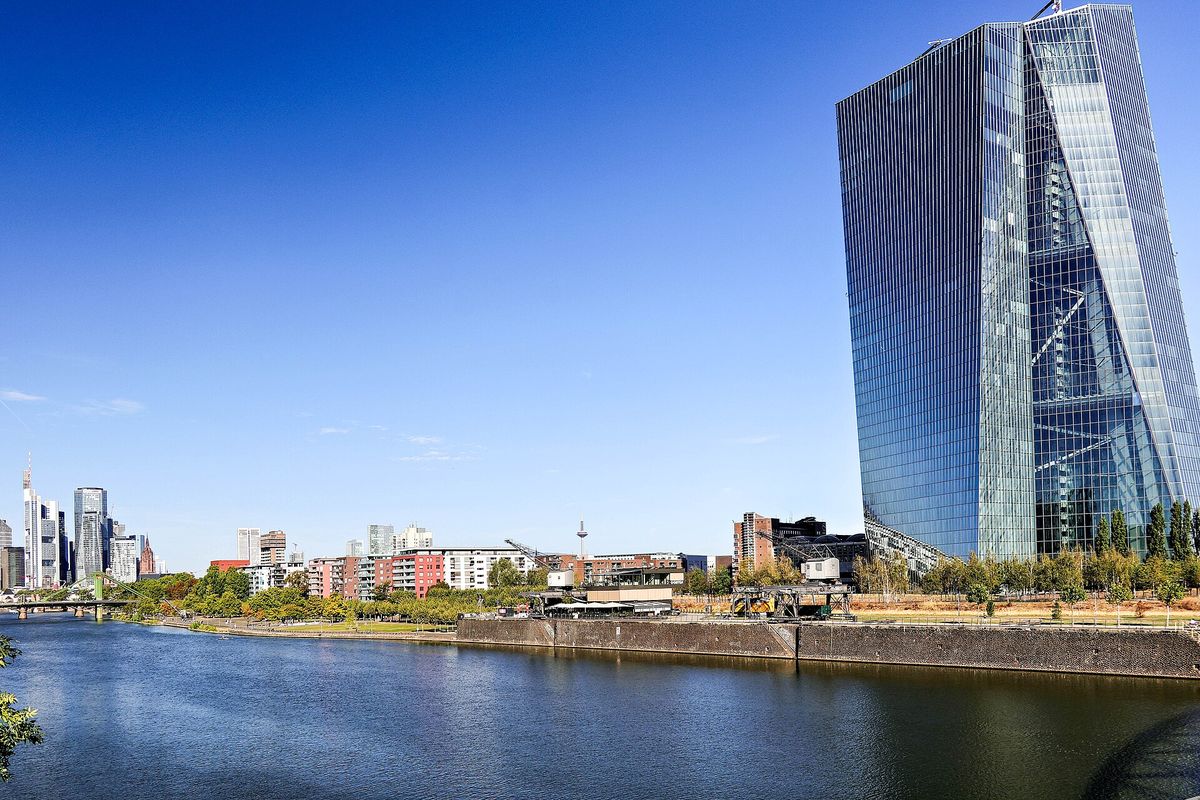
- How tall is the office tower of the ECB’s main building in Frankfurt? 185 metres8.
- Which older structure is part of the ECB main building? The Grossmarkthalle, Frankfurt’s former wholesale market hall8, which the ECB describes as 250 metres long.
- In which year was the site of the ECB main building judged suitable for it? 20018, according to the ECB; staff began moving into the new building in November 201411.
- How many trees were planted on the ECB headquarters site? 7008, according to the ECB.
- On what date were the ECB and the European System of Central Banks established? 1 June 19989.
- Which ECB President said the bank was “ready to do whatever it takes to preserve the euro”, and where? Mario Draghi, at the Global Investment Conference in London on 26 July 201210.
Sources
- S&P Global, S&P Global Flash Eurozone PMI, news release (PDF), October 23, 2026. Accessed October 27, 2026.
- ifo Institute, ifo Business Climate Rises (October 2026), press release, October 26, 2026. Accessed October 27, 2026.
- European Central Bank, Meetings of the Governing Council and the General Council. Accessed October 27, 2026.
- European Central Bank, Official interest rates. Accessed October 27, 2026.
- European Central Bank, Monetary policy. Accessed October 27, 2026.
- European Central Bank, Our money. Accessed October 27, 2026.
- Eurostat, Annual inflation up to 3.8% in the euro area, Euro indicators, October 16, 2026. Accessed October 27, 2026.
- European Central Bank, The ECB’s main building. Accessed October 27, 2026.
- Eesti Pank, European Central Bank. Accessed October 27, 2026.
- European Central Bank, Verbatim of the remarks made by Mario Draghi, Global Investment Conference, London, July 26, 2012. Accessed October 27, 2026.
- Wikipedia, Seat of the European Central Bank. Accessed October 27, 2026.