The First Photos of Earth From Space, Taken 24 October 1946
Key Points
- On 24 October 1946, a captured German V-2 rocket, V-2 #13, launched from White Sands Missile Range in New Mexico with a 35mm movie camera aboard and took the first pictures of Earth from space.
- The camera was the work of Clyde Holliday of the Johns Hopkins Applied Physics Laboratory, and the rocket coasted to a peak of 65.0 miles (104.6 km).
- Smithsonian magazine reports the rocket fell back at 500 feet per second, and an APL history says the camera and its film, in an armored case, were recovered a few hours after the flight.
- Explorer 6 sent back the first picture from orbit on August 14, 1959, and the Apollo 17 crew took the Blue Marble on December 7, 1972.
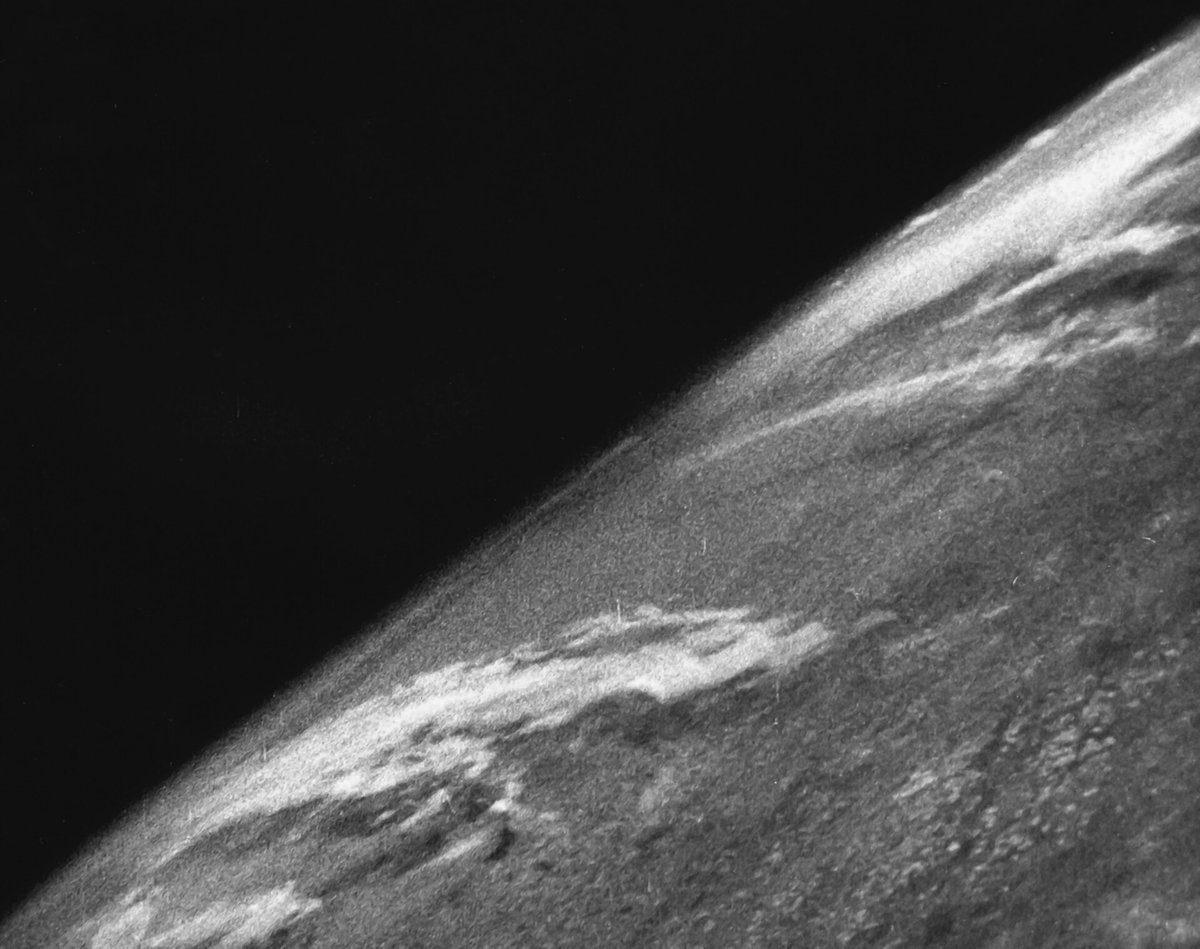

On 24 October 1946, a captured German V-2 rocket, designated V-2 #13, launched from White Sands Missile Range1 in New Mexico with a 35mm movie camera aboard. Within hours a recovery team had found the camera4 in the desert, and the film inside it held the first pictures ever taken of Earth from space. Saturday, 24 October 2026, is the 80th anniversary.
A war rocket turned into a lab
The rockets came out of Germany after World War II, and the United States put them to work on the upper atmosphere. At White Sands, assembly of the V-2s was carried out by engineers and technicians from the General Electric Co.4, according to Lorence Fraser, who wrote a history of the program for the Johns Hopkins Applied Physics Laboratory (APL) in 1985. From May 1946 until February 1949, 10 V-2 rockets were instrumented by APL4, carrying experiments on cosmic rays, solar spectroscopy and high-altitude photography4.
An APL payload4 flown even earlier, on 16 April 1946, recorded no data6 after the rocket malfunctioned, and a camera on V-2 #12 two weeks before the famous flight produced blurred, vignetted photos with a limited view of Earth8, Andrew LePage writes in his history of the flights.
The camera and the man who built it
The camera was the work of Clyde Holliday. Fraser’s account says that Clyde Holliday of APL placed a DeVry 35-millimeter motion picture camera in a V-2 rocket4 to get the first pictures of Earth from altitude. The Linda Hall Library calls it a quasi-movie camera, taking an image on film every 1.5 seconds3. Because it kept shooting for several minutes, there were quite a few “first photos” taken3. LePage adds that it rode in a steel box between the propellant tanks8, with the exposed film wound into an armored drum.
Sixty-five miles up
The rocket left the pad at 12:18 p.m. Mountain Standard Time5, the 1218 MST7 entered in the flight’s Upper Air Rocket Summary. Its engine burned for 59.8 seconds5, and the rocket then coasted to a peak of 65.0 miles (104.6 km) at 180.0 seconds5. That is past the line usually drawn for the edge of space at about 62 miles, or 100 km, and Universe Today notes the rocket cleared it by about 3 miles9.
The rocket fell back to Earth at 500 feet per second2, according to Smithsonian magazine. NASA’s account says the camera was destroyed upon impact, but the film survived1. LePage, though, says it was found in good shape save for its missing lens8, and David DeVorkin, curator emeritus at the National Air and Space Museum, writes in a passage quoted by Inverse that it turned up “in almost perfect condition”10 apart from a lost lens.
Jeeps, a hole in the sand and a steel case
Michael Neufeld, a senior curator at the National Air and Space Museum, told Inverse that the early V-2 teams would “put things in armored casings and hope that it would survive being smashed into the ground”10, then send people out to search. In his words, “They’d have to send people out in Jeeps in the desert and say, ‘look for a hole roughly over there.’”10 Fraser’s account says the camera and exposed film in an armored case were recovered a few hours after the flight4.
Fred Rulli was 19 and on the recovery team that drove out into the desert2. Smithsonian magazine, telling the story in 2016, wrote that “the film, protected by a steel case, returned the first images of our planet from space.”2 When the team found the film intact2, Rulli recalled, the researchers were thrilled. “They were ecstatic, they were jumping up and down like kids,”2 he said. Later, he said, “when they first projected [the photos] onto the screen, the scientists just went nuts.”2
What the pictures showed
The picture is grainy, showing clouds over the Southwest2, and Space Center Houston calls the V-2 frames the first shots of the Earth against the black vastness of space11. The previous height record for a photograph belonged to the Explorer II balloon, which reached 13.7 miles12 in 1935, with Captains Albert W. Stevens and Orvil A. Anderson8 aboard. The V-2 had gone almost five times higher.
APL released stills in November 1946 taken at 48, 72, and 104 km8. The Los Angeles Examiner ran them under the headline “You’re on a V-2 Rocket 65 Miles Up!”10, and the Trans-Lux newsreel service billed them as the “most sensational newsreel images of all time”10. Fraser later wrote that few news releases ever won the attention of the world-wide media4 the way the photographs from Aerobee and V-2 rockets did.
For the scientists, the pictures had a working purpose too. Fraser explains that the images provided unquestioned data on the angular motion of the rocket4, which mattered because the cosmic ray results depended on knowing which way the rocket was pointing. Writing in National Geographic in 1950, Holliday said the photos showed “how our Earth would look to visitors from another planet coming in on a space ship”11, as quoted by Space Center Houston.
What came after
In 1947 researchers assembled the first images of Earth’s cloud cover from more than 100 miles12 up, also from a V-2 camera, and between 1946 and 1950, researchers collected over 1,000 images of earth from space aboard the V2 rockets2.
The first picture from orbit came almost 13 years after the White Sands flight. On August 14, 195914, NASA’s Explorer 6 satellite sent back a rough image of the north central Pacific Ocean14, taken while it was orbiting over Mexico. One of the best known whole Earth photographs followed on December 7, 197215, when the Apollo 17 crew, heading for the Moon, took the frame now called the Blue Marble. NASA’s caption notes that almost the entire coastline of Africa is clearly visible15.
Trivia
- When did Clyde Holliday die? On June 23, 19823, according to the Linda Hall Library; he is buried in Rockville Cemetery in Rockville, Maryland.
- What did V-2 #21 photograph on 7 March 1947? The Gulf of California, from 101 miles (about 163 km) up13.
- How much did V-2 #13 weigh fully fueled? 28,277 pounds (12,826 kg)5, against 9,070 pounds unfueled.
- How far from the launch site did V-2 #13 come down? About 17 miles north-northwest5 of where it took off.
- What rocket launched Explorer 6, and from where? A Thor-Able, from Cape Canaveral, Florida, on August 7, 195914.
- How long did Explorer 6 take to send its first Earth image, and where did it go? About 40 minutes, to a ground station in Hawaii14.
- What could the Blue Marble show that no earlier Apollo crew had been able to photograph? The south polar ice cap16 of Antarctica; NASA’s caption for frame AS17-148-22727 says it was the first time the Apollo trajectory made that possible.
- Roughly how many Aerobee sounding rockets flew in all? More than 1,000. Wikipedia counts 1,037 including variants17, and Astronautix cites a flight log of 1,030 flights18.
Sources
- “1946: First photo of Earth from space”, NASA Science. Accessed October 24, 2026.
- Jason Daley, “70 Years Ago Today, Nazi Rockets and American Scientists Took the First Photo of Earth From Space”, Smithsonian Magazine, 24 October 2016. Accessed October 24, 2026.
- William B. Ashworth, Jr., “Clyde T. Holliday”, Scientist of the Day, Linda Hall Library, 24 October 2025. Accessed October 24, 2026.
- Lorence W. Fraser, “High Altitude Research at the Applied Physics Laboratory in the 1940s”, Johns Hopkins APL Technical Digest, Volume 6, Number 1 (1985). Accessed October 24, 2026.
- Bryan Swopes, “24 October 1946”, This Day in Aviation. Accessed October 24, 2026.
- “UARS 2, Upper Air Rocket Summary, V-2 No. 2, 16 April 1946”, postwarv2.com. Accessed November 6, 2026.
- “UARS 13, Upper Air Rocket Summary, V-2 No. 13, 24 October 1946”, postwarv2.com. Accessed November 6, 2026.
- Andrew LePage, “First Pictures: The View of Earth from Space, October 24, 1946”, Drew Ex Machina, 24 October 2021. Accessed October 24, 2026.
- “This Is the Very First Photo of Earth From Space”, Universe Today. Accessed October 24, 2026.
- Jon Kelvey, “The first photo of Earth from space”, Inverse, 24 October 2021, updated 20 February 2024. Accessed October 24, 2026.
- “First photo taken from space”, Space Center Houston, 24 October 2019. Accessed October 24, 2026.
- “1947: First images of Earth’s cloud cover from 100 miles in space”, NASA Science. Accessed October 24, 2026.
- Eleanor Imster, “This date in science: First-ever photo of Earth from space”, EarthSky, 23 October 2026. Accessed October 24, 2026.
- “60 Years Ago: First Satellite Image of Earth”, Kennedy Space Center Visitor Complex, 7 August 2019. Accessed October 24, 2026.
- “The Blue Marble”, NASA Science. Accessed October 24, 2026.
- “AS17-148-22727”, NASA Image Detail. Accessed October 24, 2026.
- “Aerobee”, Wikipedia. Accessed October 24, 2026.
- “Aerobee”, Astronautix. Accessed November 6, 2026.