Galileo's Gaspra Flyby at 35: First Close Look at an Asteroid
Key Points
- NASA's Galileo mission page says the spacecraft passed asteroid 951 Gaspra on October 29, 1991, becoming the first spacecraft ever to encounter an asteroid.
- NASA's page gives the closest pass as within 1,601 kilometers of the asteroid's center, at a relative speed of about 8 kilometers per second.
- NASA's caption for the highest-resolution mosaic describes an irregular body of about 19 by 12 by 11 kilometers with more than 600 craters of 100 to 500 meters visible, while other sources give different dimensions.
- NASA says the high-gain antenna failed to deploy fully in April 1991, so the mission relied on slower low-gain antennas.
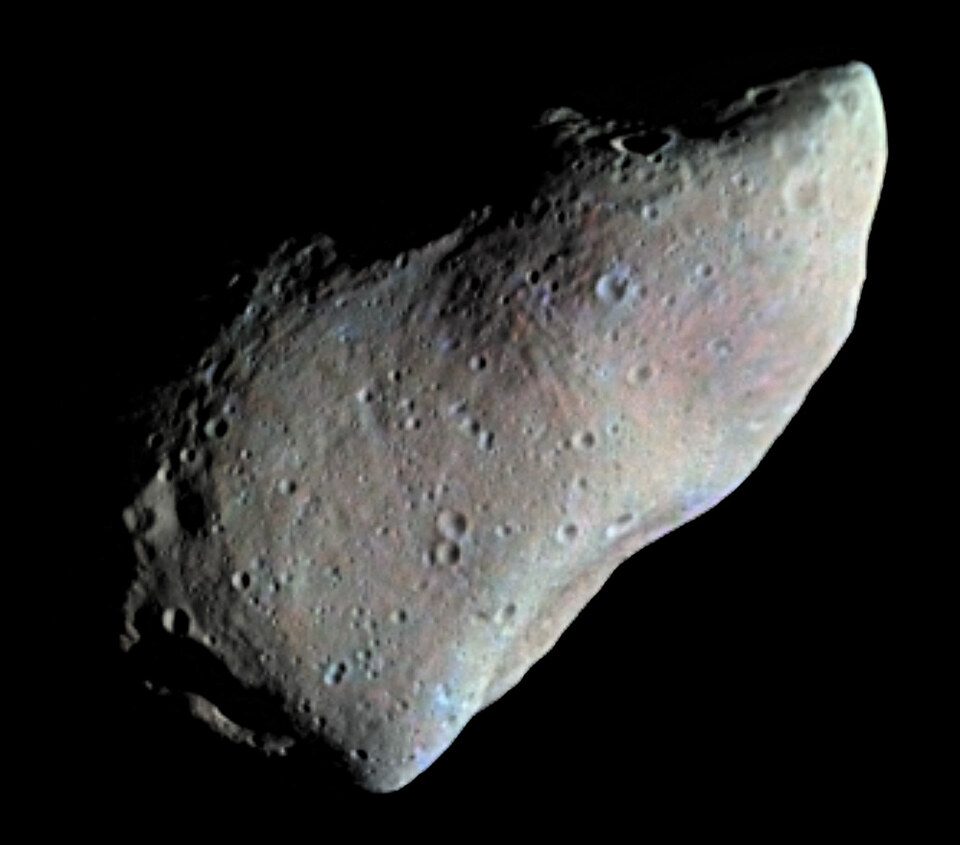

NASA's Galileo mission page says Galileo became the first spacecraft ever to encounter an asteroid when it passed Gaspra on October 29, 19911. Thursday, October 29, 2026, is 35 years to the day since that flyby. Here is what NASA's own pages say about the encounter and the asteroid, and where the figures differ between sources, as of October 29, 2026.
The flyby
The mission page says Galileo flew within 1,601 kilometers (about 1,000 miles) of the asteroid's center at a relative speed of about 8 kilometers per second (18,000 miles per hour)1. It lists the launch as October 18, 1989, from Kennedy Space Center on space shuttle Atlantis (STS-34), a Venus flyby on February 10, 1990, and Earth flybys on December 8, 1990 and December 8, 19921. Gaspra came between the two Earth flybys.
NASA's National Space Science Data Coordinated Archive describes Galileo's route as Venus, Earth, Earth gravity assists, and says that after each Earth flyby the spacecraft made excursions as far out as the asteroid belt, which allowed the first close-up studies of two asteroids, Gaspra and Ida3. The same archive page lists the close flyby of an asteroid (Gaspra) among Galileo's scientific firsts3.
What the pictures showed
NASA's Photojournal entry for the highest-resolution Gaspra mosaic, added to the archive on February 1, 1996, says the picture combines two images taken from a range of 5,300 kilometers (3,300 miles), some 10 minutes before closest approach2. It gives the resolution as about 54 meters per pixel, the highest for the encounter and about three times better than the view released in November 19912.
The caption describes an irregular body of about 19 by 12 by 11 kilometers (12 by 7.5 by 7 miles) that rotates counterclockwise every 7 hours, and says more than 600 craters of 100 to 500 meters in diameter are visible in the mosaic2. It adds that the number of such small craters compared with larger ones is much greater on Gaspra than on previously studied bodies of comparable size, such as the moons of Mars2.
The caption also describes groove-like linear features 100 to 300 meters wide and tens of meters deep, in two crossing groups, which it says had previously been seen only on Mars's moon Phobos but were predicted for asteroids2. It says Gaspra's very irregular shape suggests the asteroid was derived from a larger body by nearly catastrophic collisions, and that the grooves are believed to be related to fractures2.
Sources differ on the size. The mission page rounds the dimensions to about 20 by 12 by 11 kilometers and says the data revealed a thin covering of dust and rubble1. Wikipedia's infobox lists 18.2 by 10.5 by 8.9 kilometers, citing a 1994 paper in the journal Icarus4. The photo above is a composite. Its Commons file page quotes a description saying it combines the highest-resolution Galileo images with color information, and that the subtle color variations have been exaggerated5.
Aiming at a small target
Wikipedia's article on Gaspra says the asteroid's position was known only to within about 200 kilometers before the encounter, and that the camera's field of view was only about 5 degrees across, so a pioneering optical navigation campaign using images taken on approach was used to narrow down where Gaspra was4. It says 57 images were returned to Earth, that about 80 percent of the asteroid was imaged, and that the area around the southern pole was not seen4.
A spacecraft with a stuck antenna
NASA says the spacecraft was scheduled to deploy its 4.8-meter (16-foot) high-gain antenna in April 1991, but the antenna failed to deploy fully, and that a special team determined a few (probably three) of its 18 ribs were held by friction in the closed position1. NASA says that from 1993 to 1996 new flight and ground software was developed, and Deep Space Network ground stations were enhanced, so the mission could be performed using the low-gain antennas, which send and receive data at a much slower rate1.
The Photojournal caption for the Gaspra mosaic says additional images of the asteroid remained stored on Galileo's tape recorder, awaiting playback in November2. The pages read for this article do not say how many of the encounter's images those were.
Ida and Dactyl, two years later
NASA says Galileo made a second asteroid encounter on August 28, 1993, with Ida, which it describes as larger and more distant, about 55 kilometers (34 miles) long and 24 kilometers (15 miles) wide1. It says scientists discovered that Ida has its own moon, Dactyl, about 1.5 kilometers across, making Ida the first asteroid known to have a natural satellite1. By determining Dactyl's orbit, NASA says, scientists estimated Ida's density1.
About the asteroid itself
Wikipedia says Gaspra, formally 951 Gaspra, was discovered on July 30, 1916, by G. N. Neujmin at Simeiz Observatory, and was named after a Black Sea retreat in Crimea4. It lists an orbit of about 3.29 years at an average distance of about 2.21 astronomical units from the Sun, just outside the orbit of Mars4.
Trivia
- On what date in 1991 did Galileo fly past Gaspra? October 291.
- Which space shuttle launched Galileo in October 1989? Atlantis (STS-34)1.
- Which other asteroid did Galileo fly past on August 28, 1993? Ida1.
- What is the name of Ida's moon, found in Galileo's images? Dactyl1.
- Gaspra was named after a retreat on the coast of which sea? The Black Sea4.
Sources
- Galileo, NASA Science (mission overview, quick facts and asteroid flybys). Accessed October 29, 2026.
- Gaspra, Highest Resolution Mosaic (PIA00118), NASA/JPL, NASA Photojournal, image added February 1, 1996. Accessed October 29, 2026.
- Galileo Project Information, NASA National Space Science Data Coordinated Archive. Accessed October 29, 2026.
- 951 Gaspra, Wikipedia. Accessed October 29, 2026.
- File:951 Gaspra.jpg, Wikimedia Commons. Accessed October 29, 2026.