Halloween Costumes and Anonymity: The Trick-or-Treat Experiments
Key Points
- Seetahul and Greitemeyer's 2022 paper found equivalent helping between masked and unmasked people in two pre-registered field tests with 5,706 participants in total, and says a meta-analysis of sixty empirical papers showed little support for deindividuation.
- The paper's introduction summarizes a 1976 Halloween experiment on 1,039 children in which 10.5 percent of identifiable children stole candy, against 80 percent of those who stayed anonymous.
- A 1979 abstract reports two field experiments in which a mirror behind the candy bowl lowered transgression among children who had given their names but not among anonymous children.
- A 2003 analysis of 500 violent attacks in Northern Ireland found more serious injuries from offenders wearing disguises, but it uses attack records and cannot show cause.
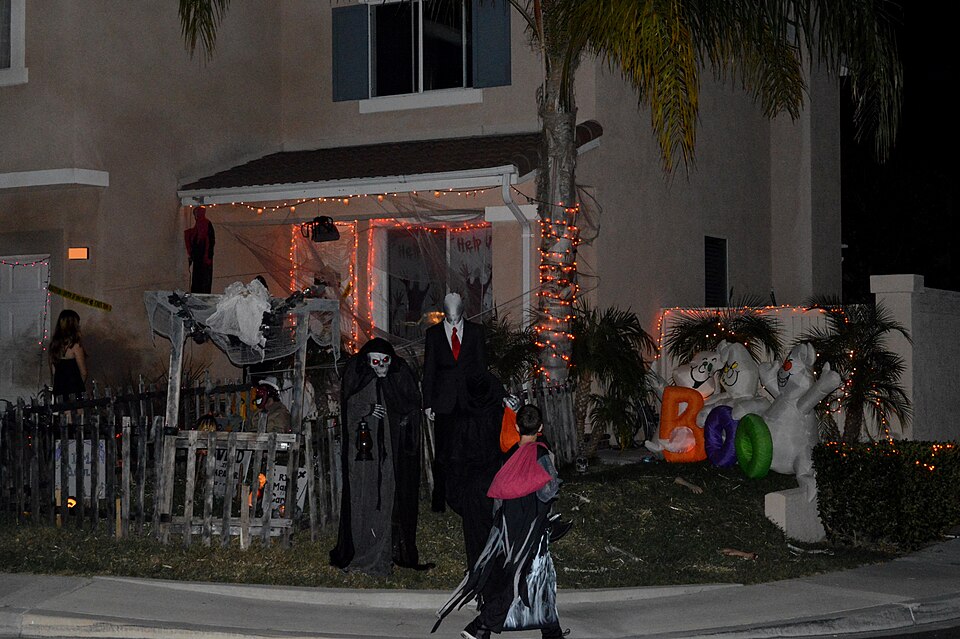

A 2022 paper in Scientific Reports by Yashvin Seetahul and Tobias Greitemeyer summarizes the early Halloween experiments on anonymity and candy-taking in its introduction1 before testing the idea again with face masks in two field studies. The older work reported a striking pattern: with children in costumes and masks, more anonymous children took extra candy. This article follows that claim from the 1970s to the 2020s and says which parts each cited source supports.
The idea behind it
The 2022 paper traces deindividuation to Festinger, Pepitone and Newcomb in 1952, who described a state in which people make less effort to behave normatively because they are not seen or paid attention to as individuals1. Zimbardo's 1969 chapter extended the idea to any situation that reduces self-observation, self-evaluation and concern for social evaluation1. In his account, the anticipation of guilt, shame or fear normally pushes people to follow norms, so removing the sense of being identifiable should make anti-normative behavior easier1.
The 1976 trick-or-treat experiment
According to the 2022 paper's summary, Diener, Fraser, Beaman and Kelem published a study in the Journal of Personality and Social Psychology in 1976 on 1,039 children trick-or-treating in costumes and masks1. The children were given the chance to steal candy, and the authors manipulated identifiability by asking half of them for their names and addresses1. In that summary, 10.5 percent of the identifiable children stole candy, against 80 percent of those who stayed anonymous1.
The same paper describes a 1979 similar study by Miller and Rowold, who counted children who stole candy and compared masked with unmasked children: 62 percent of the masked children did so, against 37 percent of the unmasked1. The two results point the same way.
A mirror and a name
A 1979 paper by Beaman, Klentz, Diener and Svanum, in the Journal of Personality and Social Psychology (volume 37, issue 10), reports two field studies on self-awareness and transgression in children2. In the first, 363 Halloween trick-or-treaters were told to take only one candy2. A mirror placed behind the candy bowl, which induced self-awareness, lowered the rate of transgression among children who had been individuated by being asked their name and address, but it did not change the behavior of children left anonymous2.
The abstract adds that self-awareness influenced older children but not younger ones, and that the behavior of the first child to reach the bowl in each group, which set a naturally occurring standard, interacted with the standard the experimenter stated2. A second study with 349 subjects replicated the first, and when the experimenter stated no standard, children took more candy when they were not self-aware than when they were2. The pattern is more specific than a simple rule that masks cause bad behavior. Here the mirror mattered for children who had given their names and did not matter for the anonymous ones.
Disguises outside the candy bowl
Silke, writing in the Journal of Social Psychology in August 2003, examined 500 violent attacks in Northern Ireland, of which 206 were carried out by offenders wearing disguises3. Disguised offenders inflicted more serious physical injuries, attacked more people at the scene, committed more acts of vandalism and were more likely to threaten victims afterward3. The author discussed the results within the framework of deindividuation theory3. The abstract describes relationships between disguise and aggression in attack records, not an experiment, so it cannot say whether the disguise caused the difference or whether people planning worse attacks were more likely to disguise themselves.
The scientific standing
The 2022 paper says that several other findings showed no evidence of a deindividuation state, and that a meta-analysis by Postmes and Spears of sixty empirical studies showed little support for the phenomenon1. It adds that early work focused on increases in antisocial behavior and showed little evidence of decreases in prosocial behavior, while more recent work suggests reduced identifiability may still lead to a deindividuated state1.
Seetahul and Greitemeyer ran two pre-registered field studies with a combined 5,706 participants, testing whether people wearing a face mask, who might feel less identifiable, would help less1. In the first, 186 people wore a mask and 212 did not; in the second, 2,250 wore a mask and 3,058 did not1. The helping measure was how many questions of a long paper survey a stranger would answer for a research assistant, with nothing gained by answering1. Most people in every group answered none1.
In the second study the mask group averaged 9.05 questions and the no-mask group 7.88, and an equivalence test rejected a difference as large as an effect size of 0.21. Mask wearers did rate themselves as less identifiable, 3.05 on average against 3.19, yet the abstract says helping was equivalent in both studies1. The authors list limits, including possible selection bias, research assistants who wore masks themselves, and explicit items that may have drawn attention to identifiability1. Their sample also differs from the Halloween children in an obvious way: people approached by research assistants, not costumed children, so the two sets of findings are not directly comparable. It only shows that a link between feeling less identifiable and helping less did not turn up in those two samples. The authors note that the design cannot test causal claims, and that people chose whether to wear a mask.
What the sources support
The 1976 figures, as the 2022 paper summarizes them, show anonymous children stealing candy far more often than children asked for their names and addresses. The 1979 abstract adds that a mirror lowered transgression among children who had given their names but not among anonymous children. They disagree on how far the idea stretches. The 2003 attack records were discussed within deindividuation theory by their author, but they cannot test it, and the 2022 paper reports weak support in a meta-analysis and equivalent helping between masked and unmasked people. None of these sources gives advice about costumes, parenting or behavior, so this article draws none.
Trivia
- In the 1976 trick-or-treat experiment as summarized in 2022, what share of anonymous children stole candy? 80 percent, against 10.5 percent of identifiable children1.
- How many trick-or-treaters were in the first 1979 mirror study? 3632.
- What did the mirror not change in that study? The behavior of children left anonymous2.
- How many of the 500 Northern Ireland attacks were committed by disguised offenders? 2063.
- What combined number of participants did the two 2022 mask field studies have? 5,7061.
Sources
- Seetahul Y, Greitemeyer T. A practical test of the link between perceived identifiability and prosociality with two field studies. Scientific Reports, 12, 13149, 2022 (PubMed 35909195, PMC9339540). Accessed November 6, 2026.
- Beaman AL, Klentz B, Diener E, Svanum S. Self-awareness and transgression in children: two field studies. Journal of Personality and Social Psychology, 37(10), October 1979 (PubMed 512839). Accessed October 31, 2026.
- Silke A. Deindividuation, anonymity, and violence: findings from Northern Ireland. The Journal of Social Psychology, 143(4), August 2003 (PubMed 12934837). Accessed October 31, 2026.