Hedy Lamarr, Born Nov. 9, 1914, and Her Frequency Hopping Patent
Key Points
- The National Inventors Hall of Fame gives Hedy Lamarr's birth date as November 9, 1914, so November 9, 2026, is her 112th birthday.
- US Patent 2,292,387, Secret Communication System, was filed June 10, 1941, and granted August 11, 1942, to Hedy Kiesler Markey and George Antheil.
- The patent proposes player piano style paper rolls at the transmitter and receiver so both change frequency together, which it says would keep an enemy without the records from knowing which frequency the next control signal would use.
- The Hall of Fame says the Navy initially shunned the technique, and that by 1957 Sylvania Electronic Systems had taken up the concept.

The National Inventors Hall of Fame gives Hedy Lamarr's birth date as November 9, 1914, and her death as January 19, 20002. Smithsonian magazine says she was born Hedwig Eva Maria Kiesler in 1914 to a well-heeled Jewish family in Vienna4. Counting from the Hall of Fame's date, Monday, November 9, 2026, is her 112th birthday. The Hall of Fame says she was best known for her work in Hollywood during its Golden Age, and that the frequency hopping technique she invented with the composer George Antheil is today referenced as an important development in wireless communications2.
The patent itself
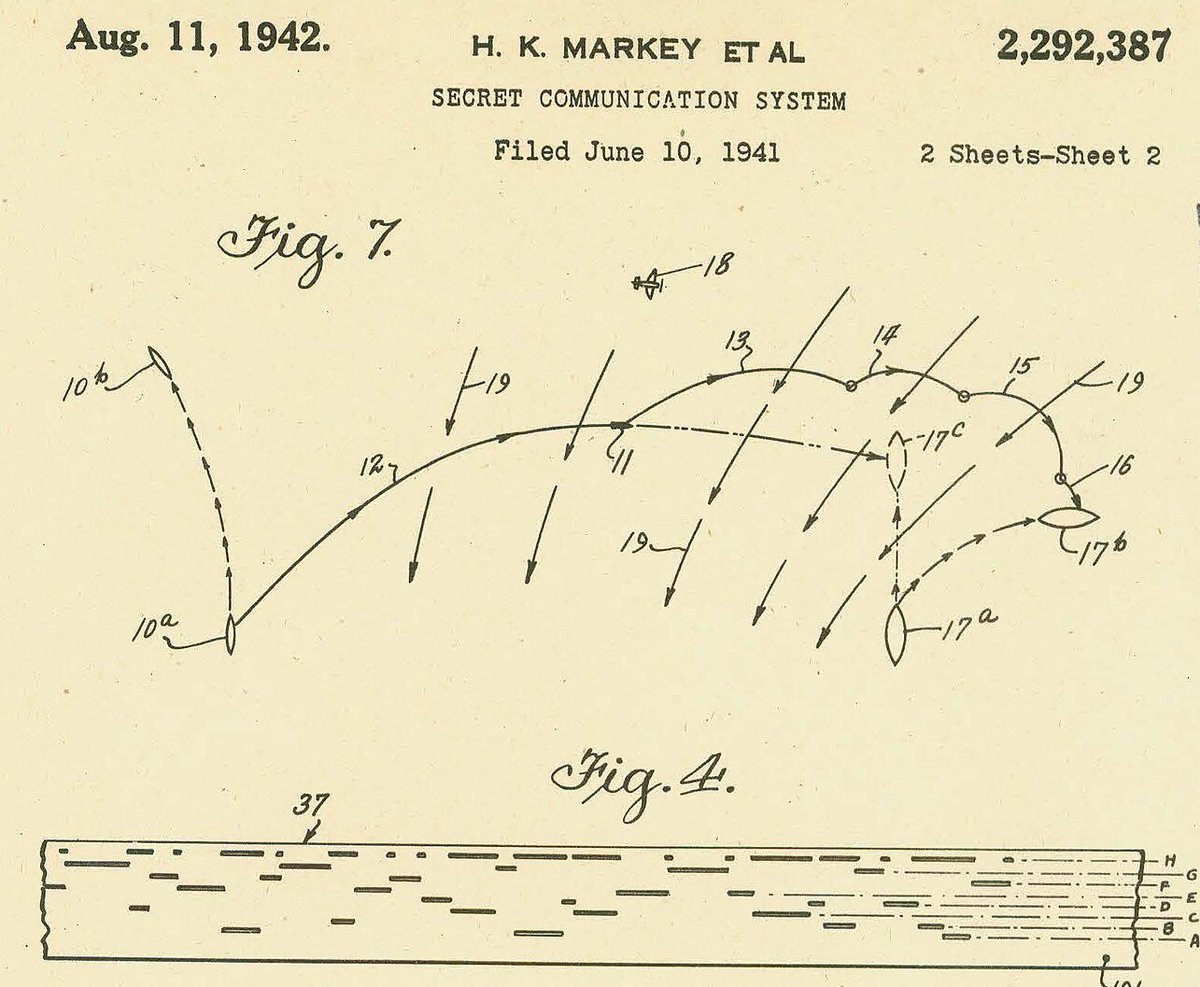
Google Patents lists US Patent 2,292,387, titled Secret Communication System, as filed on June 10, 1941, and granted on August 11, 19421. The printed patent names the inventors as Hedy Kiesler Markey of Los Angeles and George Antheil, and its opening line says the invention is especially useful in the remote control of dirigible craft, such as torpedoes1. The Hall of Fame notes that the patent carried her maiden name and her married name at the time, Hedy Kiesler Markey2.
The problem the patent sets out is jamming. It says radio control of a torpedo had been very difficult because an enemy could quickly discover the frequency of the control signals and block control by sending false signals on the same frequency1. The answer it proposes is a pair of synchronous records, one at the transmitting station and one at the receiving station, that change the tuning of both from time to time, so that an enemy without the records could not tell what frequency the next controlling impulse would use1.
The records come from music. The patent proposes perforated paper rolls of the type used for many years in player pianos, and says a conventional player piano record with 88 rows of perforations would permit 88 different carrier frequencies1. It suggests keeping the two rolls in step with accurately calibrated constant speed spring motors like those that drive clocks and chronometers, or by sending synchronizing impulses from the transmitter1. The worked example in the drawings is smaller: a record strip with eight rows of holes, seven of which switch seven tuning condensers in and out, while the eighth lights a signal lamp1.
One figure shows a mother ship firing a torpedo that is steered onto a new course several times to hit an enemy ship that turned away, with an observer in an airplane reporting the torpedo's path, and the text adds that the airplane itself could do the steering if it carried the synchronized transmitter1. The patent says plainly that remote control of a torpedo was old and did not form part of the invention1.
Who brought what
The Hall of Fame says Lamarr had once been married to a munitions manufacturer, which gave her a foundation in weapons systems, including torpedo control2. Smithsonian magazine describes that husband as a man who sold arms to the Nazis, and says Lamarr fled him4. The Hall of Fame's entry for Antheil says the two became friends in 1940 and that, to keep the signals in sync, he developed a system controlling the jumps between 88 preprogrammed frequencies based on the 88 keys of a piano3. Smithsonian magazine credits Antheil with building the mechanism4.
What the Navy did
The Hall of Fame says the Navy initially shunned the technique3. Smithsonian magazine says the Navy was skeptical of its practicality and told Lamarr to stick to raising money for the war effort4.
The Hall of Fame says that by 1957 Sylvania Electronic Systems had taken up the concept, and that in 1962 it was used in military communications systems on U.S. ships sent to blockade Cuba3. Smithsonian magazine says that years after the war, when the Navy needed a way to encode messages about detected submarines, it turned to frequency hopping, and that the concept was used again during the Cuban missile crisis4. Neither source says the paper roll hardware was ever built as drawn. Google Patents marks the patent as expired, with an anticipated expiration date of August 11, 19591.
Frequency hopping in radio today
The principle in the patent, a transmitter and receiver changing channels together on a schedule an outsider cannot predict, is written into current U.S. radio rules. Section 15.247 of the FCC rules, as published in the Electronic Code of Federal Regulations, says a frequency hopping system must hop to channels selected from a pseudo randomly ordered list, and that its receivers must shift frequencies in synchronization with the transmitted signals5. The same section says frequency hopping systems in the 2400 to 2483.5 MHz band must use at least 15 channels5.
The Bluetooth Special Interest Group's technology overview says Bluetooth Classic carries data over 79 channels in the 2.4 GHz band, and lists frequency hopping spread spectrum as the channel usage method for Bluetooth Classic and Bluetooth Low Energy alike6. Smithsonian magazine goes further, saying the idea presaged wireless communication in cellphones, GPS and WiFi4, and the Hall of Fame says later patents in frequency changing have referenced the Antheil and Lamarr patent as the basis of the field3.
Recognition, late
According to the Hall of Fame, Lamarr and Antheil never profited from the invention during their lifetimes, and the Electronic Frontier Foundation acknowledged it in 1997 as an important development in wireless communications2. Smithsonian magazine says she did not receive recognition until she was 824. Both inventors were inducted into the National Inventors Hall of Fame in 20142, under the patent number 2,292,387 and the title Frequency Hopping Communication System3.
Trivia
- In the patent example transmitter, which audio tones signaled left rudder and right rudder? A 100 cycle oscillator for left rudder and a 500 cycle oscillator for right rudder1.
- Which California town does the patent give as George Antheil's home? Manhattan Beach1.
- Which two Antheil compositions does the Hall of Fame name? Ballet Mécanique and Airplane Sonata3.
- What kind of newspaper column did Antheil write, according to the Hall of Fame? A nationally syndicated relationship advice column3.
- How much did Smithsonian magazine say Lamarr raised for the war effort in one night? A record breaking $7 million4.
- Which two Lamarr films does the Hall of Fame name? Ziegfeld Girl and Samson and Delilah2.
- How many claims does the printed patent list? Six1.
- Over how many channels does Bluetooth Low Energy transmit, according to the Bluetooth technology overview? 40 channels in the 2.4 GHz band6.
Sources
- US2292387A, Secret communication system, Hedy Kiesler Markey and George Antheil, filed June 10, 1941, granted August 11, 1942, Google Patents. Accessed November 9, 2026.
- Hedy Lamarr, Frequency Hopping Communication System, U.S. Patent No. 2,292,387, National Inventors Hall of Fame. Accessed November 9, 2026.
- George Antheil, Frequency Hopping Communication System, U.S. Patent No. 2,292,387, National Inventors Hall of Fame. Accessed November 9, 2026.
- Sasha Ingber, The Hollywood Bombshell Who Invented an Indispensable War Technology, Smithsonian magazine, May 12, 2016. Accessed November 9, 2026.
- 47 CFR 15.247, Operation within the bands 902-928 MHz, 2400-2483.5 MHz, and 5725-5850 MHz, Electronic Code of Federal Regulations. Accessed November 9, 2026.
- Bluetooth Technology Overview, Bluetooth Special Interest Group. Accessed November 9, 2026.