Hilsa Recorded in the Upper Ganga Again After Decades
Key Points
- ICAR-CIFRI reported two hilsa weighing a combined 740 grams at Tanda Khurd village in Chandauli district, Uttar Pradesh, "after nearly three decades."
- After the Farakka Barrage was commissioned in 1975, hilsa catches in the middle Ganga between Farakka and Allahabad declined sharply and later fell to almost zero.
- From 2019 to June 2026, ICAR-CIFRI and the National Mission for Clean Ganga ranched more than 385,000 hilsa and released over 4 million fertilised eggs.
- On 28 June 2026, the institute released 110 cage reared hilsa juveniles into the Ganga at Farakka.
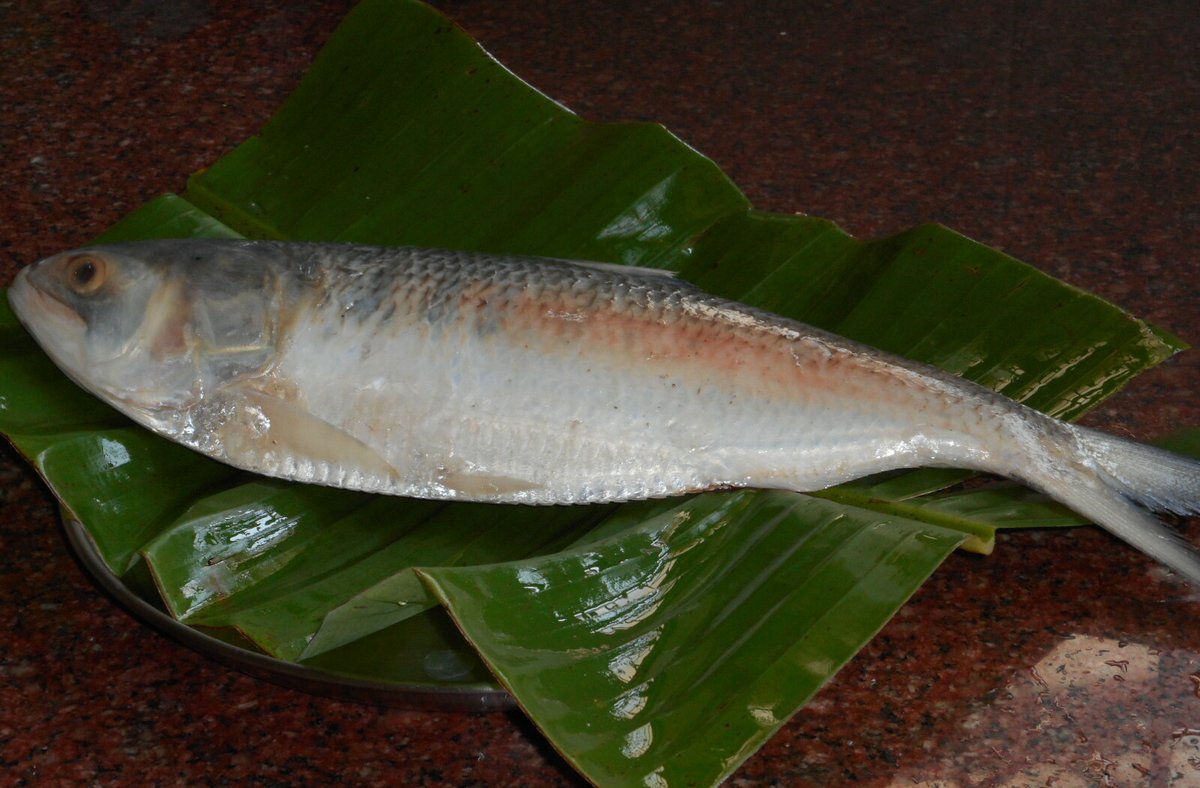

Two hilsa have turned up far up the Ganga in Uttar Pradesh. The ICAR Central Inland Fisheries Research Institute (ICAR-CIFRI), based in Barrackpore, West Bengal, reported that two hilsa weighing a combined 740 grams1 were found at Tanda Khurd village, near the Markandey Mahadev Temple in Chandauli district, "after nearly three decades." The institute does not say when hilsa were last recorded there. It says the species had been "virtually absent from the upstream reaches for several decades."
National Herald, with PTI inputs, ran the story on August 126, and The Pioneer followed on August 135.
A fish that swims upriver to breed
The hilsa (Tenualosa ilisha), also called ilish, schools in coastal waters and ascends rivers to spawn10, usually 50 to 100 km but as much as 1,200 km, according to FishBase. Its main breeding season falls during the southwest monsoon, with a shorter season from January to February or March. The species ranges across the Indo-West Pacific from Madagascar and the Persian Gulf east to Vietnam, and FishBase lists its IUCN status as Least Concern.
In the Ganga, those longer runs once carried the fish far inland. ICAR-CIFRI says hilsa historically moved from the sea up to Varanasi, Prayagraj and beyond1. Chandauli, where the two fish were found, sits in the Varanasi Division8 of Uttar Pradesh and borders Varanasi and Mirzapur districts.
What changed in 1975
The Farakka Barrage spans the Ganga in the Malda and Murshidabad districts of West Bengal and sends part of the river's flow down a feeder canal7 to the Hooghly, to flush sediment from Kolkata harbour, according to Wikipedia. ICAR-CIFRI says the commissioning of the barrage in 19751 "severely disrupted" the hilsa's migration route from the Bay of Bengal.
An earlier ICAR article, written before a new navigational lock was due to open in June 2019, set out the effect. The fish supported a good fishery in the Ganga3 until the barrage. After it was commissioned, catches in the middle Ganga between Farakka and Allahabad (Prayagraj) declined sharply and, by the time the ICAR page was written, had fallen to almost zero. That article described joint work begun in 2016 by ICAR-CIFRI, the Inland Waterways Authority of India, the Central Water Commission, the National Mission for Clean Ganga (NMCG) and the Farakka Barrage Authority.
The barrage has two fish locks. ICAR-CIFRI recommended that they be operated regularly during the monsoon months and that a bypass channel be built between the feeder canal and the river upstream. A 2016 article by the river research network SANDRP said the locks had not been operated for a minimum of a decade11, "possibly much longer."
Years of ranching
Ranching here means releasing hatchery raised eggs, spawn and young fish into the river. ICAR-CIFRI and NMCG ran a long programme of it. The institute gives these totals for the period from 2019 to June 20261:
- More than 3.85 lakh (385,000) juvenile and adult hilsa ranched.
- Over 40 lakh (4 million) fertilised eggs released.
- About 9.4 lakh (940,000) hatchery produced spawn, aged two to six days, released upstream of the Farakka Barrage.
The programme also used artificial breeding, tagging and post release monitoring, and worked with fishers. Monitoring during 2023 to 20251 had already recorded ranched hilsa moving upstream as far as Mirzapur. By October 2021 the institute had released 391 tagged live hilsa4, averaging more than 250 g each, fitted with FloyT-bar anchor tags.
The institute's partner, the NMCG, is the implementation wing of the National Ganga Council9, which was established in October 2016. The Namami Gange programme, which the NMCG runs, was launched in 2014.
The June 2026 release at Farakka
The most recent release described by ICAR came on 28 June 2026 at Farakka2, when ICAR-CIFRI let go 110 hilsa juveniles that had been reared in circular cages in the Ganga itself. The aim, the institute said, is to revive declining hilsa populations in the stretch between Prayagraj and Farakka.
Several bodies took part: the Farakka Barrage Project, the National Thermal Power Corporation (NTPC), the Central Industrial Security Force and the West Bengal Department of Fisheries. NTPC committed to support the programme through its corporate social responsibility work. ICAR-CIFRI Director Dr Pradip Dey called the Farakka work a "promising and scalable model for sustainable fisheries development."2
What two fish can tell scientists
The institute treats the record as an early sign rather than a finished recovery. It says that, as a highly sensitive migratory fish, hilsa can serve as "an important ecological indicator of river connectivity and habitat suitability."1 The ICAR article also says stocking alone is not enough, and it argues1 that releases must go with better habitat, connectivity, monitoring, responsible fishing and care by local communities. Dr Dey, the article reports, stressed that fisheries restoration should be seen as "an integral component of ecological restoration and sustainable livelihoods."
Officials quoted by The Pioneer called the return a "significant milestone in river restoration and aquatic biodiversity conservation."5 Two fish are a small number, but they show hilsa have again reached a stretch of the Ganga far above Farakka, after a programme built to help them do that.
Trivia
- Who first recorded hilsa near Kanpur and Agra, in the Ganga and Yamuna, and in what year? Hamilton, in 18223, according to ICAR. He was Francis Hamilton, born Francis Buchanan12, whose book that year was An account of the fishes found in the river Ganges and its branches.
- How far did the tagged hilsa CIFRI1516 travel after its release at Farakka in October 2021? 225 km downstream4 to Nimaitirtha Ghat in Hooghly district, in 4 days and 21 hours, where a fisherman caught it.
- Which Indian state has the ilish as its state fish? West Bengal13.
- What is the hilsa called in Telugu, in the Godavari region of Andhra Pradesh? Pulasa14.
- How many gates does the Farakka Barrage's main structure have? 11215, according to India's Comptroller and Auditor General (2013).
- How long is the Farakka Barrage's main structure? 2,245 m15, according to the same 2013 audit report.
- Which region's "rice bowl" is Chandauli known as? Purvanchal16, according to ETV Bharat, which calls it "the rice bowl of the Purvanchal."
Sources
- ICAR-CIFRI, After Decades, Hilsa Returns to the Upper Ganga: A Remarkable Story of River Restoration and Ecological Resilience, Indian Council of Agricultural Research. Accessed November 1, 2026.
- ICAR-CIFRI, Barrackpore Strengthens Hilsa Conservation Efforts through Ranching Programme in River Ganga at Farakka, Indian Council of Agricultural Research, 28 June 2026. Accessed November 1, 2026.
- ICAR, Joint Efforts towards Re-establishing Hilsa Fishery in River Ganga after Four Decades, Indian Council of Agricultural Research. Accessed November 1, 2026.
- ICAR-CIFRI, Tagged Hilsa Fish Recovery shows a Migration of 225 Kms in River Ganga, Indian Council of Agricultural Research. Accessed November 1, 2026.
- Pioneer News Service, Hilsa returns to upper Ganga after decades, The Pioneer, 13 August 2026. Accessed November 1, 2026.
- NH Environment Bureau with PTI inputs, Hilsa returns to upper Ganga after years, signals revival of river ecosystem, National Herald, 12 August 2026. Accessed November 1, 2026.
- Farakka Barrage, Wikipedia. Accessed November 1, 2026.
- Chandauli district, Wikipedia. Accessed November 1, 2026.
- National Mission for Clean Ganga, Wikipedia. Accessed November 1, 2026.
- Tenualosa ilisha (Hamilton, 1822), Hilsa shad, FishBase summary. Accessed November 1, 2026.
- Parineeta Dandekar, Sushri Uma Bhartiji: Hilsa, Fisherfolk and Ganga deserve more than promise of a Fish Ladder by CIFRI!, SANDRP, 12 August 2016. Accessed November 1, 2026.
- Francis Buchanan-Hamilton, Wikipedia. Accessed November 1, 2026.
- Shivangi Sen, State emblems of West Bengal, The Telegraph (My Kolkata), 5 August 2021. Accessed November 1, 2026.
- PTI, Godavari's iconic Pulasa fish now faces scarcity, The Week, 21 July 2025. Accessed November 1, 2026.
- Comptroller and Auditor General of India, Report No. 22 of 2013, Chapter 7: Maintenance of Farakka Barrage and its ancillaries. Accessed November 1, 2026.
- Black rice, a hit among farmers and consumers, ETV Bharat, 9 December 2020. Accessed November 1, 2026.