India Retail Inflation Rises to 6.09% in October as Onion Prices Jump
Key Points
- MoSPI reported on 12 November 2026 that retail inflation was 6.09 percent (provisional) in October, up from a final 5.54 percent in September.
- Food inflation was 8.94 percent, and onion prices were 116.22 percent higher than in October 2025.
- Inflation was 6.63 percent in rural areas and 5.41 percent in urban areas.
- India's inflation target is 4 percent with a tolerance band of 2 to 6 percent, and the target counts as missed when average inflation is above or below the band for any three consecutive quarters.

Retail inflation in India rose above 6 percent in October 2026. The Ministry of Statistics and Programme Implementation (MoSPI) reported on 12 November that inflation based on the All India Consumer Price Index was 6.09 percent (provisional) in October, up from a final 5.54 percent in September. Inflation was 6.63 percent in rural areas and 5.41 percent in urban areas. Food prices climbed faster. The Consumer Food Price Index was 8.94 percent higher than a year earlier, after 7.74 percent in September.
The rate has gone up every month of 2026 so far. On the new series, combined inflation was 2.74 percent in January, 3.93 percent in May and 4.83 percent in August before the October reading.
What the CPI measures
MoSPI describes the Consumer Price Index as “designed to measure the changes over time in general level of retail prices of selected goods and services that households purchase for the purpose of consumption.” The headline inflation rate is the percentage change in the index from the same month a year earlier. Field staff collect prices from 1,407 urban markets, online markets included, and 1,465 villages covering every state and union territory, and for October the ministry reported a response rate of 100 percent in both rural and urban markets.
Each item counts according to how much households spend on it. Food and beverages carry a weight of 36.75 out of 100, the largest of the 12 divisions, and onion alone carries a weight of 0.7006.
A new base year, 2024
The October figures come from a series that is less than a year old. MoSPI published the first CPI on base 2024=100 on 12 February 2026, replacing the 2012 base. The basket and weights now come from the Household Consumption Expenditure Survey 2023-24, and base period prices were collected from January to December 2024. The combined index for October 2026 stood at 110.05.
The update widened the basket from 299 to 358 items, with goods rising from 259 to 308 and services from 40 to 50. Spending is now sorted into 12 divisions under the United Nations COICOP 2018 classification, in place of six groups, and rural house rent is counted for the first time. E-commerce prices were added as an extra market in 12 large towns with populations above 25 lakh, and airfares and streaming subscriptions are priced online. The share of food and beverages declined in the new series, though it remains the largest component. Because the classification changed, the old and new series can be directly linked only at the general index level.
Onions led the food rise
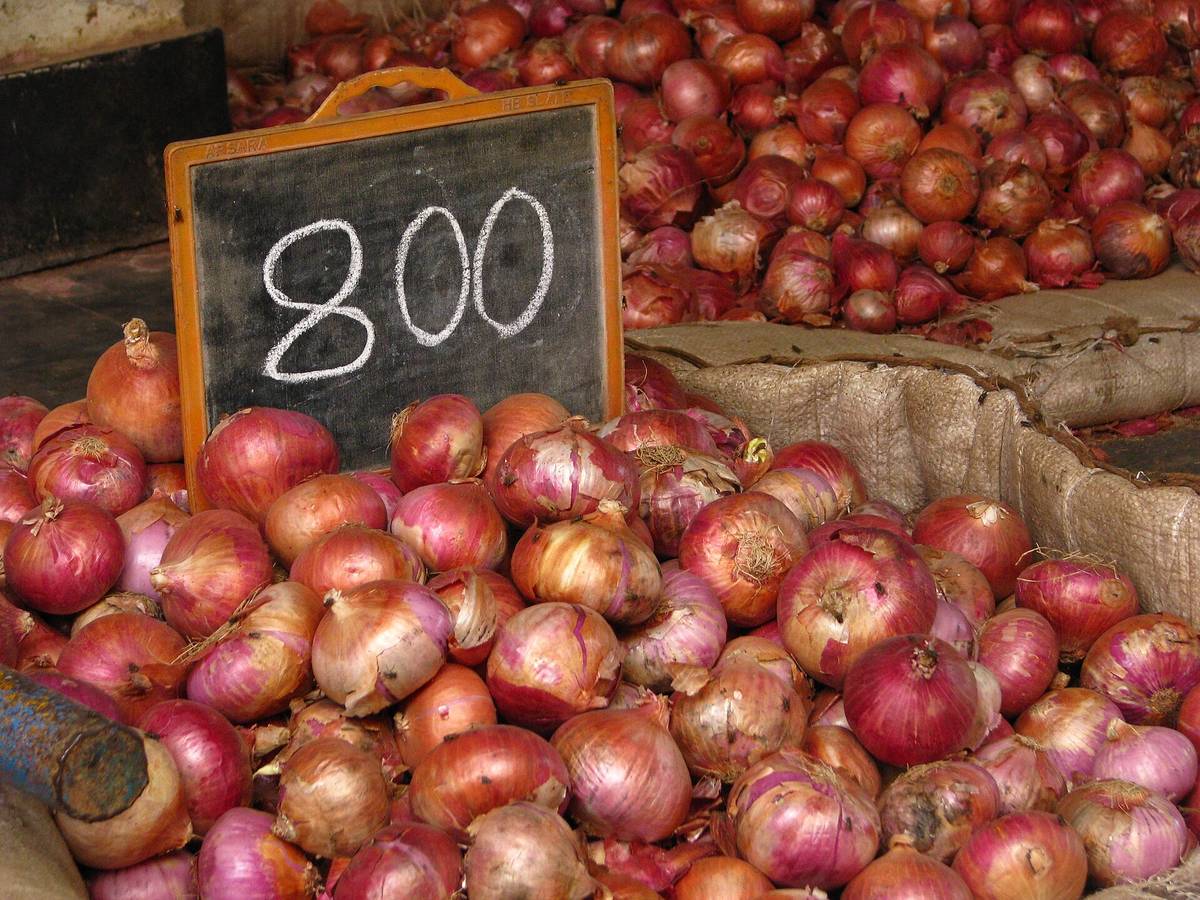
Onion prices were 116.22 percent higher than in October 2025, after a 108.13 percent rise in September. Garlic (up 60.74 percent), silver jewellery (52.39 percent), ginger (48.32 percent) and lemon (47.30 percent) completed MoSPI’s list of the five key items with the highest inflation. Some vegetables were cheaper than a year earlier. Potato prices fell 14.24 percent, cauliflower 10.57 percent and cabbage 1.92 percent.
Outside food, restaurants and accommodation services rose 10.06 percent, and the division for personal care, social protection and miscellaneous goods and services rose 10.14 percent. Housing, water, electricity, gas and other fuels was up 2.90 percent, transport 5.84 percent and health 2.05 percent.
When the Reserve Bank of India’s Monetary Policy Committee (MPC) met in early October, it said food price increases had “become more broad based along with notable spikes in certain items such as sugar and onion.”4 It expected “continued pressures from supply side on account of the deficient monsoon, ongoing El Niño conditions and high energy and other commodity prices.”4 The India Meteorological Department (IMD) forecast on 30 September that October rainfall over the country would likely be below normal, under 85 percent of the long period average5, and reported strong El Niño conditions over the equatorial Pacific5. IMD added that below normal rainfall during the Rabi season could adversely affect soil moisture, irrigation requirements and agricultural productivity5.
Differences between states
Among the states, Tamil Nadu had the highest combined rate in October, 7.29 percent, followed by Telangana at 7.26 percent and Andhra Pradesh at 7.25 percent. The union territory of Puducherry reached 7.96 percent, while the National Capital Territory of Delhi recorded 3.80 percent. Uttar Pradesh, which carries the largest state weight, had inflation of 6.47 percent.
The 4 percent target
Under the RBI Act, the central government, in consultation with the RBI, sets the inflation target in terms of the CPI once every five years3. The target is 4 percent, with an upper tolerance limit of 6 percent and a lower limit of 2 percent3, and on 25 March 2026 the government kept the same target and band for April 2026 to March 20313. October’s 6.09 percent sits just above the upper limit.
One month outside the band is not, on its own, a missed target. The government defines failure as average inflation above the upper tolerance level, or below the lower one, for any three consecutive quarters3. In that case the RBI must send the government a report setting out the reasons, the remedial actions it proposes and an estimate of when the target will be reached3.
On 7 October 2026 the MPC voted unanimously to raise the policy repo rate by 25 basis points to 5.50 percent4. By a majority, with two members preferring to keep a neutral stance, it changed its stance to “calibrated tightening”4. It projected CPI inflation of 5.2 percent for 2026-27, with 6.0 percent in the third quarter4 of the financial year. The committee’s next meeting is scheduled for 2 to 4 December 20264, and MoSPI plans to release the November CPI on 14 December 2026.
How India compares
In the euro area, Eurostat’s flash estimate put annual inflation at 4.0 percent in October 2026, with food, alcohol and tobacco up 1.6 percent and energy up 20.8 percent6. China’s National Bureau of Statistics reported consumer prices 0.7 percent higher than a year earlier in October, with food 2.9 percent lower and fresh vegetables down 16.9 percent7. In both places, food rose more slowly than the overall index. In India, food rose faster.
Trivia
- Since when has MoSPI released the rural, urban and combined CPI? Since January 2011, with 2010 as the base year.
- Which index formula does the 2024 series use to compile its elementary indices? The Jevons index.
- How many dwellings were identified for collecting rents in the 2024 series? 19,039, of which 15,715 are urban and 3,324 rural.
- Which item had the steepest annual price fall in January 2026, the first month published on the new base? Garlic, down 53.05 percent.
- On what date was the 4 percent CPI target first notified in the Official Gazette? 5 August 2016, for the period up to 31 March 20213.
- How many members sit on the RBI’s Monetary Policy Committee? Six, under Section 45ZB of the RBI Act3.
- Which state or union territory had the lowest combined inflation in October 2026? Mizoram, at 2.85 percent.
Sources
- Ministry of Statistics and Programme Implementation, Press Release of Consumer Price Index on Base 2024=100 for October, 2026, Press Information Bureau, 12 November 2026. Accessed November 12, 2026.
- Ministry of Statistics and Programme Implementation, First Press Release of Consumer Price Index on Base 2024=100, Press Information Bureau, 12 February 2026. Accessed November 12, 2026.
- Reserve Bank of India, Monetary Policy: Overview. Accessed November 12, 2026.
- Reserve Bank of India, Monetary Policy Statement, 2026-27, Resolution of the Monetary Policy Committee, October 5 to 7, 2026, 7 October 2026. Accessed November 12, 2026.
- India Meteorological Department, Seasonal outlook for Rainfall during Post-Monsoon Season 2026 and Rainfall and Temperature during October 2026, press release, 30 September 2026. Accessed November 12, 2026.
- Eurostat, Euro area annual inflation up to 4.0%, flash estimate, October 2026, euro indicators, 4 November 2026. Accessed November 12, 2026.
- National Bureau of Statistics of China, 2026年10月份居民消费价格同比上涨0.7% (Consumer prices in October 2026 up 0.7% year on year), 9 November 2026. Accessed November 12, 2026.