The iPod Turns 25: How 1,000 Songs in Your Pocket Led to the iPhone
Key Points
- Apple announced the first iPod on October 23, 2001, a 5 GB player that held up to 1,000 CD quality songs, with a suggested retail price of $399.
- The iPod worked with Macs at first; Apple said iPod for Windows would be available in late August 2002, and the iTunes Music Store opened on April 28, 2003, at 99 cents per song.
- Apple announced its 100 millionth iPod on April 9, 2007, and estimates of lifetime sales range from more than 400 million to 450 million.
- The iPod classic was discontinued in 2014, and on May 10, 2022, Apple said the iPod touch would be available while supplies last.
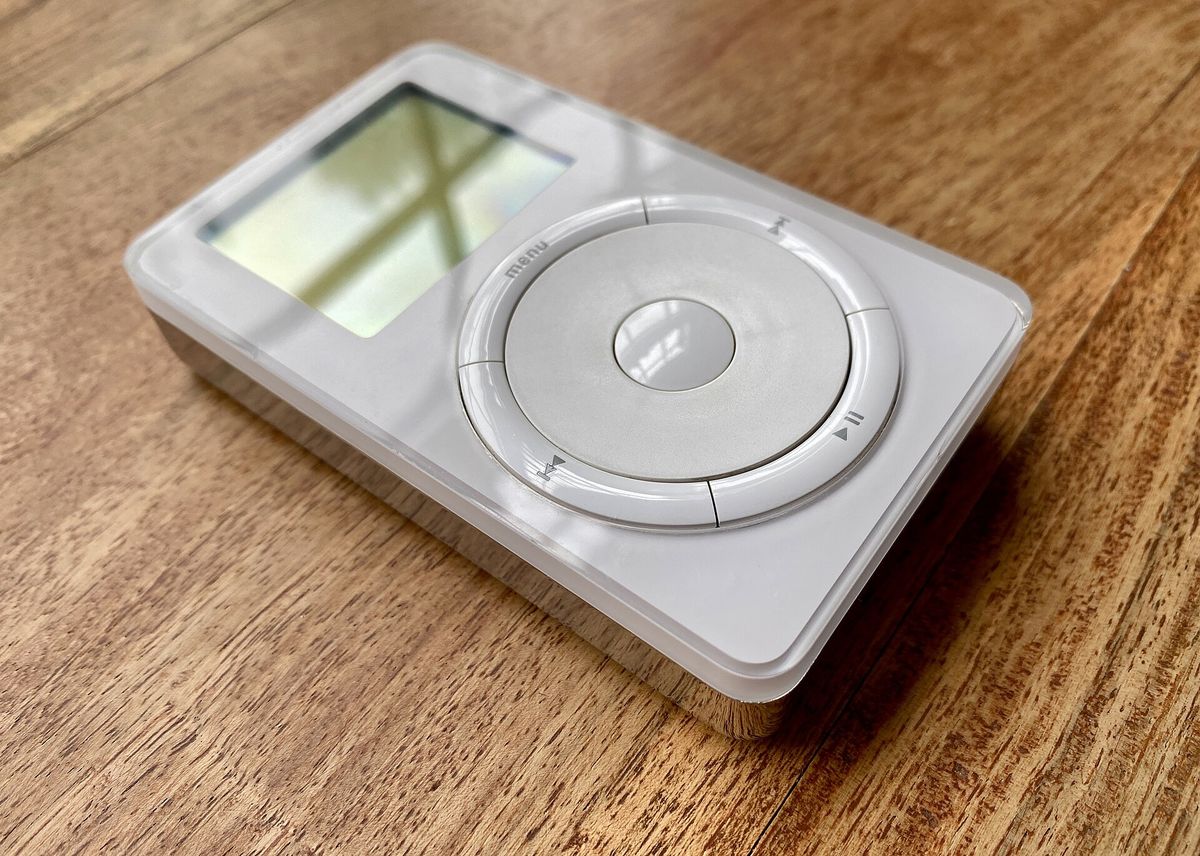

On October 23, 20011, Apple announced a white music player with a hard drive inside and a wheel on its face, and called it iPod. Friday, October 23, 2026, is the 25th anniversary, and the line it started has been out of Apple’s lineup since 2022.
A small room in Cupertino
Apple showed the first iPod at an event in Cupertino, Calif.2, and the subhead of its press release promised a player that Puts 1,000 Songs in Your Pocket1. The room was the Town Hall conference center3, located at 4 Infinite Loop on Apple’s main campus3, where Tim Cook said in 2011, “Just 10 years ago, we launched the original iPod here”3. Six Colors recalls that Steve Jobs pulled the original iPod and its 1,000 songs out of his pocket3. Every reporter in the room, by the same account, walked away with a beta version of the iPod3.
The press release said the player held up to 1,000 CD-quality songs on its super-thin 5 GB hard drive1, weighed 6.5 ounces1 and played up to 10 hours of continuous music1. Its built-in FireWire port1 could move an entire CD into iPod in under 10 seconds1, and the same cable charged it, since the battery recharges automatically whenever iPod is connected to a Mac1. To find a song you would rotate iPod’s unique scroll-wheel with your thumb or finger1. It needed iTunes 21 on a Mac, carried a suggested retail price of $399 (US)1 and went on sale on Saturday, November 10, 20011. Jobs’s statement in the release included the line “With iPod, listening to music will never be the same again.”1
Who built it
The iPod was developed in less than one year4. Apple’s hardware engineering chief Jon Rubinstein recruited Tony Fadell4, whom Apple hired as a contractor in 20015 to design it. Fadell partnered with a company called PortalPlayer to design software for the device4, Apple contracted another company, named Pixo, to help design and implement the user interface4, and within eight months, Tony Fadell’s team and PortalPlayer had completed a prototype4.
The drive inside came from Toshiba. The Computer History Museum keeps the 1.8 inch6 Toshiba drive that was the storage for music in the first Apple iPod6, and quotes Rubinstein, Apple’s engineering head: “The key element was the drive.”6
Windows, and a store
For its first months the iPod belonged to Mac owners, and iPod software for Microsoft Windows was launched with the second-generation model4. On July 17, 20028, Apple announced new models at $2998, $3998 and $4998 for 5, 10 and 20 GB, with the industry’s first solid-state touch wheel8 on the larger two, and said iPod for Windows will be available in late August8.
The bigger change came on April 28, 20039, when the iTunes Music Store opened with songs from BMG, EMI, Sony Music Entertainment, Universal and Warner9 for just 99 cents per song9. At first it required a Mac equipped with iTunes 49. On October 16, 200310, Apple released iTunes for Windows and announced that the store offers Windows users the same online music store that Mac users love10.
Mini, shuffle, nano, video, touch
Apple announced the iPod mini on January 6, 200414, and it weighed 3.6 ounces13. The first shuffle, launched January 11, 20054, used flash memory and had no screen4. The nano arrived September 7, 20054 and replaced the mini, and the fifth generation iPod, out in October 20054, brought a larger screen with video playback4. On September 5, 200713 came the first iPod touch, with a 3.5-inch display13. The original hard drive model, meanwhile, didn’t get the name Classic until the sixth generation4.
A hundred million and counting
On April 9, 200711, Apple announced that the 100 millionth iPod has been sold11, five and a half years11 after the first one, and called it the fastest selling music player in history11. Wikipedia puts lifetime sales at an estimated 450 million iPods4, while NPR, citing The New York Times, said Apple went on to sell more than 400 million iPods2.
The long goodbye
The iPod classic was discontinued on September 9, 20144. The final model, the seventh generation iPod touch, arrived on May 28, 201913, with up to 256GB13 of storage. On May 10, 202213, Apple said the iPod touch will be available while supplies last13, which ended the line. Greg Joswiak, Apple’s senior vice president of Worldwide Marketing, marked the moment with “Today, the spirit of iPod lives on.”13
The road to the iPhone
When Jobs introduced the iPhone on January 9, 200712, Apple described it as a revolutionary mobile phone, a widescreen iPod with touch controls, and a breakthrough Internet communications device12. Fadell became senior vice president of the iPod division in 20065, succeeding Rubinstein, and Wikipedia calls him the co-creator of the iPhone5. The phone soon outgrew its parent. In the quarter that ended September 25, 2010, Apple sold 14.1 million iPhones15 and 9.05 million iPods15.
Trivia
- Who proposed the name iPod? Vinnie Chieco, a freelance copywriter4, who thought of the line “Open the pod bay doors, Hal” from 2001: A Space Odyssey.
- What was the iPod’s internal code name? Project P-684.
- How many songs did the iTunes Music Store open with in 2003? Over 200,000 songs9.
- Which music software did the 2002 Windows iPods work with? MUSICMATCH Jukebox8.
- How much shock protection did the first iPod promise? Up to 20 minutes1, for nonstop playback while running or biking.
- How many songs had the iTunes Store sold by the time the 100 millionth iPod sold? Over 2.5 billion11.
- Who gave the Computer History Museum its first generation iPod? Regis McKenna7, and it is a 10GB model.
- When did Apple pull the iPod nano and shuffle from its stores? July 27, 20174.
Sources
- Apple Presents iPod, Apple Newsroom, October 23, 2001. Accessed October 22, 2026.
- Sharon Pruitt-Young, 20 years ago the iPod was born, NPR, October 23, 2021, republished by KAXE. Accessed October 22, 2026.
- Apple’s Town Hall: A look back, Six Colors, March 20, 2016. Accessed October 22, 2026.
- iPod, Wikipedia. Accessed October 22, 2026.
- Tony Fadell, Wikipedia. Accessed October 22, 2026.
- 1.8 inch MK5002MAL disk drive, Revolution: The First 2000 Years of Computing, Computer History Museum. Accessed October 22, 2026.
- iPod, catalog number 102766569, Computer History Museum. Accessed October 22, 2026.
- Apple Unveils New iPods, Apple Newsroom, July 17, 2002. Accessed October 22, 2026.
- Apple Launches the iTunes Music Store, Apple Newsroom, April 28, 2003. Accessed October 22, 2026.
- Apple Launches iTunes for Windows, Apple Newsroom, October 16, 2003. Accessed October 22, 2026.
- 100 Million iPods Sold, Apple Newsroom, April 9, 2007. Accessed October 22, 2026.
- Apple Reinvents the Phone with iPhone, Apple Newsroom, January 9, 2007. Accessed October 22, 2026.
- The music lives on, Apple Newsroom, May 10, 2022. Accessed October 22, 2026.
- Apple Introduces iPod mini, Apple Newsroom, January 6, 2004. Accessed October 22, 2026.
- Apple Reports Fourth Quarter Results, Apple press release filed as Exhibit 99.1 to Form 8-K, U.S. Securities and Exchange Commission, October 18, 2010. Accessed October 22, 2026.