IUCN Launches Its First Global Strategy on Invasive Alien Species
Key Points
- IUCN launched its first global strategy on invasive alien species during COP17 in Yerevan, Armenia, setting four outcomes to deliver by 2036.
- The strategy puts islands, marine and freshwater ecosystems, protected and conserved areas, and Key Biodiversity Areas first.
- IPBES put the global economic cost of invasive alien species above USD 423 billion a year in 2019.
- IPBES reported an 88% success rate across 1,550 eradication programmes conducted on 998 islands.

The International Union for Conservation of Nature (IUCN) has published its first global strategy on invasive alien species, the plants, animals and other organisms that people have moved outside their natural range and that go on to harm the places they reach. The strategy was launched during the UN Biodiversity Conference, COP17, in Yerevan, Armenia, according to an IUCN press release datelined 21 October 20261. It sets out how the union's Members, Commissions and Secretariat will scale up their work, and it invites governments, civil society, Indigenous Peoples, the private sector and researchers to help carry it out.
Four outcomes by 2036
The strategy names four outcomes to deliver by 20361. The first is accessible data, science, tools and technology. The second is capacity across governments, civil society and the private sector, with invasive species folded into biodiversity, climate and development policy, especially in countries with fewer resources. The third is more prevention, early detection, rapid response, eradication, control and restoration. The fourth is sustainable finance for prevention, management and the restoration of ecosystems.
It also says where to start. The strategy recommends prioritising action in the most vulnerable and biodiversity-important places1, which it lists as islands, marine and freshwater ecosystems, protected and conserved areas, and Key Biodiversity Areas. It calls for solutions fitted to local conditions and points to the potential of new technology.
How progress will be counted
IUCN says the success of the strategy will be measured1 through indicators that include the number of invasive species removed from sites, the number of species of conservation concern that benefit from removal or control, and IUCN's contribution to reducing extinction risk as measured by the Species Threat Abatement and Restoration (STAR) metric.
STAR measures the contribution that investments can make to reducing species' extinction risk7, covering two kinds of action, threat abatement and habitat restoration. Its scores are built on data from the IUCN Red List of Threatened Species, and its development was led by the IUCN Species Survival Commission Post-2020 Taskforce. Because the strategy lists STAR among its indicators, IUCN plans to use the metric to gauge how much its work lowers extinction risk for threatened species.
The size of the problem
As of October 2026, IUCN counts more than 3,500 documented invasive alien species1 worldwide, and it says, citing the IUCN Red List, that invasive species have contributed to more than 60% of global extinctions. Those figures echo the 2023 assessment by IPBES, the Intergovernmental Science-Policy Platform on Biodiversity and Ecosystem Services, which found that more than 37,000 alien species2 have been introduced by human activities to regions and biomes around the world, and that more than 3,500 of them are harmful invasive alien species.
The same assessment put the global economic cost of invasive alien species above USD 423 billion a year in 20192, with costs having at least quadrupled every decade since 1970. That is the figure the IUCN release repeats. An earlier global estimate, published in Nature in 2021 by Christophe Diagne and colleagues using a cost database called InvaCost, found an annual mean of USD 26.8 billion3 in reported costs between 1970 and 2017 and estimated that the annual mean could reach USD 162.7 billion in 2017 (all in 2017 US dollars). The authors described the costs as strongly underestimated and rising threefold per decade, and found damage costs an order of magnitude higher than spending on management.
IPBES also drew a practical conclusion. Its authors said that prevention is absolutely the best, most cost-effective option2, which is where the new strategy puts much of its weight.
Tools already in use
The strategy builds on work IUCN already does. The Global Invasive Species Database was developed and is managed by the Invasive Species Specialist Group6 of IUCN's Species Survival Commission, as part of a global initiative on invasive species. The Environmental Impact Classification for Alien Taxa, known as EICAT, was launched as an IUCN standard on 15 September 20205. It classifies alien species by the evidence of the harm they cause, and is meant to work for all taxonomic groups and environments at national, regional and global levels.
The release names three more pieces. The Global Register of Introduced and Invasive Species supports countries in reporting1 on Target 6 of the Kunming-Montreal Global Biodiversity Framework. IUCN is the official custodian of Sustainable Development Goal indicator 15.8.1, which tracks national legislation and resources for preventing or controlling invasive species. And IUCN runs a European IAS Rapid Response Fund, meant to stop newly detected species before they establish.
Target 6, agreed by the parties to the Convention on Biological Diversity, calls for reducing the rates of introduction and establishment4 of other known or potential invasive alien species by at least 50 per cent by 2030, and for eradicating or controlling invasive alien species especially in priority sites, such as islands.
Islands, where removal has worked
Islands lead the strategy's list. IPBES reported an 88% success rate across 1,550 eradication programmes2 conducted on 998 islands. Two cases in the Southern Ocean show what that looks like over time.
On Macquarie Island, a World Heritage listed island in the sub-Antarctic, a seven-year program run by the Tasmania Parks and Wildlife Service and funded by the Australian and Tasmanian governments removed rabbits, rats and mice. It removed about 150,000 rabbits8 in its first year. A hunting team of 12 people and 11 dogs spent the project's last 13 months scouring the island and found just eight adult survivors of the 2011 aerial baiting and a single litter of kittens. When the project ended in April 2014, no rabbit, rat or mouse had been detected for two and a half years, and an article in the Australian Antarctic Division's magazine called it the first time all three had been eradicated at once from an island the size of Macquarie Island. Ten years on, Dr Kris Carlyon, a wildlife biologist with Tasmania's Department of Natural Resources and Environment, described the vegetation recovery as absolutely extraordinary9, and scavenging giant petrels and skuas, some of which the baiting had killed, were returning to their former numbers.
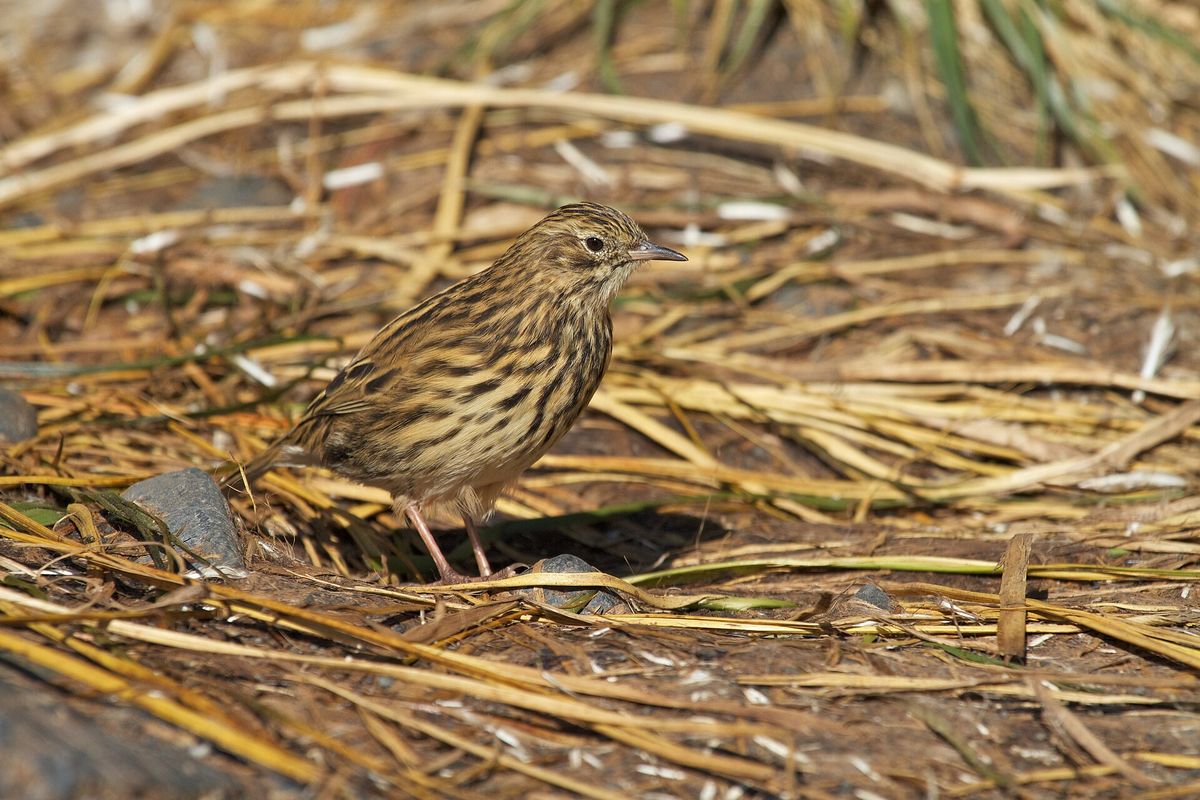
On South Georgia, the South Georgia Heritage Trust declared the island rodent free in May 201810. Rats and mice had arrived with sealing expeditions in the 18th century, so the island was free of rodents for the first time in more than 200 years. Baiting ran in three phases, a 2011 trial followed by phases in the 2013/14 and 2015/16 seasons. A monitoring team, joined by three rodent detection dogs from New Zealand, then checked the island two years after the last baiting. The government release said it hoped the endemic South Georgia pipit, the songbird pictured above, would be brought back from the brink of extinction and that the island's seabird populations would flourish.
What comes next
Kevin Smith, IUCN's Programme Head for Invasive Species and Wildlife Health, said in the release that biological invasions affect the whole of society1, and that every part of society has a role to play. Professor Helen Roy, Co-Chair of the IUCN Invasive Species Specialist Group, pointed to the record of prevention, early detection, eradication and long-term management around the world. "The challenge now is scale," she said. Her fellow Co-Chair, Professor Aníbal Pauchard, stressed a shared framework for putting the best available science and expertise into the hands of governments, practitioners and communities.
The strategy runs to 2036, six years past the 2030 deadline in Target 6.
Trivia
- How many experts, from how many countries, produced the 2023 IPBES assessment of invasive alien species? 86 experts from 49 countries2, working for more than four and a half years.
- In what share of recorded global animal and plant extinctions were invasive alien species the only driver, according to IPBES? 16%2.
- Who was the third co-chair of the IPBES invasive species assessment, alongside Helen Roy and Aníbal Pauchard? Professor Peter Stoett of Canada2.
- Which German city hosted the meeting where the 143 IPBES member States approved the assessment? Bonn2.
- What large animal did the South Georgia government remove to clear the way for the main rodent baiting? Reindeer10, which whalers had introduced in the early 1900s.
- According to the 2018 government release, how many wax tags did the final South Georgia survey team check for signs of rodents? 4,60010, across more than 2,400 km of coast and mountain.
- How large is Macquarie Island? 12,785 hectares8, according to the Australian Antarctic Division.
- What are EICAT's five impact categories, from least to most severe? Minimal Concern, Minor, Moderate, Major and Massive5; the last three count as harmful.
Sources
- IUCN, IUCN launches global strategy to tackle invasive alien species (press release), Yerevan, Armenia, 21 October 2026. Accessed October 25, 2026.
- IPBES, Media Release: IPBES Invasive Alien Species Assessment, 4 September 2023. Accessed October 25, 2026.
- Diagne C., Leroy B., Vaissiere A. C., Gozlan R., Roiz D., Jaric I., Salles J. M., Bradshaw C. J. A., Courchamp F., High and rising economic costs of biological invasions worldwide, Nature 592 (7855): 571-576, 2021 (IRD bibliographic record with abstract). Accessed October 25, 2026.
- Convention on Biological Diversity, Kunming-Montreal Global Biodiversity Framework, Target 6. Accessed October 25, 2026.
- IUCN, IUCN Standard to support global action on invasive alien species, 15 September 2020. Accessed October 25, 2026.
- IUCN SSC Invasive Species Specialist Group, Global Invasive Species Database. Accessed October 25, 2026.
- IUCN, Species Threat Abatement and Restoration (STAR) metric. Accessed October 25, 2026.
- Wendy Pyper, Pests eradicated from Macquarie Island, Australian Antarctic Magazine, Issue 26, June 2014. Accessed October 25, 2026.
- Australian Antarctic Division, Macquarie Island's astounding recovery ten years on from rats, mice and rabbits, 29 May 2024. Accessed October 25, 2026.
- Government of South Georgia and the South Sandwich Islands, South Georgia Heritage Trust Declares South Georgia Rodent Free, 9 May 2018. Accessed October 25, 2026.