Juno Finds Jupiter Brakes the Solar Wind in Stages
Key Points
- A University of Iowa release says Jupiter slows and heats the solar wind with plasma waves at several frequencies, while Earth's bow shock relies mainly on waves around a single frequency.
- The release says smaller shock structures called shocklets help slow the solar wind before it reaches Jupiter's main bow shock.
- In the December 11, 2024 crossing, magnetic structures recurred about every 8.3 seconds. The paper calls a shock front that breaks down and builds up again the most likely cause, though Juno's ion measurements, taken every 120 seconds, are too slow to confirm the ion reflection directly.
- Joseph calls Jupiter's bow shock a nearby natural laboratory for shocks like those around supernova remnants, which the release says are vastly more powerful.
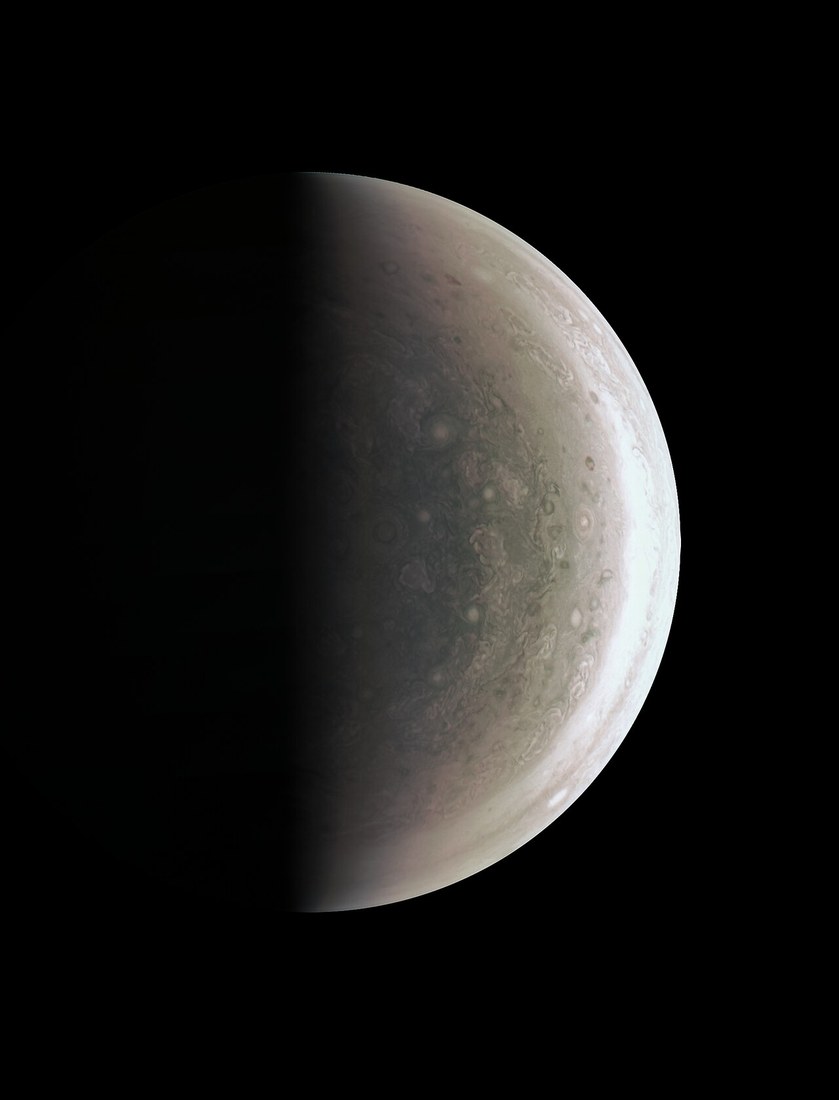
A University of Iowa release carried by ScienceDaily on October 29, 2026 says NASA's Juno spacecraft found Jupiter's bow shock to be more complex than Earth's1. The bow shock is the invisible boundary where particles streaming from the Sun meet the planet's magnetic environment, and the measurements behind the finding were collected in December 20241. The full results appeared in Nature Communications on July 31, 2026, in a paper titled "Plasma wave observations from Juno spacecraft at the Jovian bow shock," with J. Joseph as first author and 12 coauthors2.
What a bow shock does
The solar wind arrives at tremendous speeds, often faster than sound waves move through the plasma it is made of1. On the side of a planet that faces the Sun, a bow shock forms because that wind has to flow around a nearly impenetrable boundary, and at the shock it is abruptly slowed, with most of its excess kinetic energy turned into heat2. Earth has one, and so does Jupiter.
The paper describes two crossings of the shock, an outbound one on December 10, 2024 at about 17:25 UT and an inbound one on December 11 at about 03:05 UT2. Both took place about 81.44 Jupiter radii from the planet, on the dusk flank and at southern magnetic latitudes near 60 degrees, and the authors put the Alfvénic Mach number of both crossings at approximately 92. For the measurements, the team used electric fields from the Waves instrument and magnetic field data from the MAG instrument2, and the release notes that Waves was designed and built by physicists at the University of Iowa1.
Many frequencies instead of one
According to the release, Jupiter slows and heats the incoming particles with plasma waves at several frequencies, which the researchers call harmonics, while Earth's bow shock relies mainly on waves around a single frequency1. In the paper, one example from the December 11 crossing is a set of ion-acoustic waves with a fundamental at 5,610 hertz and harmonics at 11,130 and 16,680 hertz2. The authors write that the distorted shape of these waves can be attributed to electrons trapped in the waves' electric potential2.
The paper notes that the harmonic structure of ion-acoustic waves had been seen before in Earth's auroral zone, but says this appears to be the first direct observation of such occurrences at a planetary bow shock2. It also reports intense activity from the electron cyclotron drift instability, with about 18 spectral peaks spaced roughly 300 hertz apart in one burst near 03:06 UT on December 112. The authors add that some stretches of the Jovian data look much like Earth's, while others show stronger ion-acoustic waves and stronger electron cyclotron drift activity2.
The temperature jump is also bigger at Jupiter. Citing earlier work, the paper puts the ion temperature ratio across the shock at about 80 and the electron ratio at about 10, against typical Earth values of about 18 and 5, and says that larger temperature jump is why stronger nonlinear wave behavior is expected at Jupiter2. "Jupiter has found its own way to deal with the solar wind," said Jayasri Joseph, a postdoctoral researcher at Iowa and the paper's corresponding author1. Bill Kurth, an Iowa research scientist and a coauthor, said Earth does not need to take these extra steps because the impact there "isn't as powerful"1.
Shocklets and a shock that may rebuild itself
Before the solar wind reaches the main bow shock, the release says, it can run into smaller shock structures called shocklets, which help slow it before it arrives at the primary boundary1. At Earth, the release says, the main bow shock does most of the work1.
In the inbound crossing on December 11, the magnetic field data show periodic structures recurring approximately every 8.3 seconds, which the paper says is about a quarter of the proton gyroperiod2. The authors conclude that shock self-reformation, a cycle in which the shock front breaks down and builds up again, is the most likely explanation, though Juno's ion measurements, taken every 120 seconds, are too slow to confirm the ion reflection directly at that timescale2. The abstract itself says only that the magnetic field measurements suggest possible shock reformation2.
A nearby stand-in for exploding stars
Joseph says Jupiter's bow shock offers a nearby natural laboratory for studying shocks like those around supernova remnants, the expanding clouds of material left behind when certain dying stars explode1. The release adds that the shock waves around those remnants are vastly more powerful than the ones near Jupiter1.
Juno, from launch to now
Juno launched on August 5, 2011, from Cape Canaveral Air Force Station3. NASA confirmed it was in orbit around Jupiter at 8:53 p.m. PDT on July 4, 20164. NASA's Jet Propulsion Laboratory manages the mission for its principal investigator, Scott Bolton of the Southwest Research Institute, and the spacecraft carries instruments ranging from a microwave radiometer and a magnetometer to JunoCam3.
As of November 1, 2026, NASA's mission page still lists Juno as an active mission3, and the agency has kept publishing new Juno work in 2026. A JPL release dated July 22, 2026 reported subsurface temperature readings of the moon Io made during the mission's extended phase5, and NASA's photojournal posted a Juno image of the moon Thebe taken during a close pass on May 1, 2026, from about 5,000 kilometers away6.
Trivia
- Before Juno, how many spacecraft had encountered Jupiter's bow shock? Eight, from the two Pioneers and two Voyagers through Ulysses, Galileo, Cassini and New Horizons2.
- Which rocket launched Juno in 2011? An Atlas V3.
- How long was the engine burn that put Juno into orbit around Jupiter? 35 minutes4.
- Which NASA program is Juno part of? The New Frontiers Program, managed at NASA's Marshall Space Flight Center5.
- In what month was Juno's high-resolution waveform capture first directed at the bow shock region? November 20242.
- At about what frequency did Juno record Langmuir waves upstream of the shock? About 9.6 kilohertz, near the electron plasma frequency2.
- Which company built Juno and operates the spacecraft? Lockheed Martin Space, in Denver5.
Sources
- NASA discovers Jupiter's invisible shield is more complex than Earth's, ScienceDaily (source: University of Iowa), October 29, 2026. Accessed November 1, 2026.
- J. Joseph, W. S. Kurth, L. B. Wilson III, J. E. P. Connerney, F. Allegrini, R. J. Wilson, A. H. Sulaiman, R. W. Ebert, J. B. Faden, C. W. Piker, A. N. Jaynes, B. H. Mauk and S. J. Bolton, "Plasma wave observations from Juno spacecraft at the Jovian bow shock," Nature Communications 17, 9263, July 31, 2026, doi:10.1038/s41467-026-76223-x. Accessed November 1, 2026.
- Juno, mission page, NASA Science. Accessed November 1, 2026.
- NASA's Juno Spacecraft in Orbit Around Mighty Jupiter, NASA news release 16-071, July 5, 2016. Accessed November 1, 2026.
- NASA's Juno Takes Temperature of Jupiter's Fiery Moon Io, NASA Jet Propulsion Laboratory, July 22, 2026. Accessed November 1, 2026.
- NASA's Juno Misson Captures Jupiter Moon Thebe, NASA Science Photojournal, May 5, 2026. Accessed November 1, 2026.