Mariner 9 Became the First Spacecraft in Mars Orbit on Nov. 14, 1971
Key Points
- NASA Science says Mariner 9 launched May 30, 1971, and entered orbit around Mars on November 14, 1971, the first human-made object to orbit another planet.
- NASA's data center says a dust storm that began September 22, 1971, left only the summits of Olympus Mons and the three Tharsis volcanoes visible when the spacecraft arrived.
- NASA Science says clear photos began on January 2, 1972, and that the spacecraft mapped 85 percent of the planet and returned 7,329 photos before its last contact on October 27, 1972.
- NASA's two records differ on the arrival burn (915.6 seconds against 15 minutes 23 seconds) and on the spacecraft's eventual fate, so this article attributes each figure.
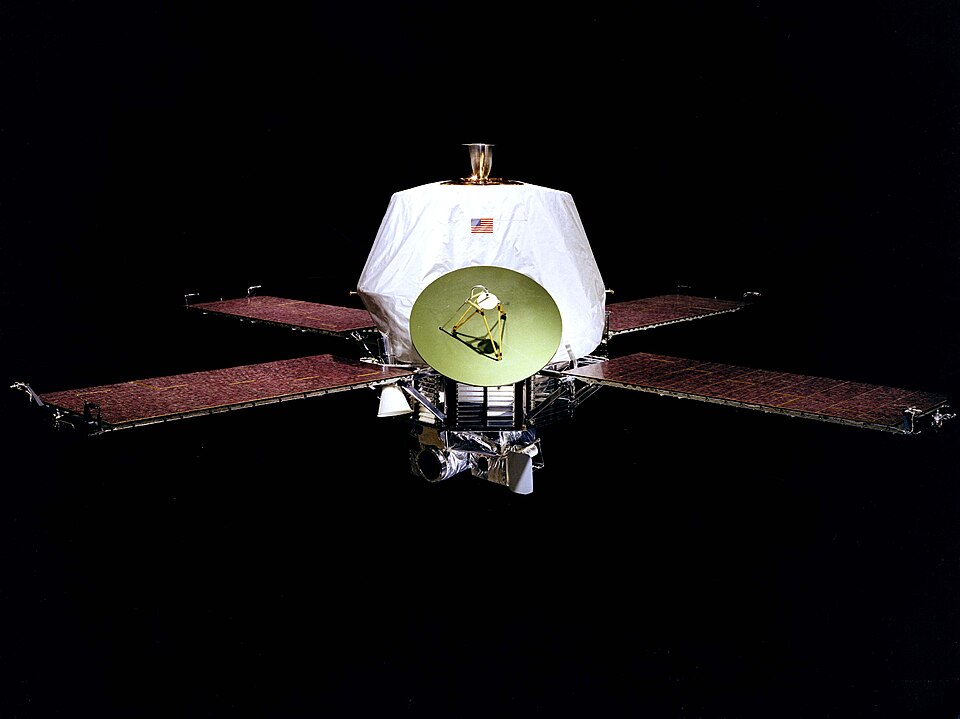

NASA Science's Mariner 9 page says the spacecraft entered orbit around Mars on November 14, 1971, and describes it as the first spacecraft to orbit another planet1. Saturday, November 14, 2026, is the 55th anniversary. Here is what NASA's mission page and the agency's National Space Science Data Center record for the spacecraft say about the arrival, the dust storm that greeted it and the maps that followed, as of November 7, 2026, including two places where the two records differ.
A second try after a failed launch
NASA's page says Mariner 9 lifted off from Cape Canaveral, Florida, on May 30, 1971, on an Atlas Centaur rocket, and was the second in a pair of identical Mars orbiters1. It says Mariner 8 failed to reach Earth orbit on May 9, three weeks before the May 30 launch of Mariner 91. The data center record says only one spacecraft was available after that failure, so Mariner 9 combined the objectives of both, including the plan to map 70 percent of the Martian surface and to study changes in the Martian atmosphere and surface over time2.
The NASA page gives the spacecraft's mass as 997.9 kilograms and says it spanned about 22 feet (6.9 meters) with its solar panels extended1. The data center record says the four solar panels carried 14,742 solar cells and could produce 800 watts at Earth and 500 watts at Mars2. It adds that the onboard computer and sequencer had a memory of 512 words, and that data was stored on a tape recorder that could hold 180 million bits2.
Entering orbit, 167 days later
According to the data center record, Mariner 9 arrived at Mars on November 14, 1971, after a 167 day flight, and a rocket burn put the spacecraft into Mars orbit, making it the first spacecraft to orbit another planet2. NASA Science says the main engine ignited at 00:18 UT on November 14 and that the burn made Mariner 9 the first human-made object to enter orbit around another planet1. The first orbit, in NASA's account, ran about 870 by 11,130 miles (1,398 by 17,916 kilometers) above Mars at a 64.3 degree inclination1.
The page says Mariner 9 beat the Soviet Mars 2, which launched 11 days earlier, to the planet1. The data center record gives the first orbit's low point as 1,398 kilometers and its period as 12 hours 34 minutes, and says a 6 second burn two days later brought the period to just under 12 hours2.
A planet hidden by dust
The data center record says a dust storm that started on September 22, 1971, in the Noachis region quickly grew into one of the largest global storms ever observed on Mars2. It says that by the time the spacecraft arrived, no surface details could be seen except the summits of Olympus Mons and the three Tharsis volcanoes, and that the storm abated through November and December2. NASA's page says the dedicated imaging mission began in late November, but photos taken before about mid-January 1972 did not show great detail because of the storm1.
The page says that once the dust subsided, from January 2, 1972, Mariner 9 began returning spectacular photos of deeply pitted terrain, including a system of parallel rilles stretching more than 1,100 miles (1,700 kilometers) across Mare Sirenum1. It says the volume of data countered the notion that Mars was geologically inert, and that there was speculation about water on the surface in an earlier period, but the data could not provide conclusive proof1.
What the maps showed
By February 1972, NASA says, the spacecraft had identified about 20 volcanoes, one of which was later named Olympus Mons, which spectrometer data suggested is about 9 to 19 miles (15 to 30 kilometers) tall with a base 370 miles (600 kilometers) across1. It says another major feature, Valles Marineris, a canyon system more than 2,500 miles (4,000 kilometers) long, 120 miles (200 kilometers) wide and in places more than 4 miles (7 kilometers) deep, was named in honor of Mariner 91.
On February 11, 1972, according to the page, NASA announced that Mariner 9 had achieved all its goals, although the spacecraft kept returning useful data into the summer1. The page puts the last contact at 22:32 UT on October 27, 1972, when the spacecraft ran out of the gaseous nitrogen it used for attitude control, by which time it had mapped 85 percent of the planet and returned 7,329 photos, including at least 80 of Phobos and Deimos1. The data center record gives the same 7,329 images and says the mission returned a total of 54 billion bits of scientific data2.
Where the two records differ
NASA Science gives the arrival burn as 915.6 seconds1, while the data center record gives 15 minutes 23 seconds, which is 923 seconds2. Both sources date the burn to November 14, 1971, and this article does not choose between the two durations.
On the spacecraft's fate, NASA Science says it was expected to crash onto the Martian surface sometime around 20201, while the data center record says it was left in an orbit that should not decay for at least 50 years2. The two statements are different forecasts made at different times, and neither source says whether the spacecraft has come down, so this article makes no claim about it.
NASA's page says Mariner 9 mapped 85 percent of the surface1, while the data center record describes the mapping plan as 70 percent2. The first is a result and the second was the goal, so the figures do not conflict.
Trivia
- On what date in 1971 did Mariner 9 enter orbit around Mars? November 141.
- Which earlier spacecraft in the pair failed to reach Earth orbit on May 9, 1971? Mariner 81.
- Which Martian canyon system was named in honor of the spacecraft? Valles Marineris1.
- What kept Mariner 9 from seeing most surface details when it arrived? A global dust storm that began on September 22, 19712.
- How many photos did NASA say Mariner 9 returned? 7,3291.
Sources
- Mariner 9, NASA Science (mission page). Accessed November 7, 2026.
- Mariner 9 (1971-051A), NASA NSSDCA Spacecraft Details. Accessed November 7, 2026.