Mars's Longest Cloud May Form by Ice Physics Never Seen in Nature
Key Points
- ESA and a team led from Paris said on October 7, 2026 that a model reproduces Mars's Arsia Mons Elongated Cloud when it includes ice forming without any particle to cling to, which earlier simulations had not managed.
- The cloud forms each morning in the Martian spring and summer downwind of the 20 km tall Arsia Mons volcano and stretches up to 1800 km.
- The paper in Nature Geoscience says its finding strongly suggests the process occurs on Mars, a model result and not a direct sighting.
- ESA says some aspects of the modelled cloud do not exactly match the observations.
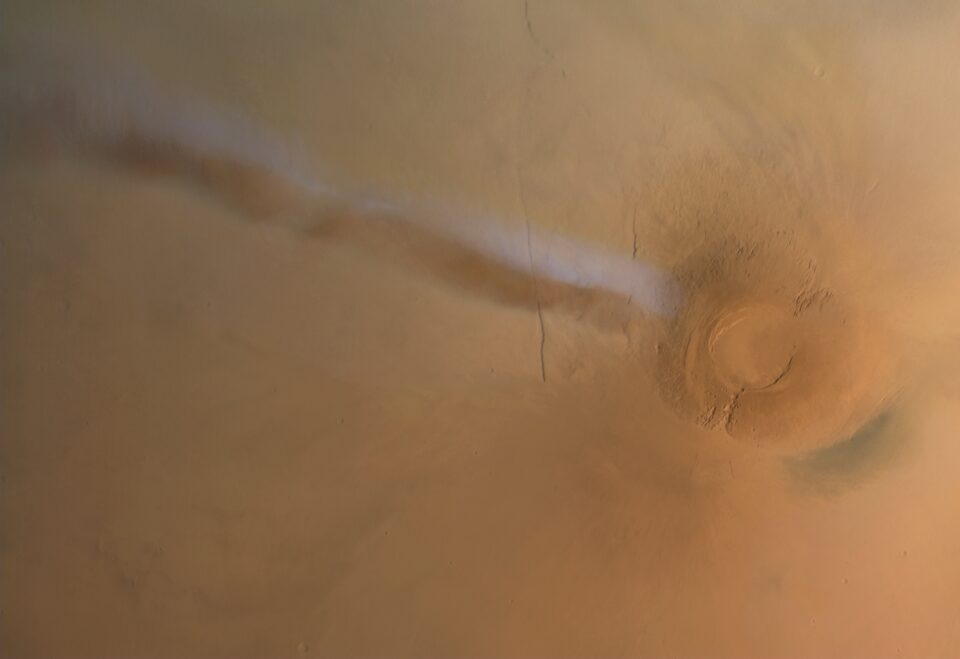

Every Martian spring and summer, a thin white streak of water ice grows out from the side of a giant volcano each morning, then fades away. On October 7, 2026, the European Space Agency (ESA) and a team led from Paris said they had finally reproduced it in a computer model, and that doing so seemed to require a process never seen in a planetary atmosphere. The paper, in Nature Geoscience2, calls the finding a strong suggestion, not a proven fact.
The cloud itself
It is called the Arsia Mons Elongated Cloud, or AMEC. ESA describes it as a white wisp of water ice that emerges downwind of the 20 km tall Arsia Mons volcano1. It stretches out for up to 1800 km, nearly twice the length of the UK, before quickly evaporating, and the cycle repeats every morning for several months.
ESA says Mars Express first revealed the cloud in 20181, and has watched the cloud repeatedly since. Researchers had already worked out that it is an orographic cloud1, a type that also forms on Earth when wind flows past a volcano or mountain.
What the model needed
On Earth, clouds usually form through heterogeneous nucleation1, where water vapor condenses onto specks such as salt, pollen, soot or dust. ESA says dust is thought to play that role on Mars. Earlier simulations, ESA says, did not reproduce what the images show1.
The new work changed that. Lead author Jorge Hernandez-Bernal of Sorbonne Universite in Paris says in the release that the team needed to include physics that textbooks treat as theoretical and usually thought not to happen in nature1. In the paper's abstract, the team reports that a model of homogeneous ice nucleation from water vapor, meaning ice forming without a pre-existing particle,2 inside a meteorological model of Mars reproduces the unique characteristics of the AMEC2.
In ESA's telling, water vapor turns directly into icy cloud particles, like droplets of condensation appearing in the middle of a room rather than on a window1.
Why it is so rare
The process needs unusual conditions. According to ESA, it takes relative humidity levels of over 100 000 times those usually experienced in daily life on Earth1. As winds flow past Arsia Mons, ESA says, the volcano triggers a powerful wave that lifts moist parcels of air several kilometers up in just a few minutes1, and that cools the air so fast that temperatures drop by 30 degrees in just 10 minutes1.
The abstract adds that scientists had considered the process possible for mesospheric clouds on Earth and Venus, but that it has never been observed in nature2.
What is a model result and what is not
This is a simulation matched to spacecraft images, not a direct sighting of ice forming. The researchers based the modelling on data from the three instruments aboard Mars Express (the Visual Monitoring Camera, the High Resolution Stereo Camera and the OMEGA imaging spectrometer)1. ESA also says some aspects of the modelled cloud do not exactly match the observations1, though the lead author calls the result remarkable anyway.
The news also reached a wider audience through a report by Ars Technica on October 24, 20263. That version, which Ars Technica says originally appeared in WIRED Czech Republic and Slovakia, gives the length as over 1,000 miles and says the required humidity is more than 100,000 times greater than any value measured on Earth. ESA, the source of the finding, words the comparison differently, as levels usually experienced in daily life, so the figures here follow ESA's wording.
Trivia
- Which ESA spacecraft first revealed the Arsia Mons Elongated Cloud, and in what year? Mars Express, in 20181.
- About how tall is the Arsia Mons volcano, according to ESA? 20 km1.
- Which journal published the new paper? Nature Geoscience2.
- What name do scientists give to ice forming from vapor with no particle to cling to? Homogeneous nucleation1.
- By how much, and how fast, does the temperature drop in the modelled cloud? 30 degrees in just 10 minutes1.
Sources
- Mars's oddest cloud may be even odder than we thought, European Space Agency (October 7, 2026). Accessed October 26, 2026.
- J. Hernandez-Bernal et al., Homogeneous ice nucleation from water vapour suggested by elongated clouds on Mars, Nature Geoscience (October 7, 2026). Accessed October 26, 2026.
- A 1,000-mile cloud on Mars may reveal physics never seen in nature, Ars Technica (October 24, 2026). Accessed October 26, 2026.