A Nuclear Ride to Mars for SkyFall, and Sharper Blades for Later
Key Points
- NASA says an experimental blade shape, built on an airfoil called roamx-0201, could in simulations let a future Mars helicopter carrying science instruments cover as much as 18.7 kilometers in one uninterrupted flight, against Ingenuity's 0.7 kilometers.
- NASA says the blade technology is not yet ready for Mars and is aimed at missions after SkyFall.
- NASA says SR-1 Freedom, which it calls the first fission-powered spacecraft to travel outside Earth's orbit, is set to launch in late 2028 carrying SkyFall's three Mars helicopters.
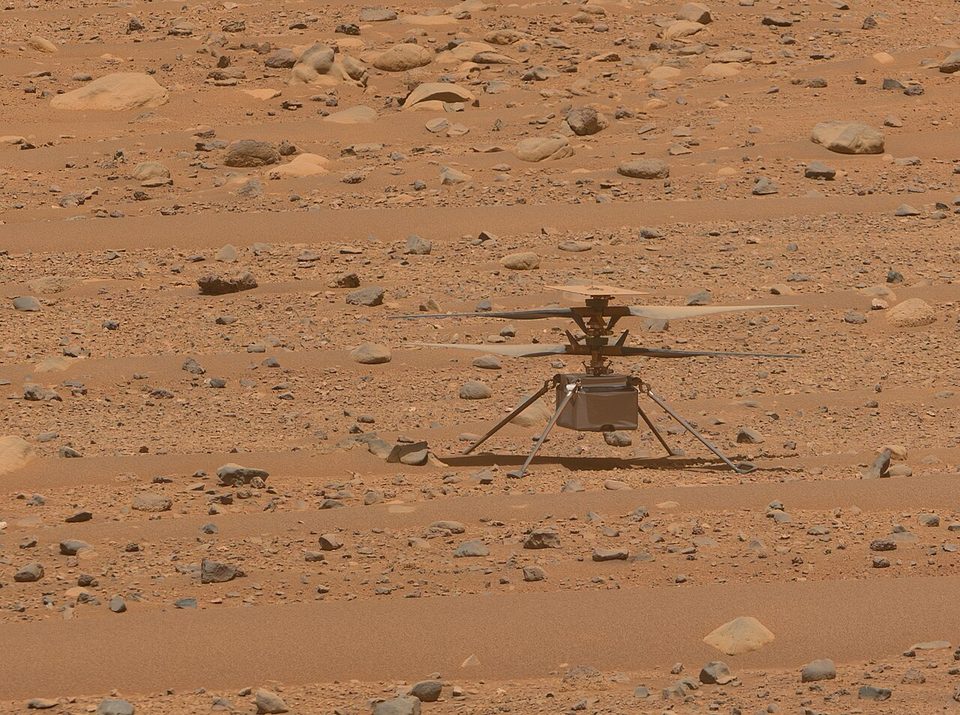

NASA published two updates on Tuesday, October 20, 2026, about the helicopters that will follow Ingenuity to Mars. One describes an experimental rotor blade shape that, in simulations, could let a future helicopter carrying science instruments cover as much as 18.7 kilometers in one uninterrupted flight, against Ingenuity's 0.7 kilometers1. The other reports progress on SR-1 Freedom, the fission-powered spacecraft meant to carry the SkyFall mission's three Mars helicopters when it launches in late 20282.
A thinner, sharper blade
A team at NASA's Ames Research Center in California, working with Imperial College London and Nagoya University in Japan, designed a new blade cross-section, or airfoil, called roamx-02011. It came out of computer simulations tuned to Mars conditions, which pointed toward a thinner, asymmetrical shape. NASA says wind tunnel tests then showed the design boosted performance and was better able to recover in risky flight conditions. NASA says the findings appeared in a paper published September 22 in a journal of the American Institute of Aeronautics and Astronautics1.
By NASA's account, the blade stands out in a few ways. It can run longer at higher speeds before drag divergence, a sudden drop in performance as the rotors approach the speed of sound (and the speed of sound is lower on Mars than on Earth)1. And it deliberately disturbs the thin layer of air flowing over its leading edge, which NASA says counterintuitively pulls the blade upward and helps lift the rotorcraft. Under the conditions studied, it also handled stall, where performance drops sharply and flight becomes unstable after a change in the angle of the airflow, much better than Ingenuity's blades.
NASA is clear that the technology is not yet ready for Mars1. The blade is aimed at missions after SkyFall, which will use a curved-edge blade designed for thin Martian air, like Ingenuity's.
SR-1 Freedom and SkyFall
NASA calls SR-1 Freedom the first fission-powered spacecraft to travel outside Earth's orbit2, built to demonstrate nuclear electric propulsion in deep space. In the October 20 update, NASA said Sierra Lobo will provide the power module's closed Brayton cycle system, which turns heat from the fission reactor into electricity, while the Department of Energy's Idaho National Laboratory designs the reactor. NASA also says the reactor will stay inactive until the spacecraft leaves Earth orbit2.
The mission page lists the spacecraft at about 12,000 kilograms (26,455 pounds), fueled by high-assay low-enriched uranium (HALEU), with a 20-kilowatt power conversion system and a 12-kilowatt Hall thruster3. Its cargo, SkyFall, is three helicopters evolved from Ingenuity's design that will carry ground-penetrating radar and imagers and be able to measure air temperature, wind speed and direction3. NASA says the radar will collect data on features below the surface, and if it finds buried ice, the measurements may help show how far and how deep it goes.
What Ingenuity did
Ingenuity rode to Mars under the Perseverance rover and made the first powered, controlled flight on another planet on April 19, 20214. It was built to make no more than five test flights in 30 days and ended up flying 72 times, the last on January 18, 2024. Across those flights it logged 128.8 minutes in the air and 17.0 kilometers of distance, and flew as high as 24.0 meters. At the top of NASA's simulated range for the new blade, 18.7 kilometers in one flight1, a single flight could cover more ground than the 17.0 kilometers Ingenuity logged across all 72.
Trivia
- On what date did Ingenuity make the first powered, controlled flight on another planet? April 19, 20214.
- How many flights was Ingenuity designed to make, and how many did it make? No more than five in 30 days, and 72 in nearly three years4.
- What is the experimental Mars rotor airfoil called? It's called roamx-02011.
- How many helicopters will SkyFall carry to Mars? Three2.
- Which national laboratory is designing SR-1 Freedom's reactor? Idaho National Laboratory2.
- What fuel will SR-1 Freedom's reactor use? High-assay low-enriched uranium, or HALEU3.
Sources
- NASA Experimental Mars Helicopter Blade Designs Target Longer Flights, NASA, October 20, 2026. Accessed October 22, 2026.
- NASA's SR-1 Freedom Advances with Progress on Nuclear Power Module, NASA, October 20, 2026. Accessed October 22, 2026.
- Space Reactor-1 Freedom, mission page, NASA. Accessed October 22, 2026.
- Ingenuity Mars Helicopter, NASA Science. Accessed October 22, 2026.