Norges Bank Holds Its Policy Rate at 4.5% and Stays Ready to Raise
Key Points
- Norges Bank kept its policy rate unchanged at 4.5 percent in a unanimous decision announced on 5 November 2026, after a meeting on 4 November.
- The rate had been raised from 4.25 percent to 4.50 percent in September, and the committee said it is prepared to raise it again if warranted by the inflation outlook.
- Consumer prices rose 3.4 percent in the twelve months to September 2026 and CPI-ATE rose 3.0 percent, both above the 2 percent target.
- The next decision, with new forecasts in Monetary Policy Report 4/26, is due on 17 December 2026.
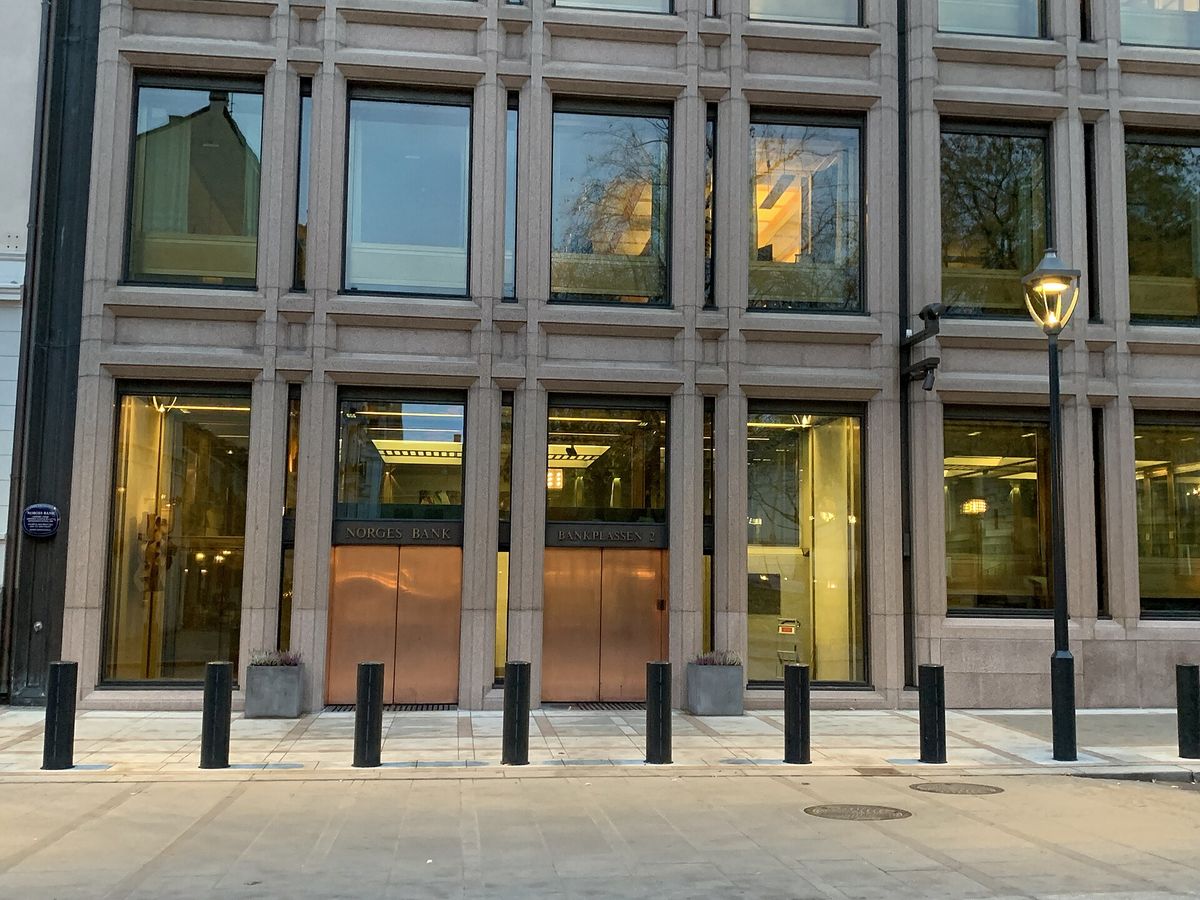

Norway's central bank left its main interest rate alone on Thursday, 5 November 2026. Norges Bank said its Monetary Policy and Financial Stability Committee had decided to keep the policy rate unchanged at 4.5 percent1 at a meeting on 4 November, and that the decision was unanimous1. The hold followed a rise in September, when the committee raised the policy rate from 4.25 percent to 4.50 percent2. Its statement says the Committee is prepared to raise the policy rate if warranted by the inflation outlook1.
The decision was widely expected. Reuters reported that all 26 economists in a poll taken from 29 October to 2 November expected a hold at 4.5 percent9.
What the policy rate is and who sets it
Norges Bank calls the policy rate its most important tool for keeping inflation low and stable3. Technically it is the interest rate on banks' deposits with Norges Bank, up to a certain quota7, also known as the sight deposit rate. Together with the overnight lending rate it forms an interest rate corridor within which short-term money market rates normally move7. After this meeting the overnight lending rate stays at 5.5 percent and the reserve rate at 3.5 percent1. In the bank's own words, changes in the policy rate influence activity levels across the whole economy and thereby inflation6, and the effect comes often with some lag6.
The rate is set by a committee of five members who are appointed by the government6, chaired by the Governor, which meets normally eight times a year6. A Monetary Policy Report with new forecasts accompanies four of the eight meetings6. November was one of the meetings without a report.
The goal is set out in a regulation. The task of monetary policy, the bank says, is to ensure low and stable inflation and to help keep employment as high as possible5, and the operational target is annual consumer price inflation of close to 2 percent over time5. The bank calls its approach flexible inflation targeting, meaning it should be forward-looking and flexible5 and give weight to high and stable output and employment5.
How the rate got here
Norges Bank's own interest rate series shows the policy rate reaching 4.5 percent in a change that took effect on 15 December 20234, then holding there until a first cut, effective 20 June 2025 (4.25 percent)4, and a second, effective 19 September 2025 (4.0 percent)4. The direction then turned. The same series records a rise to 4.25 percent effective 8 May 20264 and to 4.5 percent effective 25 September 20264, which put the rate back at the level it held from December 2023 to June 2025.
The bank's strategy notes two features of the Norwegian economy that shape its decisions. First, in Norway energy prices most often contribute to large short-term fluctuations in the CPI5, which is why the bank also tracks CPI-ATE, an index that excludes energy products. Second, the currency matters, because an increase in the policy rate normally leads to an appreciation of the krone5, which means a slower rise in prices for imported goods5.
For comparison, Reuters reported that Sweden's Riksbank raised its rate by a quarter point to 2.0 percent9 on Wednesday, 4 November, its first rise since 2023.
The inflation and jobs figures behind the hold
Statistics Norway (SSB) reported on 9 October that from September 2025 to September 2026 the Consumer Price Index (CPI) rose by 3.4 per cent8. CPI-ATE, the index adjusted for tax changes and excluding energy products, rose 3.0 per cent8 over the same twelve months. Both sit above the 2 percent target. The committee said inflation remains markedly above target1, and that it has been above target for several years1. The bank also said that domestically produced goods and services inflation remained elevated and was higher than expected1.
The bank pointed to costs as a reason inflation may stay elevated. High labour cost growth in recent years will likely contribute to keeping inflation elevated ahead1, the committee said, and it expects the rapid rise in business costs in recent years1 to work the same way.
The job market has been steady. According to Norges Bank, registered unemployment was 2.0 percent in October, unchanged1, and preliminary figures suggest employment has increased a little more than expected1.
Reasons to wait, and reasons to stay ready
Some of the news since September pointed toward holding. The committee said the krone has appreciated and is stronger than assumed1, and that a stronger krone will in isolation dampen inflation1. It also judged that capacity utilisation in the Norwegian economy has declined and appears to be slightly below a normal level1. House prices, adjusted for normal seasonal variations, have risen as expected1, while new home sales and the number of building permits remain at very low levels1.
Abroad, the committee observed that several central banks have raised their policy rates, and more rate hikes are expected going forward1, and that growth among Norway's trading partners appears to have been somewhat stronger in the third quarter of 20261.
The committee does not want to restrict the economy more than needed1, but it judges that a restrictive monetary policy is still needed1. Governor Ida Wolden Bache said we are prepared to raise the policy rate if needed to bring inflation down to target within a reasonable time horizon1. In September, the bank's forecast had the policy rate close to the current level for a period ahead before declining somewhat2.
What forecasters expect next
Outside forecasts lean toward a long pause. Reuters said the vast majority of economists in its poll predicted no further hikes9. Nomura, in a view summarised by FXStreet on 5 November, expects no rate changes in 2026 or 202710, and its central case is that the next move will be a cut, though probably not until 2028 at the earliest10, because it sees Norway's disinflation as very gradual.
The next decision is due on 17 December 20261, when Norges Bank will also publish new forecasts in Monetary Policy Report 4/261.
Trivia
- When, and by whom, was Norges Bank established? By an Act of the Storting, the Norwegian parliament, on 14 June 181611.
- Which city was the bank's seat before it moved to the capital? Trondheim. The seat moved to Kristiania (Oslo) on 1 January 189711.
- Where did the bank's seat go temporarily in 1940? London11, while Norway's gold reserves were evacuated via Åndalsnes, Molde and Tromsø to London11, and later to New York and Ottawa.
- What did the krone replace in 1875, and at what rate? The speciedaler, at 4 kroner to 1 speciedaler12. With the change, Norway joined the Scandinavian Monetary Union.
- When was the 50 øre coin, the last øre coin, withdrawn? On 1 May 201212.
- Before the sight deposit rate, which rate served as the policy rate? The overnight lending rate for banks, the D-loan rate, from March 1986 to May 19937.
Sources
- Rate decision November 2026, Norges Bank, 5 November 2026. Accessed November 6, 2026.
- Rate decision September 2026, Norges Bank, 24 September 2026. Accessed November 6, 2026.
- Policy rate, Norges Bank. Accessed November 6, 2026.
- Policy rate series IR B.KPRA.SD.R (sight deposit rate), 2022 to 2026, Norges Bank open data. Accessed November 6, 2026.
- Monetary policy strategy, Norges Bank. Accessed November 6, 2026.
- How are policy rate decisions made?, Norges Bank. Accessed November 6, 2026.
- Policy rate, more about the key policy rate, Norges Bank. Accessed November 6, 2026.
- CPI up 3.4 per cent last 12 months, Statistics Norway, 9 October 2026. Accessed November 6, 2026.
- Norway central bank keeps rate on hold, may hike again, Reuters via RTE, 5 November 2026. Accessed November 6, 2026.
- Norwegian Krone: Gradual disinflation delays rate cuts, Nomura, FXStreet, 5 November 2026. Accessed November 6, 2026.
- Norges Bank, Wikipedia. Accessed November 6, 2026.
- Norwegian krone, Wikipedia. Accessed November 6, 2026.