Orionid Meteor Shower 2026: When It Peaked, and Why Halley Matters
Key Points
- NASA's October skywatching guide said the Orionid meteor shower peaks on the night of October 21 into the morning of October 22 in 2026.
- As of October 14, 2026, the American Meteor Society expected a waxing gibbous Moon on peak night, and NASA said the best chance might come a few hours before dawn, after the Moon sets.
- Every Orionid is a speck of comet 1P/Halley, and NASA history gives the comet's next perihelion as July 28, 2061.
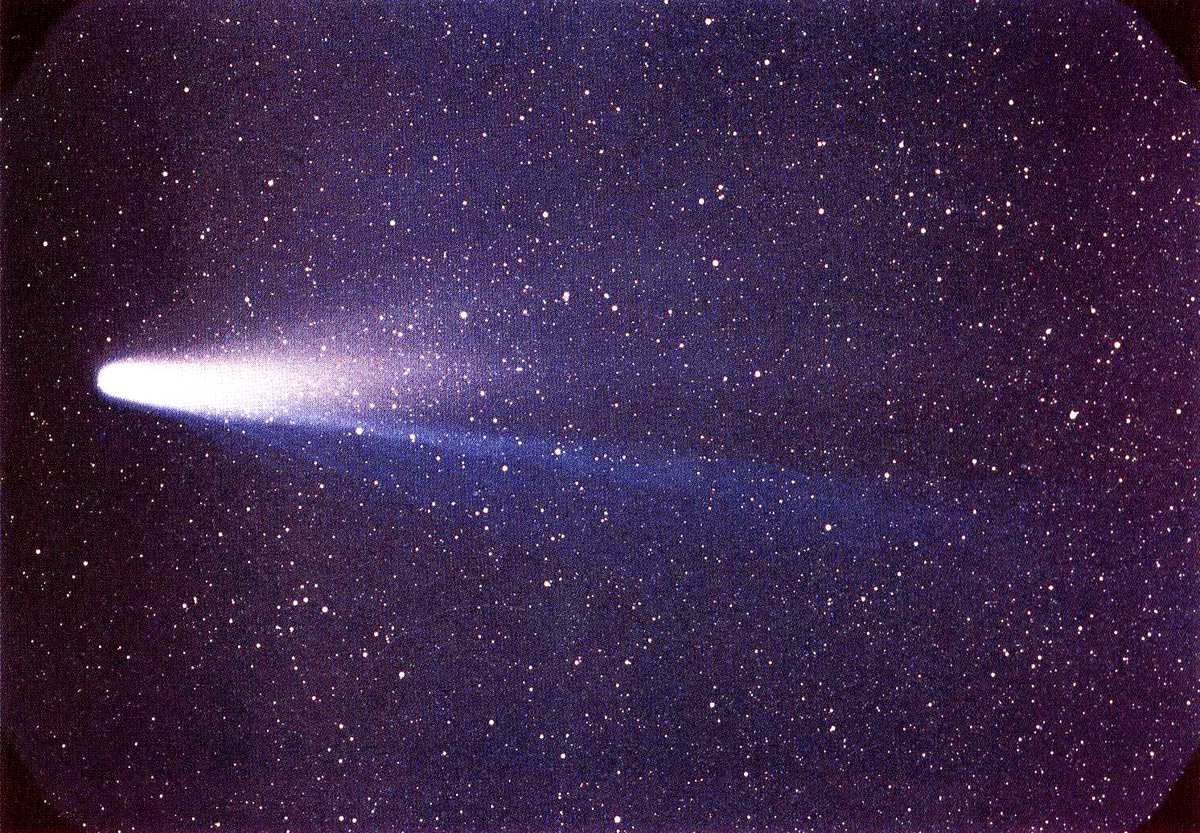

Every October, Earth plows through a stream of dust shed by the most famous comet there is. The result is the Orionid meteor shower, and NASA's October skywatching guide said it peaks on the night of October 21st into the morning of October 22nd2 in 2026. The shower is listed as active from October 2 to November 7, 20261. That peak night has passed. As of November 6, 2026, this page has not found a published count of how many meteors observers saw, so the figures below are the forecasts and the background that were published before the peak.
The Moon was the catch this year
As of October 14, 2026, the American Meteor Society expected a waxing gibbous Moon3 on peak night, and warned to "expect significant interference while the Moon is above the horizon, though brighter meteors can still be visible."3 Full Moon followed a few days later, at 12:12 a.m. Eastern time on October 264.
The fix was timing. NASA's advice was that "your best chance may come in just a few hours before dawn, after the Moon sets."2 The U.S. Naval Observatory put moonset on the morning of October 22 at 3:27 a.m. in Washington, D.C.4, with civil twilight beginning at 6:58 a.m., and at 3:22 a.m. in Los Angeles5, with twilight at 6:39 a.m. (both in local daylight time). That left a little over three hours between moonset and the start of civil twilight.
How to watch the Orionids
The forecast for dark skies was that NASA expected about 10 to 20 meteors per hour1, in line with the American Meteor Society's figure for a normal year, 10 to 20 shower members at maximum3.
NASA's viewing tips start with location. "Find an area well away from the city or street lights."1 Bring a sleeping bag, blanket or lawn chair, then lie flat on your back with your feet facing southeast (northeast in the Southern Hemisphere) and take in as much sky as you can. "In less than 30 minutes in the dark, your eyes will adapt and you will begin to see meteors."1
The meteors seem to fly out of a point called the radiant, which sits just to the north of Orion's bright star Betelgeuse1. Staring right at that spot is a mistake, though. NASA says it is "actually better to view the Orionids from 45 to 90 degrees away from the radiant,"1 where the streaks look longer. Meteors close to the radiant appear short because of foreshortening.
Orionids are quick. They hit the atmosphere at about 41 miles (66 kilometers) per second1, and fast meteors can leave glowing trains of debris that linger "for several seconds to minutes."1 Some brighten into fireballs, so keep an eye out for a longer flash of light.
Why Halley makes meteors twice a year
Every Orionid is a speck of comet 1P/Halley1. Each time Halley swings through the inner solar system, its nucleus "sprays ice and rock into space."6 NASA says that debris stream produces "two weak meteor showers each year: the Eta Aquarids in May and the Orionids in October."6 Orion only marks the direction the meteors appear to come from. In NASA's words, "The constellation is not the source of the meteors."1
The spring shower (the American Meteor Society spells it Eta Aquariids) next peaks on the night of May 5 to 6, 20273, and the society expects only a 2% illuminated waning crescent3 Moon that night.
The comet Edmond Halley figured out
Before Halley, comets were thought to pass through the solar system once and leave. In 1705, the English astronomer used Isaac Newton's theories of gravitation and planetary motions6 to compute the orbits of several comets and noticed that bright comets reported in 1531, 1607 and 1682 traveled similar paths. He suggested they were one comet coming back, and "correctly predicted the comet would return in 1758."6 He did not live to see it. NASA gives his dates as 1656 to 17426.
The orbit averages 76 Earth years6, though the planets tug it longer or shorter. NASA lists periods as short as 74.42 years (1835 to 1910) and as long as 79.25 years (451 to 530)6. The comet has been linked to observations dating back more than 2,000 years6, and it appears in the Bayeux Tapestry, which chronicles the Battle of Hastings in 1066.
The nucleus itself is small and dark, about 9.3 by 5 miles (15 by 8 kilometers)6, with an albedo NASA gives as 0.03, meaning it reflects only 3% of the light that falls on it6.
1986 and the spacecraft fleet
Halley's last perihelion, its closest point to the Sun, came on February 9, 19866, when it passed well inside the orbit of Venus. For people on the ground, that return "proved somewhat disappointing"7 because Earth and the comet were on opposite sides of the Sun at perihelion, according to a NASA history by John Uri.
NASA history describes a "veritable flotilla of spacecraft, informally known as the Halley Armada"7, among them Japan's Suisei and Sakigake, the Soviet Union's Vega 1 and Vega 2, the international ICE spacecraft and the European Space Agency's Giotto. Vega-1 passed within 5,525 miles of the nucleus7 on March 6, 1986, and Vega-2 came within 4,990 miles on March 9.
Giotto went much closer. Launched on 2 July 19858, it met Halley on 14 March 1986, and ESA says that "only 7.6 seconds before closest approach, the spacecraft was sent spinning by an impact from a 'large' (one gram) particle."8 Contact came back over the following 32 minutes, by which point Giotto had passed within 596 kilometers (about 370 miles) of the nucleus. ESA says its images showed for the first time the shape of a comet nucleus8, and credits the mission with the first evidence of organic material in a comet.
Mark Twain and the 1910 return
Mark Twain was born two weeks after the comet's 1835 perihelion7 and died the day after its 1910 perihelion. His biographer Albert Bigelow Paine recorded him saying, the year before that return, "I came in with Halley's comet in 1835. It is coming again next year, and I expect to go out with it."9
That 1910 pass produced the first photographs of the comet7, and Earth passed through the comet's tail, which caused some popular unease at the time.
Next stop, 2061
Halley reached its farthest point from the Sun in December 20237 and is now heading back. NASA history gives its next perihelion as July 28, 20617, and this time "Earthbound viewing should be favorable as the two objects will be on the same side of the Sun."7
Trivia
What do the names of the Soviet Vega probes combine?
Venera and Galley, the Russian words for Venus and Halley7. The probes visited Venus before heading on to the comet.
Which painter is ESA's Giotto probe named after, and why?
Giotto di Bondone, who observed Halley's Comet in 1301 and depicted it as the star of Bethlehem8 in his Adoration of the Magi in the Scrovegni Chapel.
What is the first positive record of Halley's Comet?
An observation from 240 B.C.E. in the Chinese chronicle "Records of the Grand Historian," or Shiji7.
When did Halley's Comet come closest to Earth?
On April 10, 837, at a distance of 0.033 AU (3.07 million miles)6, when, according to NASA, it reached about magnitude -3.5, nearly as bright as Venus at its most brilliant.
Which way does Halley travel around the Sun?
Backward. It moves opposite to Earth's motion, in a plane tilted 18 degrees6 to Earth's orbit.
Which space shuttle mission carried a satellite built to study Halley in 1986?
STS-51L, Challenger, which carried SPARTAN-203, also known as SPARTAN-Halley7. The satellite was lost in the accident.
How strong did the Orionids get from 2006 to 2009?
Peak rates were comparable to the Perseids, at 50 to 75 per hour3, according to the American Meteor Society.
Which spacecraft made the first ever close encounter with a comet?
ICE, which on Sept. 11, 1985, passed through the tail of Comet Giacobini-Zinner7, about six months before the Halley flybys.
Sources
- Orionids, NASA Science. Accessed November 6, 2026.
- What's Up: October 2026 Skywatching Tips from NASA, NASA Science. Accessed November 6, 2026.
- Meteor Shower Calendar, American Meteor Society. Accessed November 6, 2026.
- Complete Sun and Moon Data for One Day: Washington, DC, October 22, 2026, U.S. Naval Observatory, Astronomical Applications Department. Accessed October 14, 2026.
- Complete Sun and Moon Data for One Day: Los Angeles, CA, October 22, 2026, U.S. Naval Observatory, Astronomical Applications Department. Accessed October 14, 2026.
- 1P/Halley, NASA Science. Accessed October 14, 2026.
- John Uri, 955 Years Ago: Halley's Comet and the Battle of Hastings, NASA History, October 14, 2021. Accessed October 14, 2026.
- Giotto overview, European Space Agency. Accessed October 14, 2026.
- Albert Bigelow Paine, Mark Twain: A Biography, Volume III, Part 2: 1907-1910, Project Gutenberg eBook 2987. Accessed October 14, 2026.