Perseverance Finds Bright Hydrated Silica Rocks at Idubi, NASA Says
Key Points
- A NASA Perseverance team update dated November 16, 2026 says newly downlinked SuperCam data show bright, light-toned rocks at Idubi, outside Jezero crater, are not igneous and are rich in hydrated silica.
- The post says hydrated silica forms in several watery settings on Earth and can preserve microfossils, so it is a prime target for studying Mars' water history.
- Earlier silica-rich rocks on Jezero's inner rim were too small for the rover's close-up instruments, and a detailed proximity science campaign is already under way at Idubi.
- The update reports a composition result only. It does not report any sign of life, and it frames that question as open.

NASA's Perseverance team posted a mission update on Monday, November 16, 2026, about an area called "Idubi" in the Lac de Charmes region outside Jezero crater. It says newly downlinked SuperCam data confirm that a cluster of bright, light-toned rocks there are not igneous and are rich in hydrated silica1. The post is a team member's science update, not a peer-reviewed paper, and the work it describes is still under way.
What the update says
The rover team describes Idubi as an area of ancient Martian crust exposed in the Lac de Charmes region, outside of Jezero crater1. The post says the team was captivated by a cluster of eerily bright, light-toned rocks1 that stand out against the darker, often dust-covered surface, and that the fragments are even brighter than the igneous and impactite rocks previously investigated1. Suspecting they were not typical igneous rocks, the team directed Perseverance to examine them, and the SuperCam data show they are not igneous in origin1.
The image that opens the post is a Mastcam-Z view of a silica-rich rock taken on October 29, 2026 (sol 2023)1, with a close-up from the SHERLOC WATSON camera on the same sol. NASA's instrument page says SuperCam examines rocks and soils with a camera, laser and spectrometers3 and can identify the chemical and mineral makeup of areas as small as a pencil point from a distance of more than 20 feet (7 meters)3. It describes WATSON as a color camera for taking close-up images of rock grains and surface textures3.
Why hydrated silica matters
According to the post, hydrated silica can form in many aqueous environments on Earth, including hydrothermal, pedogenic and groundwater systems1. It therefore calls such deposits prime targets for understanding Mars' hydrological history1, since several of those environments could have been capable of supporting life1. The post also says hydrated silica holds immense astrobiological value due to its remarkable capacity to preserve microfossils1, and it asks, as an open question, whether these rocks hold signs of ancient life.
The team notes that Perseverance previously encountered silica-rich rocks on the inner rim of Jezero Crater1, but those deposits were too small to deploy proximity science instruments1 for the high-resolution chemical and mineralogical data needed to judge their origin. At Idubi the rocks offer a much more promising scale, and a detailed proximity science campaign is already underway1.
How this fits the earlier Idubi findings
A mission blog post written on September 29, 2026 and dated October 5 describes a vast field of light-toned rocks peppering the Martian surface2 after about six months in Lac de Charmes. It says early data indicated many of them are igneous rocks called gabbro2, and that a patch of possible bedrock between the boulders looked like light- and dark-colored, angular fragments of rock, forming what geologists call a breccia2. One possibility the team was investigating was that the boulders had eroded out of that breccia. The November 16 update concerns the bright rocks in the area and says SuperCam found them to be hydrated silica rather than igneous. It does not say how the two kinds of rock relate, and neither post gives an age or origin for the silica.
What this does and does not show
The update reports one instrument's composition result for light-toned rocks at one site. It does not report that any biosignature, organic molecule or fossil was found, and the question it raises about ancient life is posed as a question, not answered. The origin of the silica, whether hydrothermal, pedogenic or groundwater, is not settled in the post, which lists those settings only as ways hydrated silica forms on Earth. The proximity science campaign it mentions is how the team expects to learn more.
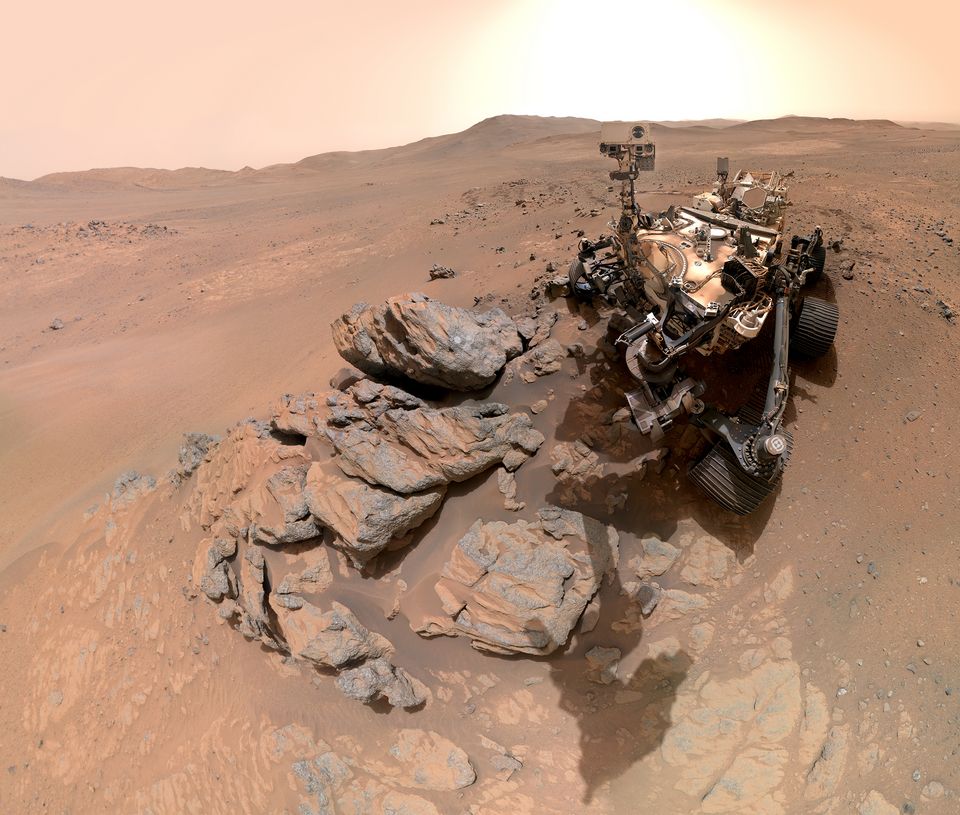
The photo at the top of this page is not from Idubi. It is a Perseverance selfie that, according to its Wikimedia Commons file page, was assembled from 61 images and taken on March 11, 2026 (sol 1797) at a Lac de Charmes location after the rover made a circular abrasion patch, with Jezero crater's western rim in the background.
Trivia
- Which Perseverance instrument's data showed the bright Idubi rocks are not igneous? SuperCam1.
- What mineral material do the light-toned rocks turn out to be rich in? Hydrated silica1.
- On what date, and sol, was the post's Mastcam-Z image of a silica-rich rock taken? October 29, 2026, sol 20231.
- From how far can SuperCam identify the makeup of an area as small as a pencil point? More than 20 feet (7 meters)3.
- What are the angular, mixed light and dark rock fragments called that the earlier Idubi post describes? A breccia2.
Sources
- Perseverance Update: The Ghostly Rocks of 'Idubi', Bright Remnants of Aqueous Systems from Long Ago, NASA Mars 2020 Mission Team, November 16, 2026. Accessed November 17, 2026.
- A Journey to the Depths of Ancient Mars?, NASA Mars 2020 Mission Team, October 5, 2026. Accessed November 17, 2026.
- Science Instruments, NASA Mars 2020 Perseverance Rover. Accessed November 17, 2026.
- File:Perseverance Stuns in New Selfie.png, Wikimedia Commons file page. Accessed November 17, 2026.