Perseverance Measured Ultrafine Mars Dust on Rover Test Targets
Key Points
- NASA said on October 26, 2026 that Perseverance measured fine and ultrafine Martian dust over 1,645 Martian days, on calibration targets that include spacesuit material samples.
- NASA says the particles included ultrafine grains of around 100 nanometers, smaller than the roughly 3 micrometers earlier Mars measurements resolved.
- NASA says the findings are due to be published October 27, 2026, in the Proceedings of the National Academy of Sciences, and could inform spacesuit and habitat design.
- The release reports particle sizes and what stuck to which material, and it does not report a measured health effect on a person.
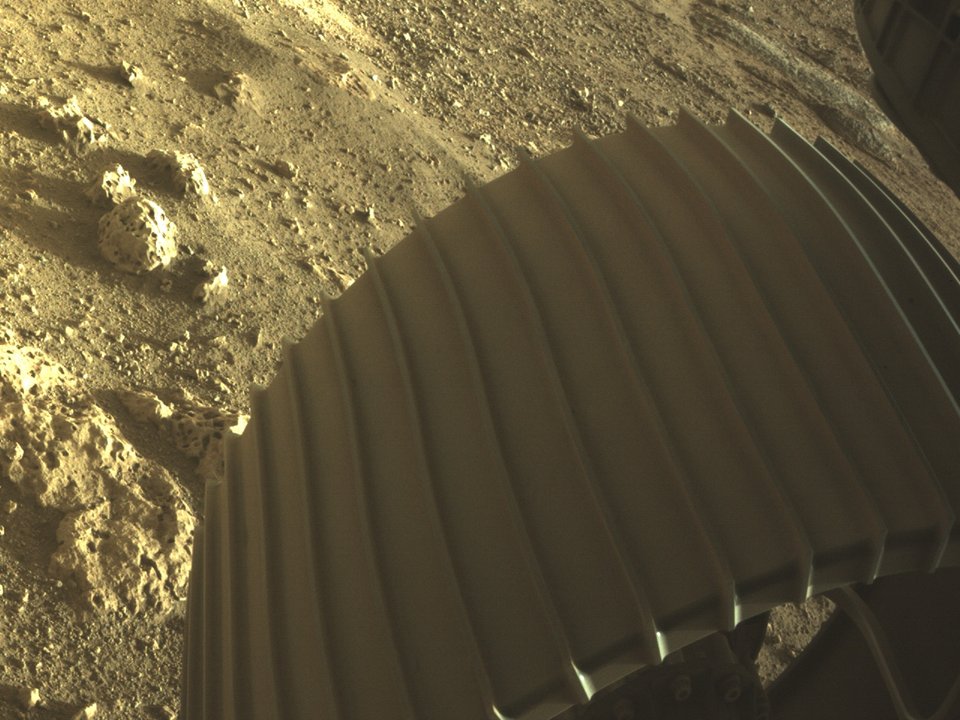

NASA says its Perseverance rover has measured Martian dust particles smaller than earlier measurements on Mars resolved, and that it found them on the calibration targets of two of its instruments, which hold spacesuit material samples and other reference materials. NASA's release, dated October 26, 2026, says the findings will be published Tuesday, October 27, in the Proceedings of the National Academy of Sciences1. The numbers below are NASA's account of that work. The paper itself was not read for this article.
Spacesuit swatches on a rover
Perseverance carries a set of five samples of spacesuit material1, each three-quarters of an inch (20 millimeters) square. They sit on the calibration target for SHERLOC, an instrument on the rover's robotic arm. NASA says the swatches were sent to Mars to study how spacesuit materials hold up on the planet's surface. The calibration target for a second instrument, PIXL, carries a sample of Teflon and of basaltic glass1. NASA explains that Teflon contains no elements PIXL can directly detect, so any elemental signal the X-ray spectrometer picks up from it comes from dust resting on it.
How small the dust is
NASA says that earlier measurements on Mars resolved dust particles down to about 3 micrometers across1. PIXL detected two smaller categories: fine particles measuring less than 2.5 micrometers1 and ultrafine particles of around 100 nanometers, which NASA compares to a human hair that is about 70 micrometers wide.
Particles on PIXL's Teflon target and SHERLOC's Vectran swatch averaged about 2 micrometers1. On PIXL's basaltic glass and SHERLOC's Teflon swatch, sizes ranged down to about 100 to 300 nanometers1. The measurements were made over 1,645 Martian days1. NASA calls the PIXL results the first on-site measurements of fine and ultrafine particles on Mars1.
Why dust sticks
NASA says static electricity appears to determine which size dust particles stick to which surface1, with grains picking up charge as they collide in the air. In NASA's account the finest particles stayed attached through years of driving and drilling1, and, NASA says, the results show organic polymers such as the Teflon swatch, which are common in the outer layers of spacesuits, readily collect fine dust. The release also says some materials hold less dust than others. In the words of lead author Scott VanBommel of Washington University in St. Louis, "The larger clumps, the Martian dust bunnies, get shaken off over time. But the smallest particles stay behind, and those are the ones that pose the greatest challenge for human support systems."1
The Apollo comparison
NASA frames the work against the Moon. Its release says lunar dust scratched visors, degraded outer spacesuit layers and damaged seals during the Apollo missions1, and that some crew members reported symptoms similar to hay fever. Martian grains are described differently: rounded by wind-driven collisions, less abrasive than those on the Moon1, enriched in sulfur, chlorine and iron, and with more silica than lunar dust. NASA says the dust also matches the iron- and sulfur-rich composition that earlier missions measured, and that PIXL found it enriched in phosphorus with signs of calcium sulfate.
What NASA says about health, and what it does not
NASA points out that on Earth, airborne particles below 2.5 micrometers are tied to a range of negative health effects because they can penetrate deep into the lungs and enter the bloodstream1. It describes Martian dust as predominantly silicate minerals carrying chemically reactive compounds, including perchlorates that can disrupt thyroid function and reactive iron that induces cellular damage1. It also says scientists believe the risk depends on the quantity of dust and the length of exposure. The release does not report any measured health effect on a person; it says the results could inform spacesuit and habitat design, dust-removal procedures and crew health standards.
Design ideas named in the release are suitports, which let astronauts enter a suit attached to the outside of a habitat, and dual-chamber airlocks1, which it says could reduce how much dust gets inside living quarters. NASA is also working on dust hazards with ground tests and lunar missions. Its Electrodynamic Dust Shield, which uses electric fields, removed regolith from glass and thermal radiator surfaces on the Moon during Firefly Aerospace's Blue Ghost Mission 12, a mission that concluded on March 16, 2025, according to a NASA image article dated March 27, 2025.
Trivia
- Which journal does NASA say will publish the Perseverance dust findings on October 27, 2026? Proceedings of the National Academy of Sciences1.
- What is the name of the second rover instrument, besides SHERLOC, whose calibration target supplied dust measurements? PIXL (Planetary Instrument for X-ray Lithochemistry)1.
- About how wide is the human hair NASA uses to size the dust? About 70 micrometers1.
- According to NASA, which material on PIXL's calibration target gives a dust signal because it has no elements PIXL can directly detect? Teflon1.
- Which NASA technology uses electric fields to clear lunar dust and flew on Blue Ghost Mission 1? The Electrodynamic Dust Shield2.
Sources
- NASA's Perseverance Offers Clues to Protect Crews From Mars Dust, Jet Propulsion Laboratory, NASA (October 26, 2026). Accessed October 27, 2026.
- NASA's Dust Shield Successfully Repels Lunar Regolith on Moon, Stephanie Plucinsky, NASA (March 27, 2025). Accessed October 27, 2026.