Philae's Comet Landing Turns 12 on Nov. 12: Three Touchdowns
Key Points
- NASA's mission page says Philae successfully landed on comet 67P/Churyumov-Gerasimenko on Nov. 12, 2014, making Rosetta the first mission designed to orbit and land on a comet.
- ESA's November 14, 2014 article says the lander touched the surface three times, at 15:34, 17:25 and 17:32 GMT in comet time, after its harpoons did not fire.
- ESA says the first hop lasted 1 hour 50 minutes and covered about 1 kilometer, and the second, smaller hop ended seven minutes later in the final resting place.
- ESA's June 14, 2015 announcement says Philae shut down on November 15, 2014, after about 60 hours, and woke from hibernation with signals received on June 13, 2015.

NASA's Rosetta-Philae mission page says that on Nov. 12, 2014, the European Space Agency's Philae probe successfully landed on the surface of a comet and began sending back images and data1. Thursday, November 12, 2026, falls 12 years to the day after that landing on comet 67P/Churyumov-Gerasimenko. Here is what ESA and NASA wrote about the descent, the three touchdowns and the long silence that followed, as of November 6, 2026.
A mission built to orbit and land
NASA's page calls Rosetta the first mission designed to orbit and land on a comet, made of an orbiter and a lander called Philae1. It lists the launch as March 2, 2004, and says the two spacecraft carried 20 science instruments to study comet 67P/Churyumov-Gerasimenko for two years as it orbited the Sun1. In August 2014, according to the same page, Rosetta became the first spacecraft to orbit a comet1.
The page gives the mission's end as a controlled impact on the comet on September 30, 20161. Philae's landing sits between those two dates, and it is the part of the mission that the November 2014 ESA updates describe in the most detail.
The plan for November 12, 2014
ESA's Rosetta blog published a timeline of the descent on November 7, 2014, compiled with inputs from the flight control team at ESOC and the science operations team at ESAC3. The blog warned that many of the times were subject to change and confirmation3. The version it later updated lists the lander's separation from Rosetta as a forecast for 09:03:20 UTC on November 12, with a 94-second window, and the expected landing as a forecast for 16:02:20 UTC with 40 minutes of variability3.
The same timeline gives a one-way light time of 28 minutes 20 seconds and an Earth distance of 511 million kilometers3. That delay is why the team on the ground learned of each event about half an hour after it happened at the comet.
For the touchdown itself, the timeline describes an Active Descent System, a cold gas thruster that pushes the lander upward to avoid a rebound, expected to fire for about 15 seconds on landing, and two harpoons that were to fire to secure the lander to the surface3. Those two devices were the plan for staying put, and the next section covers what the data showed about them.
Three touchdowns, not one
In an article dated November 14, 2014, ESA's Rosetta blog said touchdown was confirmed at ESA's Space Operations Centre in Darmstadt, Germany, at 16:03 GMT (17:03 CET) on November 122. Analysis of the first data returned showed that the lander had touched down on the comet three times, not once2.
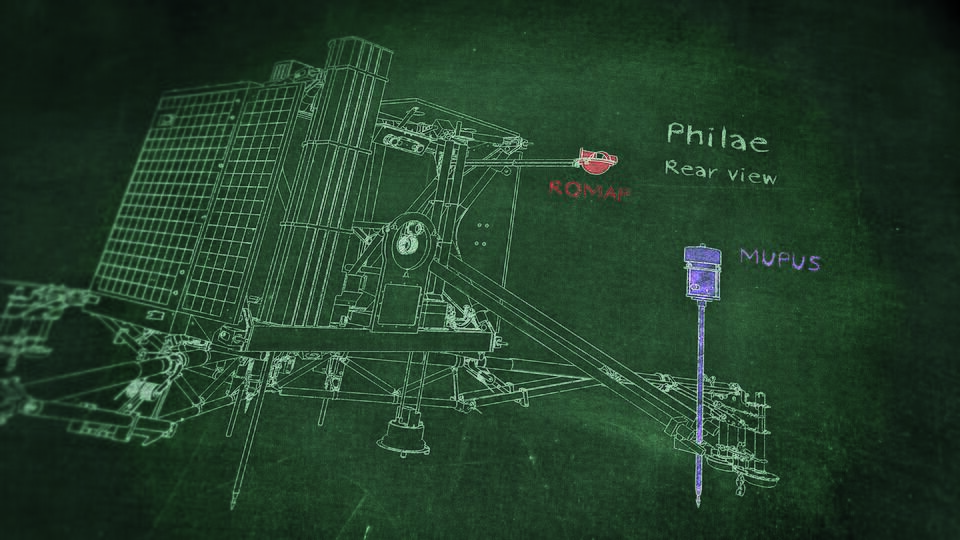
The blog says the harpoons did not fire and that Philae appeared to be rotating after the first touchdown, which indicated it had lifted from the surface again2. It quotes the Philae manager at the DLR German Aerospace Center as reporting contact with the surface at 15:34, 17:25 and 17:32 GMT, in comet time2. The blog says information came from several instruments, including the ROMAP magnetic field analyser, the MUPUS thermal mapper and sensors in the landing gear that were pushed in on the first impact2.
After the first touchdown, the blog says, the lander was off the surface for 1 hour 50 minutes, traveling about 1 kilometer at a speed of 38 centimeters per second2. It then made a smaller second hop at about 3 centimeters per second and landed in its final resting place seven minutes later2. The three times agree with each other, since 15:34 plus 1 hour 50 minutes is about 17:24, and 17:25 plus seven minutes is 17:32.
The blog says the first touchdown was inside the predicted landing ellipse, confirmed by combining the lander's downward-looking ROLIS descent camera with images from the orbiter's OSIRIS camera2. It adds that the touchdown signal from the first contact led the instruments to treat the lander as landed, which started the next sequence of experiments2.
What Philae reported from the surface
ESA's November 14 article says the descent camera showed a surface covered by dust and debris ranging from millimeter to meter sizes2. It says the CIVA camera returned a panoramic image that, on first impressions, suggested the lander was close to a rocky wall and perhaps had one of its three feet in open space2. The same article says the lander remained unanchored to the surface at an orientation that had not yet been determined2.
On the location, the blog reports that preliminary data from the CONSERT experiment suggested Philae could have traveled closer to a large depression known as Site B, perhaps sitting on its rim, while high-resolution orbiter images had yet to confirm it2. That is a preliminary reading from November 14, 2014, and the article does not present it as settled.
The blog also described the power budget, saying the primary battery might run out within the next 24 hours and that, with only about 1.5 hours of sunlight a day at the final spot, the solar-charged secondary battery would limit longer science2. It compares that with the original landing site, which offered nearly seven hours of illumination per 12.4-hour comet day2.
Silence, then a signal
ESA's June 14, 2015 announcement says Philae shut down on November 15, 2014, at 1:15 CET after about 60 hours of operation on the comet4. It says the lander woke after seven months of hibernation, with signals received at ESA's European Space Operations Centre in Darmstadt at 22:28 CEST on June 13, 20154.
According to the announcement, Philae spoke with its team for 85 seconds through Rosetta, reporting an operating temperature of -35 degrees Celsius and 24 watts available4. More than 300 data packets were analyzed at the Lander Control Center at DLR, and more than 8,000 packets remained in the lander's mass memory4. The announcement adds that the lander must also have been awake earlier, because it sent historical data, although it had not been able to contact the team before4.
Where the sources need care
The times in this article come from two different kinds of clock. The November 7 timeline labels its 16:02:20 UTC forecast as the expected landing and receipt of signal3, so it is a ground time, while the times in the November 14 article are, in ESA's words, comet time. That article notes it takes over 28 minutes for a signal to reach Earth2, so a time on the comet and a time on the ground for the same event differ by that much. ESA's own confirmation time of 16:03 GMT is the ground time, while the first touchdown at 15:34 GMT is comet time2.
The figures for the hops, the location and the batteries are what the team reported within days of the landing. The 2015 announcement is the later source for how the lander's first stay ended, and this article does not use anything later than it.
Trivia
- On what date in 2014 did Philae reach comet 67P/Churyumov-Gerasimenko? November 121.
- How many times did ESA's analysis say Philae touched the surface that day? Three2.
- Which two devices were supposed to keep the lander from bouncing away? A cold gas thruster (the Active Descent System) and two harpoons3.
- About how long did the first hop last, according to ESA's November 14, 2014 article? 1 hour 50 minutes2.
- In what month and year did Philae wake from hibernation? June 20154.
Sources
- Rosetta-Philae, NASA Science (mission overview). Accessed November 6, 2026.
- Three touchdowns for Rosetta's lander, ESA Rosetta blog, November 14, 2014. Accessed November 6, 2026.
- Rosetta and Philae landing timeline, ESA Rosetta blog, November 7, 2014 (updated November 8 and 12). Accessed November 6, 2026.
- Rosetta's lander Philae wakes up from hibernation, ESA, June 14, 2015. Accessed November 6, 2026.