Prospero at 55: The UK Satellite Launched on a Cancelled Rocket
Key Points
- Prospero was launched on October 28, 1971, from Woomera in Australia on a Black Arrow rocket, which Wikipedia says made Britain the sixth nation to orbit a satellite on a domestically developed rocket.
- Wikipedia's Black Arrow article says the project's cancellation was announced on July 29, 1971, and that the rocket already at the launch site was allowed to fly.
- Gunter's Space Page says Prospero was officially deactivated in 1996, and Wikipedia says it is not expected to decay until about 2070.

Wikipedia's Prospero article gives the launch as 04:09 GMT on October 28, 1971, from Woomera in South Australia on a Black Arrow rocket2. Wednesday, October 28, 2026, marks 55 years since that launch. Here is what the satellite was for, why its launch is an odd footnote in British space history and what the sources say about it as of October 28, 2026.
A launch after a cancellation
Wikipedia's Black Arrow article says Minister of State Frederick Corfield announced the cancellation of the project in the House of Commons on July 29, 1971, and that the R3 rocket had already been shipped to the launch site, so permission was given for it to fly3. BBC News, in a report by Richard Hollingham dated September 5, 2011, wrote that ministers had cancelled the rocket project in the run up to the flight, and that the programme team went ahead because the Black Arrow was ready1. The same Wikipedia article says the Ministry of Defence had calculated that the American Scout rocket would be cheaper for future launches3.
Wikipedia's Prospero article says the satellite had been called Puck and was renamed Prospero when it became the last planned launch of a British rocket2. Wikipedia's Black Arrow article says the name refers to events in Shakespeare's The Tempest, in which the sorcerer Prospero gives up his powers3.
Wikipedia says the launch made Britain the sixth nation to place a satellite into orbit using a domestically developed rocket, and that Ariel 1, launched in April 1962 on an American rocket, was the first British satellite in orbit2. BBC News called Prospero the first UK satellite launched on a UK launch vehicle, and in 2011 described it as the last1.
What the satellite carried
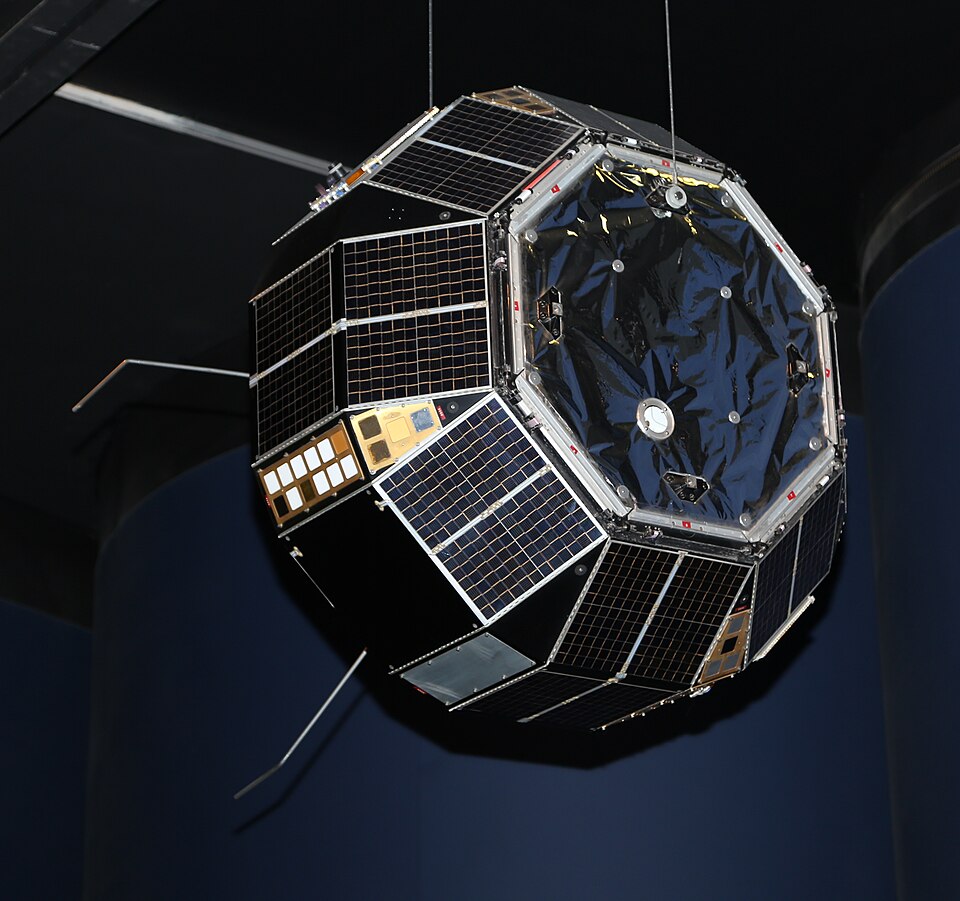
Gunter's Space Page describes a satellite with a shape similar to a pumpkin, an equatorial diameter of 1.2 meters and a height of 0.7 meters4. BBC News gives its mass as 66 kilograms1.
Gunter's Space Page says it was built to test technologies needed by communications satellites, including solar cells, telemetry and power systems, and that it carried a micrometeoroid detector4. Wikipedia reports that the lightweight solar cell design was found successful, while a cerium oxide cover tested on another cell was not, because that cell degraded faster2.
The 1975 paper "The Prospero satellite" by Sketch, Massey, Dalziel and King-Hele, in the Proceedings of the Royal Society A, says in its abstract that some of the on-board systems were tried for the first time in this spacecraft, and that it was the first use of a British control centre to service a satellite in orbit. It also says Prospero designs and operating experience were used in later spacecraft projects5. Only the abstract of that paper was read for this article.
The companion 1975 paper "Observations of the micrometeoroid flux from Prospero" by Bedford, Massey, Dalziel and King-Hele analyses one year of data from the detector aboard Prospero and reports statistical evidence of particle clusters in its abstract6. Only that abstract was read as well.
A rough start in orbit
Wikipedia says the Black Arrow's final stage kept thrusting after separation and collided with Prospero, detaching one of the satellite's four radio antennas2. Wikipedia's Black Arrow article says the spacecraft was still able to complete its mission successfully3.
How long it was heard from
BBC News reported in 2011 that the satellite operated successfully until 1973 and was contacted annually until 19961. Gunter's Space Page says the onboard tape recorder failed on May 24, 1973 and that the satellite was officially deactivated in 19964. Wikipedia says it is in low Earth orbit and not expected to decay until about 20702.
The BBC's 2011 report described a team at University College London's Mullard Space Science Laboratory, led by PhD student Roger Duthie, that hoped to re-establish contact in time for the 40th anniversary. It said the codes to contact Prospero were eventually found typed on a piece of paper in the National Archives at Kew, and that the team needed approval from the regulator Ofcom to use frequencies now employed by other satellite operators1. Wikipedia says that as of September 2012 not much progress had been made, because of time constraints2.
Where the hardware is
Wikipedia's Black Arrow article says the final Black Arrow to be completed, R4, which never flew, is preserved at the Science Museum in London along with the flight spare for the Prospero satellite3. Gunter's Space Page says the spare was not needed after the successful launch and was donated to the Science Museum4. The photo above shows that flight spare.
Trivia
- Which rocket launched Prospero in 1971? Black Arrow3.
- From which launch site, in Australia, did Prospero lift off? Woomera2.
- What was Prospero called before it was renamed? Puck2.
- Which Shakespeare play does the name Prospero come from? The Tempest3.
- Which British satellite, launched in April 1962 on an American rocket, was the first in orbit? Ariel 12.
Sources
- Plan to revive 1970s UK satellite, Richard Hollingham, BBC News, September 5, 2011. Accessed October 28, 2026.
- Prospero (spacecraft), Wikipedia. Accessed October 28, 2026.
- Black Arrow, Wikipedia. Accessed October 28, 2026.
- Prospero (X 3), Gunter's Space Page. Accessed October 28, 2026.
- The Prospero satellite, Sketch, Massey, Dalziel and King-Hele, Proceedings of the Royal Society A, 343 (1633), April 29, 1975. Accessed October 28, 2026.
- Observations of the micrometeoroid flux from Prospero, Bedford, Massey, Dalziel and King-Hele, Proceedings of the Royal Society A, 343 (1633), April 29, 1975. Accessed October 28, 2026.