Pune Metro Pink Line Opens to the Hinjewadi IT Corridor
Key Points
- Prime Minister Narendra Modi inaugurated Pune Metro Line 3, the Pink Line, by video link on 3 November 2026, and passenger services began on 4 November.
- Railway Gazette gives the line as 23.3 km with 23 elevated stations, and Swarajya and Punekar News reported that 17 of them would open at launch.
- Pune IT City Metro Rail Ltd, a Siemens and Tata joint venture, holds a 35-year concession that Railway Gazette reports was the first contract awarded under the 2017 Metro Rail Policy.
- The PTI wire report puts the cost at over Rs 8,300 crore, about $875 million at the 3 November 2026 reference rate.
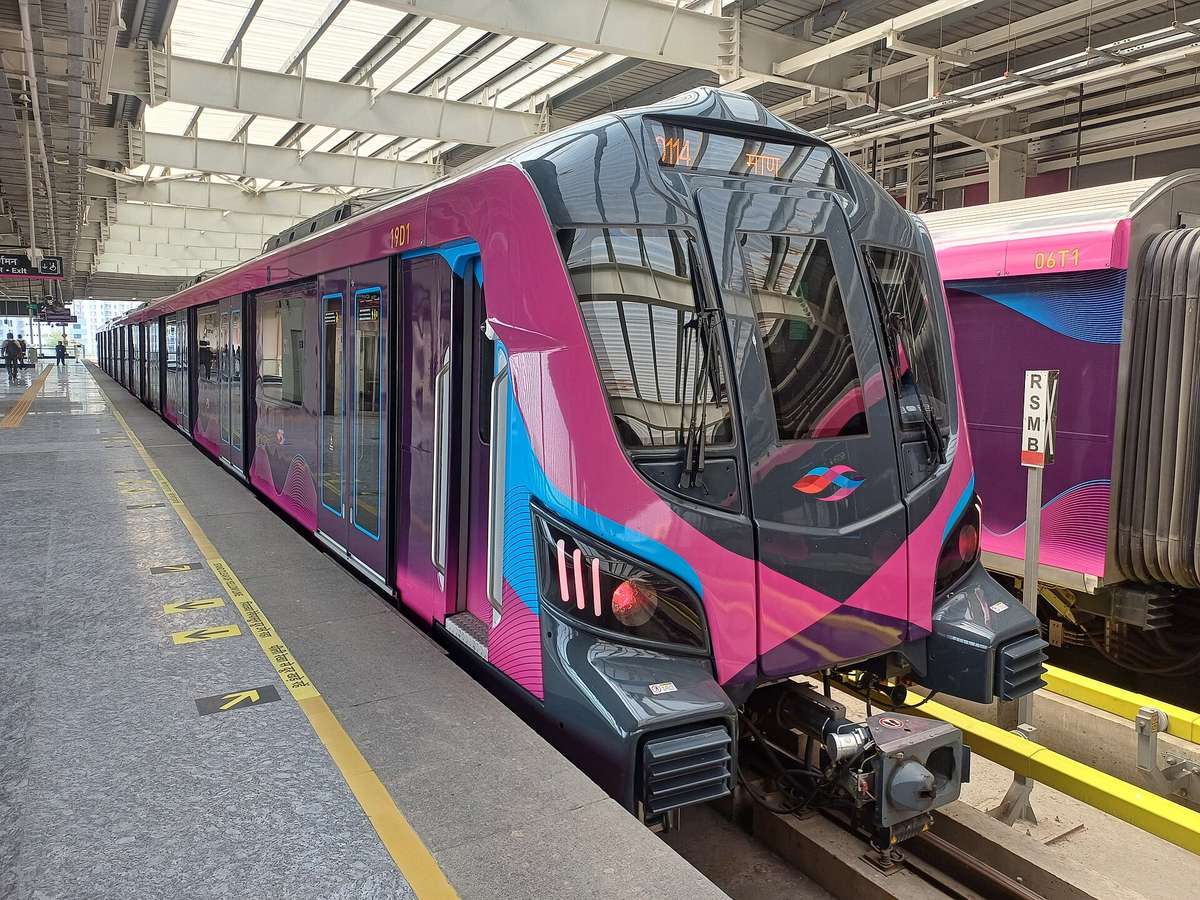

Pune now has its third metro line8. Prime Minister Narendra Modi inaugurated Pune Metro Line 3, the Pink Line, by video link on 3 November 20261, and passenger services began at 6 a.m. on 4 November13. The elevated line links Maan, in the Hinjewadi IT hub, with District Court at Shivajinagar1 in the city's central business district. Unlike the city's first two lines, which were built and operated by a government body8, it was financed, built and will be run by a private consortium, and Railway Gazette reports that its concession was the first contract awarded under the New Metro Rail Policy approved in August 20171.
What opened
Railway Gazette gives the line's length as 23.3 km, with 23 elevated stations1. Other wire reports give 23.2 km4 or round it to 23 km3. Not every station opened on the first day. Swarajya and Punekar News both reported that 17 of the 23 stations would open at launch5 (Punekar News lists all 176), after clearance from the Commissioner of Metro Railway Safety. The two outlets give different timetables for the rest: Swarajya expected the six closed stations to open in late November or early December 20265, while Punekar News put two of them in that window and four others by January 20276.
At District Court the new line meets the existing network and provides interchange with the Aqua and Purple lines6. Railway Gazette reports that trains run every 5 and a half minutes at peak times and every 10 minutes off peak1; Swarajya, writing before the launch, reported service from 6 AM to 11:40 PM5. Railway Gazette puts the end to end journey at 45 minutes1.
Who built it, and how it was paid for
The line was built by Pune IT City Metro Rail Ltd, which Railway Gazette describes as a joint venture of Siemens and Tata Group company TRIL Urban Transport1. Siemens names the partners more precisely as TRIL Urban Transport Private Limited and Siemens Project Ventures GmbH2, a subsidiary of Siemens Financial Services. The company holds a 35-year design, build, finance, operate and transfer concession awarded by the Pune Metropolitan Region Development Authority in September 20191.
The PTI wire report says the line cost over Rs 8,300 crore3 (about $875 million at the Reserve Bank of India reference rate of 94.8606 rupees per US dollar on 3 November 202612). When the Tata and Siemens consortium was chosen for the project in 2018, trade press reported, citing state government sources, an estimated investment of Rs 8,313 crore9 (about $876 million at the same rate), with part of the money coming from the state and central governments as viability gap funding9 and the rest raised by the joint venture.
Why the financing model matters
India's Union Cabinet approved a new Metro Rail Policy in August 2017. As reported at the time, it makes the public-private partnership component mandatory for availing of central assistance for new Metro projects11, with private participation either for the complete provision of Metro rail or for some unbundled components11. That requirement is what makes the Pune concession notable: it was the first contract awarded under the policy1, with the private partner raising the remainder9 of the money beyond the public viability gap funding.
At the inauguration, Modi described the metro PPP approach as “a model of development whose success gives further momentum to the progress of the country”1.
The trains, the systems and the crews
Alstom built the fleet, 22 three-car Metropolis trainsets1, at its plant in Sricity, Andhra Pradesh7. When it delivered the first train in June 2024, Alstom said the trains are 100% locally manufactured7 in India. A consortium of Siemens companies and Alstom Transport India won the electrical and mechanical systems contract in December 2021, with the share of Siemens Limited put at about Rs 900 crore14 (about $95 million at the 3 November 2026 rate), covering project management, turnkey electrification, signalling, communications and depot equipment14. Railway Gazette reports that the line uses 750 V DC third-rail electrification1. The Siemens Trainguard MT train control system supports semi-automated operation, with a driver on board each train, and is designed to be upgraded to unattended operation1. Siemens also holds 10 years of maintenance for the electrification and signalling systems2.
The French operator Keolis holds a 10-year operating contract1, awarded by the concessionaire in September 20258. Railway Gazette reports that almost 100 train drivers were recruited, all of them women1, and the PTI wire report says about 30% of the line’s electricity needs will come from solar power3.
What it means for the Hinjewadi corridor
The line was planned around one commute, between the IT parks of Hinjewadi on the city's western edge and the centre, in a corridor with road congestion and connectivity bottlenecks8. Railway Gazette reports that the line is intended to halve travel times1 there. Swarajya reports the line is expected to benefit over 200,000 IT professionals who commute daily5, and says PMRDA has approved a Rs 426 crore plan for 19.2 km of last-mile links to eight major IT park stations5 (about $45 million), including pedestrian walkways and cycle tracks. The PTI report says the line should mean less traffic congestion and less dependence on private vehicles3.
The opening took longer than first planned. When the foundation stone was laid in December 2018, construction was expected to take about three years10, and passenger service began close to eight years later.
Phase II and the national picture
At the same event Modi laid foundation stones for Phase II corridors estimated at about Rs 13,500 crore4 (about $1.42 billion), part of a package the PTI report put at about Rs 21,800 crore3 (about $2.30 billion). The corridors are Line 2A from Vanaz to Chandani Chowk, Line 2B from Ramwadi to Vitthalwadi, Line 4 from Kharadi to Khadakwasla and Line 4A from Nal Stop to Manik Baug3, with interchanges planned at Swargate, Nal Stop and Kharadi Bypass3.
Nationally, Modi said at the inauguration that India's metro network has grown to nearly 1,200 km across 26 cities, serving over 10 million commuters a day1, and that Maharashtra alone has nearly 175 km in service, with more than 680 km under construction1. In 2018, Pune's three planned lines were expected to total 54.58 km10 once complete.
Trivia
- What track gauge do the Line 3 Metropolis trainsets run on? 1,435 mm8.
- How many passengers can each Line 3 trainset carry? 1,0007.
- Where was the foundation stone for Pune Metro Line 3 laid in 2018? The Chhatrapati Shivaji Maharaj Sports Complex in Balewadi10.
- By how many years can the Line 3 concession be extended? 25 years1.
- What is the design speed of the Alstom trains built for Line 3? 95 km/h7.
- What fare range did Swarajya report for Line 3 at launch? Rs 12 to Rs 62, based on distance5.
- Who heads the mobility business at Siemens Limited, according to its Line 3 release? Rajeev Joisar2.
Sources
- Railway Gazette International, Prime Minister inaugurates Pune Metro Line 3, 3 November 2026. Accessed November 6, 2026.
- Siemens Limited via Business Wire India (UNI), Siemens Delivers Advanced Rail Technologies for Pune Metro Line 3 Corridor under Public-Private Partnership, 3 November 2026. Accessed November 6, 2026.
- The Week (PTI), PM Modi to inaugurate Pune Metro Line 3, launch Phase II projects on Tuesday, 2 November 2026. Accessed November 6, 2026.
- Telangana Today (IANS), PM Modi inaugurates Pune Metro Line 3, lays foundation for Phase II expansion, 3 November 2026. Accessed November 6, 2026.
- Swarajya, Pune's Pink Line metro launches 4th November: 17 stations ready, fares range from 12 to 62, 1 November 2026. Accessed November 6, 2026.
- Punekar News, Hinjawadi to Shivajinagar Metro: 17 Stations to Open Next Week, Check Names, 31 October 2026. Accessed November 6, 2026.
- Alstom, Alstom successfully delivers first train for Pune Metro Line 3, 3 June 2024. Accessed November 6, 2026.
- Railway Gazette International, Keolis appointed to operate Pune metro Pink Line with all-female drivers, 18 September 2025. Accessed November 6, 2026.
- NBM&CW, Tata Realty-Siemens secure Rs 8,313 cr metro contract, 6 October 2018. Accessed November 6, 2026.
- Swarajya, Pune gets its third metro line: PM Modi lays foundation stone for 23 km Hinjewadi-Shivajinagar stretch, 18 December 2018. Accessed November 6, 2026.
- The Tribune, Govt okays Metro Rail Policy 2017, 16 August 2017. Accessed November 6, 2026.
- Metropolitan Stock Exchange of India, RBI Reference Rate (Archives), USD/INR, 3 November 2026. Accessed November 6, 2026.
- Free Press Journal, Pune Metro Line 3 Begins Operations: 45-Minute Ride Excites Hinjawadi IT Employees, But Parking and Last-Mile Gaps Remain, 4 November 2026. Accessed November 6, 2026.
- Siemens Limited, Tata-Siemens JV to develop Metro Corridor for Pune Metro under PPP route, press release, Mumbai, 27 December 2021. Accessed November 6, 2026.