Roman Space Telescope Nears Science After August 2026 Launch
Key Points
- NASA's Roman Space Telescope launched on a SpaceX Falcon Heavy from Kennedy Space Center at 7:26 a.m. EDT on August 30, 2026.
- Its field of view is at least 100 times larger than Hubble's, with a primary mirror the same 2.4 meter size.
- As of NASA's October 22, 2026 update, Roman is in science commissioning; a September 15 NASA post said the team was on track to release its first science images by early 2027.
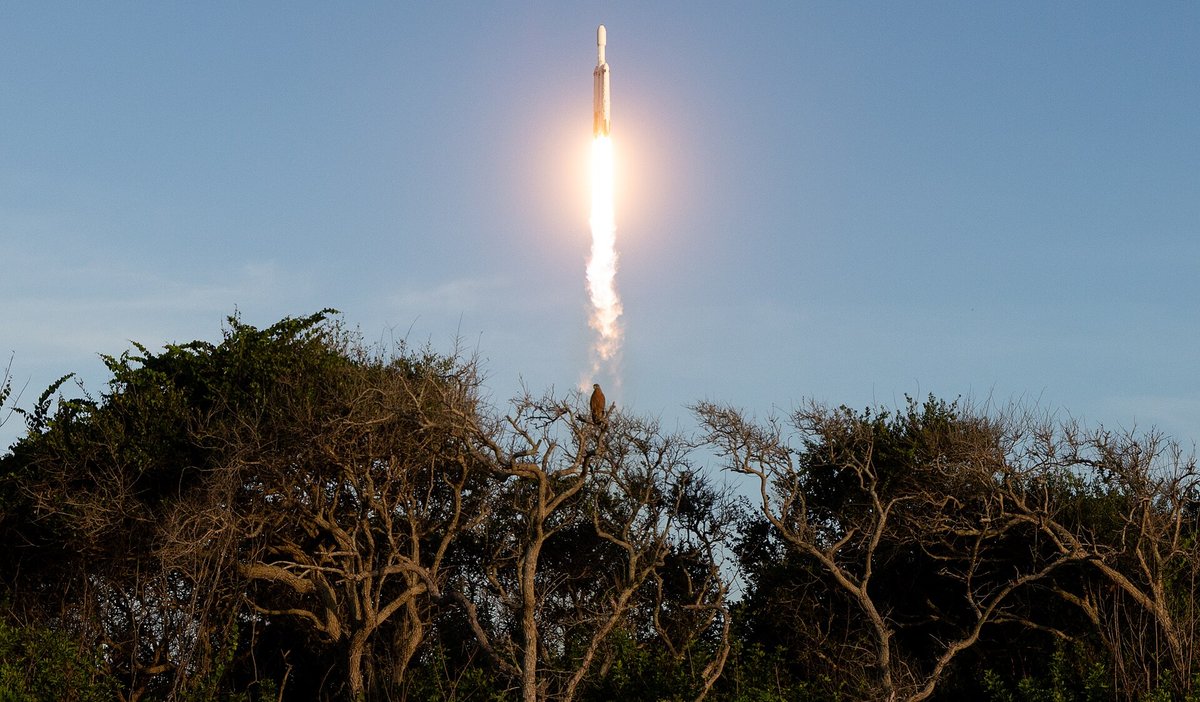

NASA's Nancy Grace Roman Space Telescope left Florida on a SpaceX Falcon Heavy on Sunday, August 30, 2026. The rocket lifted off from Launch Complex 39A at Kennedy Space Center at 7:26 a.m. EDT1, and the telescope separated from the second stage at 7:57 a.m. EDT1 and began flying on its own. NASA's launch page, quoting the mission blog, describes the date as eight months ahead of schedule and even earlier than previously targeted1. As of NASA's update of October 22, 2026, Roman has moved into science commissioning5, the last stretch of checkout before regular observations, and a September 15 NASA post said the team is on track to release Roman's first science images by early 20278.
A wide view with a Hubble-sized mirror
Roman began life under another name. When NASA renamed it on May 20, 2020, the agency's release described it as the Wide Field Infrared Survey Telescope, or WFIRST12, and noted that its primary mirror is 2.4 meters (7.9 feet) in diameter12, the same size as Hubble's. The difference is how much sky it sees at once. Roman's field of view is at least 100 times larger than Hubble's2, and a single Roman image holds the equivalent detail of 100 pictures from Hubble12.
Two instruments do the work. The Wide Field Instrument is the main camera, and the Coronagraph Instrument is what lets the observatory block starlight to directly see exoplanets and planet-forming disks2. The mission's science goals center on dark energy, exoplanets, and infrared astrophysics2.
Who Nancy Grace Roman was
The telescope's namesake was born in Nashville, Tennessee, on May 16, 1925, and died December 25, 2018. She is known as the mother of the Hubble Space Telescope3. She earned a bachelor's degree in astronomy from Swarthmore College in 1946 and a doctorate from the University of Chicago in 1949. She joined NASA in early 1959, about six months after the agency was formed3, and NASA calls her its first female executive and its first Chief of Astronomy.
Colleagues gave her the nickname. NASA's page names getting the Hubble Space Telescope approved by Congress3 as one of the biggest challenges of her career. She oversaw the launch of four Orbiting Astronomical Observatories12 (1966 to 1972), precursors to Hubble, and championed the International Ultraviolet Explorer and the Cosmic Background Explorer. Asked once what Hubble's most interesting discovery was, she answered dark energy3, which is the first item on the list for the telescope that now carries her name.
Dark energy, a billion galaxies and microlensing
Dark energy is the name for the mysterious force that is accelerating the expansion of the universe12. Roman goes after it by sheer numbers, potentially measuring light from a billion galaxies in its lifetime2.
Planets come from microlensing. A January 2026 NASA article on the Galactic Bulge Time-Domain Survey explains that a microlensing event happens when the light of a distant star is warped slightly11 by a star passing in front of it. Put simply, the nearer star acts like a magnifying glass, and a planet orbiting it can add a brief extra brightening. Roman will watch hundreds of millions of stars every 12 minutes11 across six patches of sky near the center of the Milky Way, 1.7 square degrees in all, for 438 days of observing split into six seasons over five years. Scientists expect over 1,000 new planets11 from microlensing alone, against just over 200 found that way so far. That feeds a statistical census of planetary systems2 in the galaxy.
A million miles out, at L2
Roman's destination is an orbit around the second Sun-Earth Lagrange point, or L2, about 1 million miles from Earth1. NASA's commissioning page describes a three-month trip ending in a halo orbit around L2 that lets Roman hold a relatively steady orbit without using much fuel4. The first course correction followed quickly. NASA's August 31 post10 reported a burn of about 3 minutes that began at 12:02 p.m. EDT. NASA's September 14 update says that burn used about 40 pounds (18 kilograms)9 of a 441-pound allocation, and puts orbital insertion at L2 about 100 days after launch, around early December9.
Where commissioning stands
Commissioning is the phase in which the observatory's systems are turned on, adjusted, calibrated, and prepared for science operations4.
- On September 11, 2026, the team let the Wide Field Instrument cool and switched on its 18 infrared detectors8, which together have a sensing area about the size of a laptop screen.
- From September 15 to 21, the fine guidance system passed its tests, holding the observatory steady to better than 1/100,000 of a degree7.
- On September 22, the Coronagraph Instrument opened its eyes to cosmic light for the very first time7.
- By October 14, the team had moved the instrument's alignment mechanism from its launch position to its predicted best focus and nudged the secondary mirror. NASA reported that the Wide Field Instrument was performing nearly 30% better than predicted6; NASA measured 63 nanometers RMS6 against a requirement of about 90 nanometers.
- On October 22, NASA announced the move into science commissioning. Julie McEnery, Roman's senior project scientist, said, "We've established that the observatory is fully functional5."
The work still under way, according to that October 22 update, is test observations to calibrate how the instruments respond to light5 and fine-tune image quality before science operations begin. Roman will see objects a hundred million times fainter than the human eye can detect5, according to the same update. NASA's commissioning page, updated November 4, 2026, gives no fixed end date and says the schedule is subject to change as the team assesses and adjusts as needed4.
Trivia
- At what age did Nancy Grace Roman start an astronomy club, and where? At age 11, with classmates in Reno, Nevada3, according to NASA's biography page.
- Which colleague is credited with calling her the mother of Hubble? Edward J. Weiler3, who succeeded her as Chief of Astronomy after she retired in 1979.
- Which NASA administrator said he could think of no better name for WFIRST? Jim Bridenstine12, in the renaming announcement of May 20, 2020.
- Where did the Falcon Heavy's two side boosters land after the Roman launch? At Landing Zone 2 and Landing Zone 401, according to NASA's launch page.
- How many years of potential science operations does Roman now have fuel for? At least 22 years9, Goddard center director Jamie Dunn said in NASA's September 14, 2026 update, against an original projection of 10.
- What did the Coronagraph Instrument look at for its first observation? A faint star in the Large Magellanic Cloud7, a neighboring galaxy.
- How small was the adjustment made to Roman's secondary mirror? About one-sixteenth the diameter of a human hair6.
- How many megapixels is the Wide Field Instrument? NASA calls it a 300-megapixel8 infrared camera.
Sources
- Roman Launch, NASA Science, updated 8 September 2026. Accessed November 4, 2026.
- Nancy Grace Roman Space Telescope, mission page, NASA Science. Accessed November 4, 2026.
- Who Is Nancy Grace Roman?, NASA Science. Accessed November 4, 2026.
- Roman Commissioning, NASA Science, updated 4 November 2026. Accessed November 4, 2026.
- Ashley Balzer, NASA's Roman Space Telescope Enters Final Commissioning Phase, NASA Science Roman blog, 22 October 2026. Accessed November 4, 2026.
- Ashley Balzer, NASA Roman Team Checks Out Main Instrument, Sharpens Telescope's Focus, NASA Science Roman blog, 14 October 2026. Accessed November 4, 2026.
- Ashley Balzer, NASA Checks Roman Guidance System, Takes First Coronagraph Observation, NASA Science Roman blog, 30 September 2026. Accessed November 4, 2026.
- NASA Activates Roman's Primary Instrument, Checks Out Coronagraph, NASA Science Roman blog, 15 September 2026. Accessed November 4, 2026.
- Fuel Savings Double Potential Lifetime for NASA's Roman Mission, NASA Science Roman blog, 14 September 2026. Accessed November 4, 2026.
- NASA's Roman Completes First Mid-Course Correction Burn, NASA Science Roman blog, 31 August 2026. Accessed November 4, 2026.
- Journey to Center of Milky Way with Upcoming NASA Roman Core Survey, NASA, 23 January 2026. Accessed November 4, 2026.
- NASA Telescope Named for Mother of Hubble Nancy Grace Roman, NASA JPL, 20 May 2020. Accessed November 4, 2026.
- Nancy Grace Roman Space Telescope Launch (NHQ202608300012), Wikimedia Commons file page. Accessed November 4, 2026.